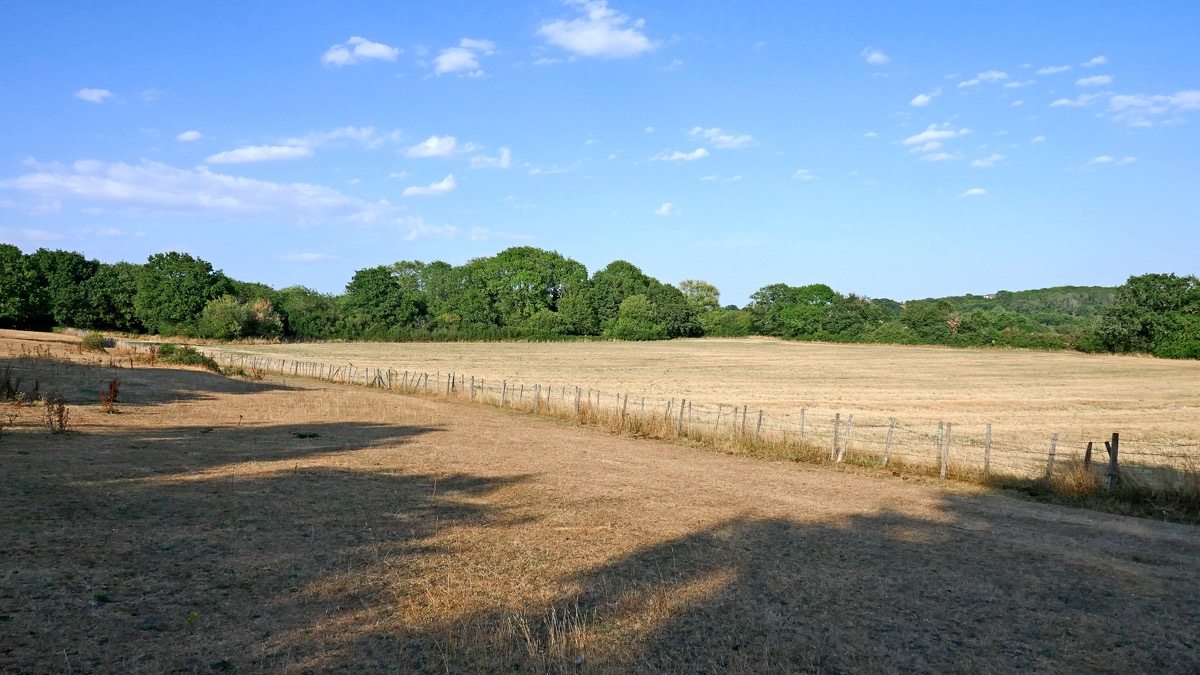
Climate change and land-use change are both named as key drivers of global change, and they are usually studied one at a time. Crossing them needs a field experiment that manipulates both at once. The Global Change Experimental Facility in Central Germany does exactly that, superimposing regional climate projections onto real weather across large plots. Eight years of grassland data came out of it. Which driver dominated?
The real weather, by a wide margin. variation in background climate during the study years was high, including three of the driest years on record for the region. The effects of that temporal variability far exceeded the effects of the experimentally imposed climate change on diversity and productivity. The gap was largest in intensively used grasslands sown with only a few grass cultivars.
Climate and land-use change are both key drivers of global change, and understanding their potentially interactive effects needs field experiments in which both are manipulated together. Studies that vary one and hold the other fixed cannot see an interaction at all.
The Global Change Experimental Facility in Central Germany is built for this. On large experimental plots, temperature and seasonal patterns of precipitation are manipulated by superimposing regional climate model projections onto the background climate variability, rather than onto a steady baseline. That climate manipulation is factorially crossed with agricultural : intensively used meadows, and extensively used meadows and pastures.
Eight years of grassland dynamics data came out of it, and the background weather did not cooperate. Inter-annual variation during the study years was high, including three of the driest years on record for the region.
The result is a reordering. The effects of that temporal variability far exceeded the effects of the experimentally imposed climate change on plant species diversity and productivity, especially in the intensively used grasslands sown with only a few grass cultivars. The changes came about through immigrant species replacing the target , which is a management failure as much as a climate response. Note that this is one facility over eight years, and that the comparison leans on the weather those years happened to bring.
wat. Ordinary year-to-year weather did more to these grasslands than a simulated future climate, and the intensively managed plots suffered most.
wat wat
It reorders the threats. A meadow sown with a handful of cultivars was vulnerable to an ordinary dry year, well before any future climate arrived, and that vulnerability came from how it was managed.
How do we know?
Korell and colleagues report eight years of grassland data from the Global Change Experimental Facility. There, temperature and seasonal precipitation are manipulated by superimposing regional climate model projections onto background climate variability, crossed factorially with land-use scenarios.
What is still unknown
One facility in Central Germany over eight years, and the comparison is partly an accident of the weather, since the study happened to include three of the driest years on record.
Learn something?
Where to next
 If trees cancel almost half the urban heat effect, why does the thermometer barely move?climate
 Does the Amazon still absorb more carbon than it releases?climate
 What comes out of the frozen ground of the north when it thaws?climate