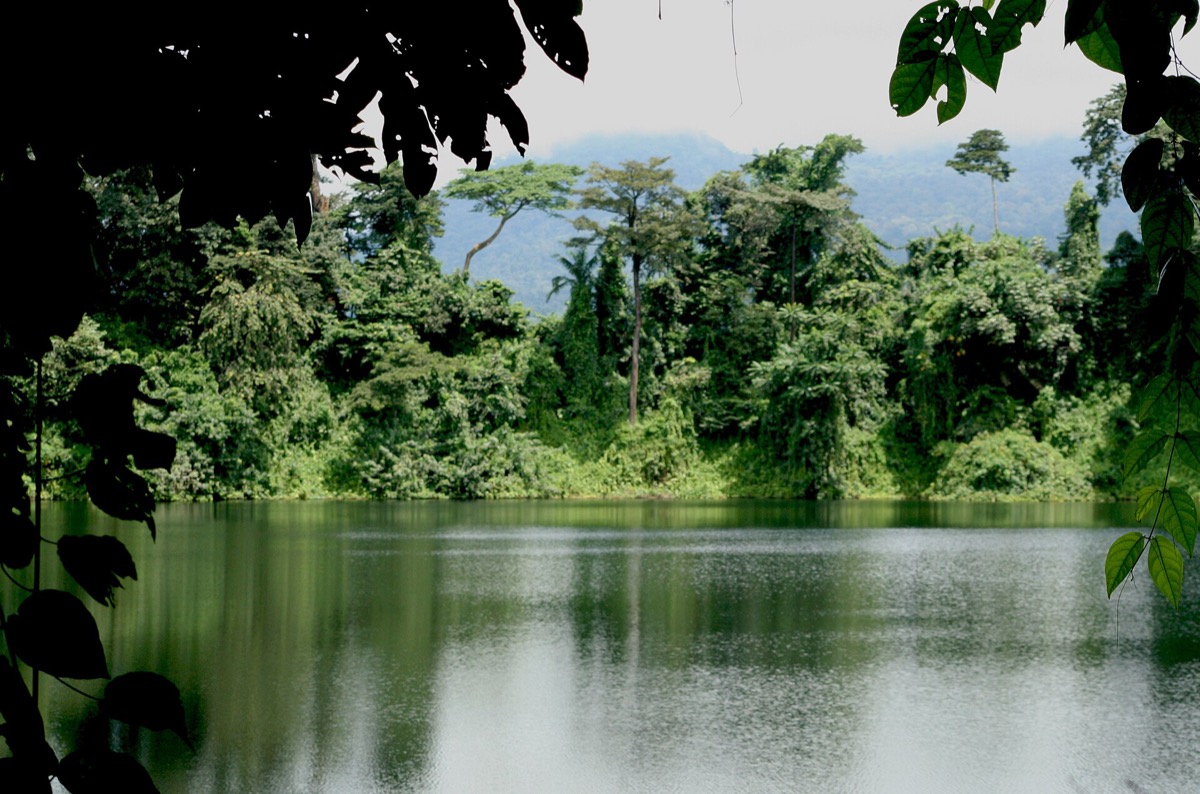
Lakes Nyos and Monoun in Cameroon did exactly that in the nineteen eighties, in events geologists call . Carbon dioxide had accumulated in the deep water until the lake released it. Kusakabe and colleagues monitored both lakes for twenty-one years, and their record shows the gas quietly building back up afterwards at a steady rate.
The danger is that no outside trigger may be needed. By January 2003 the carbon dioxide concentration at fifty-eight meters depth in Lake Monoun was very close to saturation, and the authors note this suggests an eruption could take place spontaneously. That is the case for intervention. through pipes began at Nyos in 2001 and at Monoun in 2003, and the gas content of both lakes has fallen since.
Lakes Nyos and Monoun sit in volcanic craters in Cameroon, and in the nineteen eighties each released a cloud of carbon dioxide that flowed downhill and killed people in the valleys below. Kusakabe and colleagues report regular monitoring of both lakes over the following twenty-one years, which turns a disaster into a measured system.
The first task was to work out how much gas there had been. Using instrument data taken in October and November 1986, the authors estimated the dissolved carbon dioxide profiles for Monoun and Nyos soon after the eruptions. From those profiles they calculated gas content and its change over time. At Nyos the accumulation rate was constant from 1986 to 2001. At Monoun it was initially high and later slowed.
Then came the finding that justified the engineering. By January 2003 the carbon dioxide concentration at fifty-eight meters in Lake Monoun was very close to saturation. The authors describe this as suggestive of a mechanism for a limnic eruption, because a saturated layer may release its gas spontaneously without any external trigger. A hazard that needs no trigger cannot be managed by watching for one.
Controlled degassing started at Nyos in March 2001 and at Monoun in February 2003, and the gas content of both lakes has fallen below the level estimated just after the eruptions. The relief is partial. At Nyos the content still stands at eighty percent of the maximum recorded in January 2001, and the authors expect the removal rate to decline once the reaches the pipe intakes. Because continues, they recommend further equipment at Monoun rather than treating the job as finished.
wat. Two Cameroonian lakes are kept safe only by pipes that bleed gas out faster than it accumulates.
wat wat
It is an unusual hazard, because the lake refills with gas on its own. Natural recharge continues, so the engineering is not a repair but a permanent obligation.
How do we know?
Regular monitoring ran for twenty-one years, and dissolved carbon dioxide profiles were reconstructed from instrument data taken soon after the eruptions. From those the authors calculate each lake’s gas content and how it changed.
What is still unknown
The early profiles are estimates reconstructed from data taken after the eruptions, not direct measurements of the pre-eruption lakes. Projections of how fast the degassing will slow assume the pipe system stays as it is.
Learn something?
Where to next
 Has the Earth been getting greener, and if so why?carbon dioxide
 How does the world’s fourth-largest lake disappear?lakes