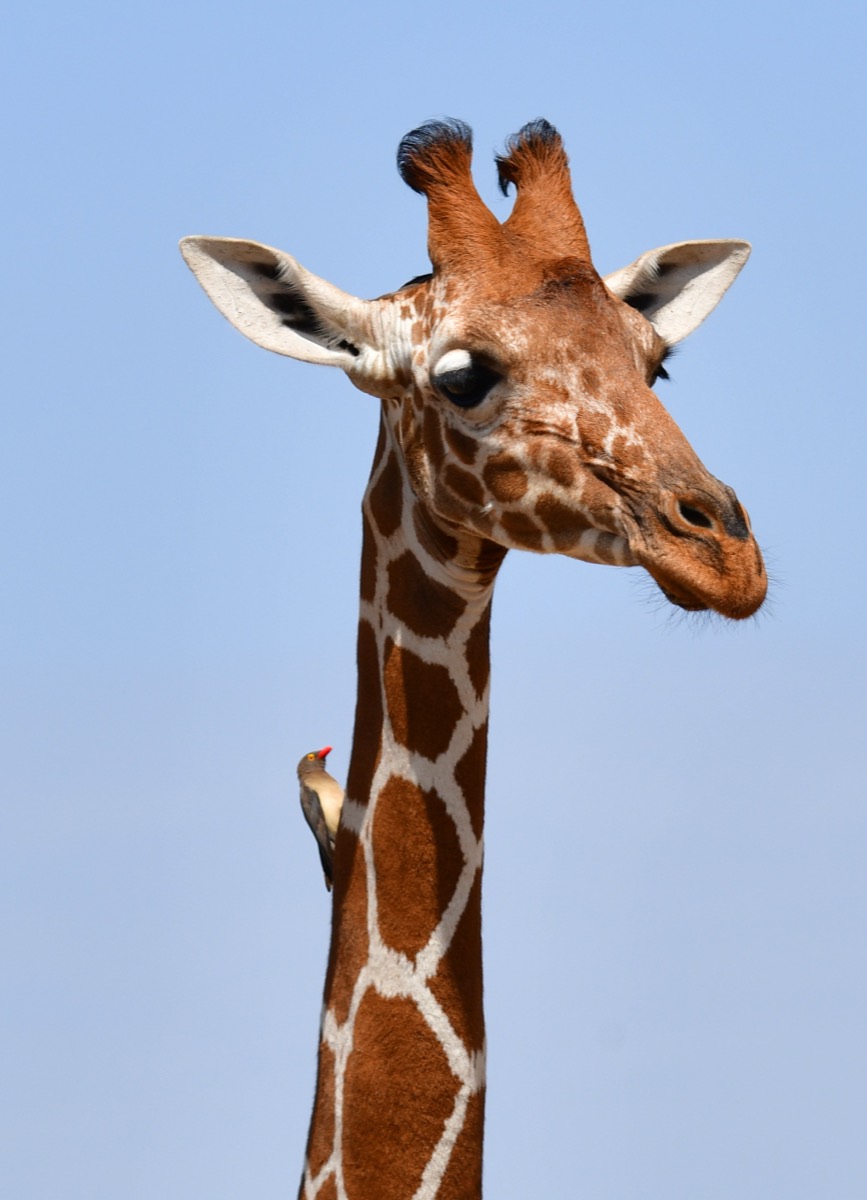
Red-billed live on large mammals, eating their ectoparasites and calling sharply when something approaches. Giraffes depend on spotting an ambush early, so the arrangement looks like a bargain with a built-in alarm. Whether giraffes read the calls that way was untested. Baotic and Szipl played oxpecker alarms to three giraffe populations, some living with lions and some without. Who takes the warning seriously?
The ones who have met a lion. Giraffes in the predator-inhabited reserve stayed vigilant for longer after a playback than giraffes in predator-free areas, so prior exposure to risk sharpens the response. Acoustically the alarms are harsh and broadband, with low , the structure known to push attention and urgency. But call structure alone did not explain the vigilance; ecological context did.
Animals routinely listen in on the alarm calls of other species, which is cheap information about danger. How that eavesdropping fits into an animal’s overall vigilance strategy is much less clear.
Giraffes are a good case. They rely on early detection to avoid an ambush, and they host red-billed oxpeckers, which feed on their ectoparasites and call in response to approaching threats. The early warning is assumed to be worth something, but nobody had shown how a giraffe interprets it.
Baotic and Szipl ran across three giraffe populations that differ in whether predators are present. Individuals in the predator-inhabited reserve maintained vigilance longer than those in predator-free areas, which points at prior exposure enhancing responsiveness rather than the response being fixed.
The acoustics pull in an interesting direction. Oxpecker alarms have low harmonic-to-noise ratios, making them harsh broadband signals of the kind known to raise attention and perceived urgency. Yet call structure alone did not explain the vigilance responses, which were modulated by whether the giraffes lived alongside lions. The oxpecker serves a , and how much that sentinel is worth depends on what the listener has learned.
wat. The same harsh call means something to a giraffe that has met a lion and considerably less to one that has not.
wat wat
Eavesdropping on another species is often described as an ability an animal has or lacks. Here it is a setting, tuned by what the listener has actually lived through.
How do we know?
Baotic and Szipl ran playback experiments of oxpecker alarm calls across three giraffe populations differing in predator presence, measured how long vigilance lasted, and analyzed the acoustic structure of the calls.
What is still unknown
Three populations differing in more than lions alone, and playbacks rather than real approaching threats, so experience is one plausible explanation for the difference rather than a proven cause.
Learn something?
Where to next
 Why do city birds sing at a higher pitch?birds
 Do migrating birds actually see the magnetic field?birds
 Which bird travels between both poles every single year?birds