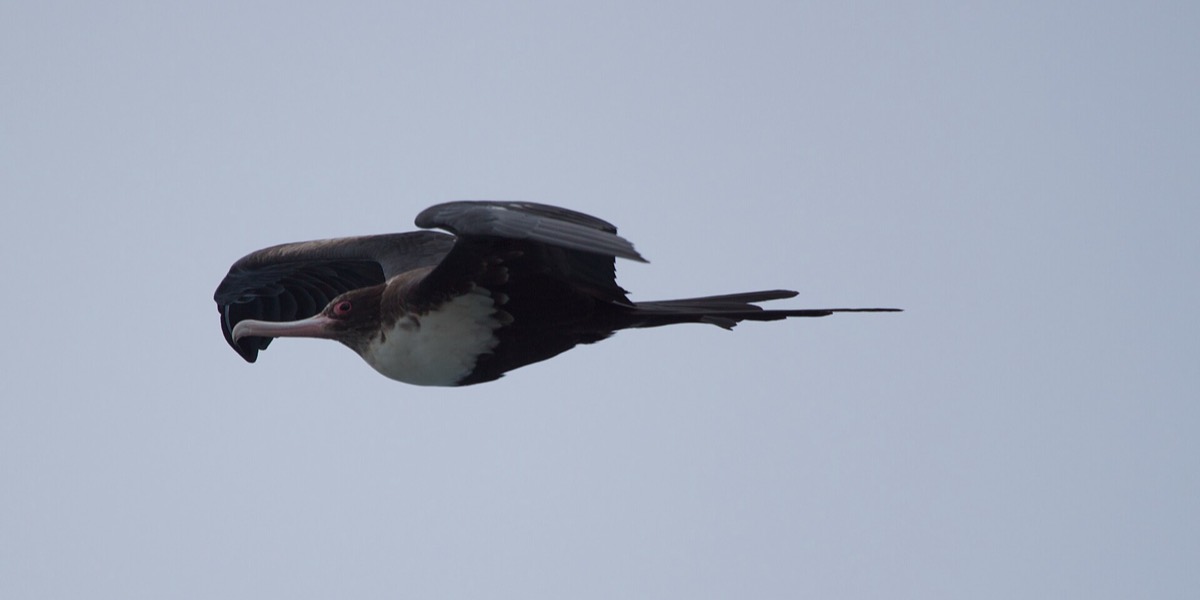
Many birds fly without stopping for days at a time, which raises an awkward question about when they sleep. The standing assumption was that they sleep with one eye closed and one cerebral hemisphere at a time, keeping watch and staying airborne with the other half. Sleep had never actually been shown in a flying bird. So were fitted with brain recorders over the ocean.
They do sleep aloft, and barely at all. recordings from frigatebirds flying for up to 10 days showed sleep with and also with both hemispheres simultaneously, which nobody expected. But total sleep came to only 0.69 hours a day, which is 7.4 percent of what the same birds sleep on land. They fly those days close to sleepless.
Many birds fly non-stop for days or longer, and whether they sleep while doing it had never been shown. The common assumption filled the gap with a tidy mechanism: flying birds maintain environmental awareness and aerodynamic control by sleeping with only one eye closed and one cerebral hemisphere at a time.
Testing that needs brain recordings from a bird in the air. Electroencephalogram recordings were made from great frigatebirds flying over the ocean for up to 10 days, which is long enough that any sleep debt would have to show somewhere.
The birds did sleep in flight, which settles the first question. They also slept with both hemispheres simultaneously as well as one at a time, which the standard assumption had ruled out. Whole-brain sleep while airborne is not what anybody predicted.
The amount is the more striking number. Frigatebirds slept for only 0.69 hours a day in flight, which is 7.4 percent of the time they spend sleeping on land. The authors read that as usually exceeding what sleeping unihemispherically can afford. It also undercuts the comfortable idea that long flights are sustained by normal sleep on the wing: these birds fly for days while barely sleeping.
wat. Frigatebirds slept about forty minutes a day in flight, a fourteenth of what they sleep ashore, and sometimes with both brain halves at once.
wat wat
Both halves of the finding overturn something. Birds can sleep with the whole brain while flying, and they mostly do not sleep at all, so prolonged flight is not sustained by getting normal sleep on the wing.
How do we know?
Rattenborg and colleagues made electroencephalogram recordings from great frigatebirds flying over the ocean for up to 10 days, and compared sleep in flight against the same birds sleeping on land.
What is still unknown
One species, recorded over the ocean, and sleep identified from brain traces rather than from behavior. What a frigatebird tolerates says nothing about whether other long-flying birds do the same.
Learn something?
Where to next
 What does the brain do at night that it cannot get done by day?sleep
 Which way does a sleeping duck point its open eye?sleep
 Who decides which of today’s memories you still have tomorrow?sleep