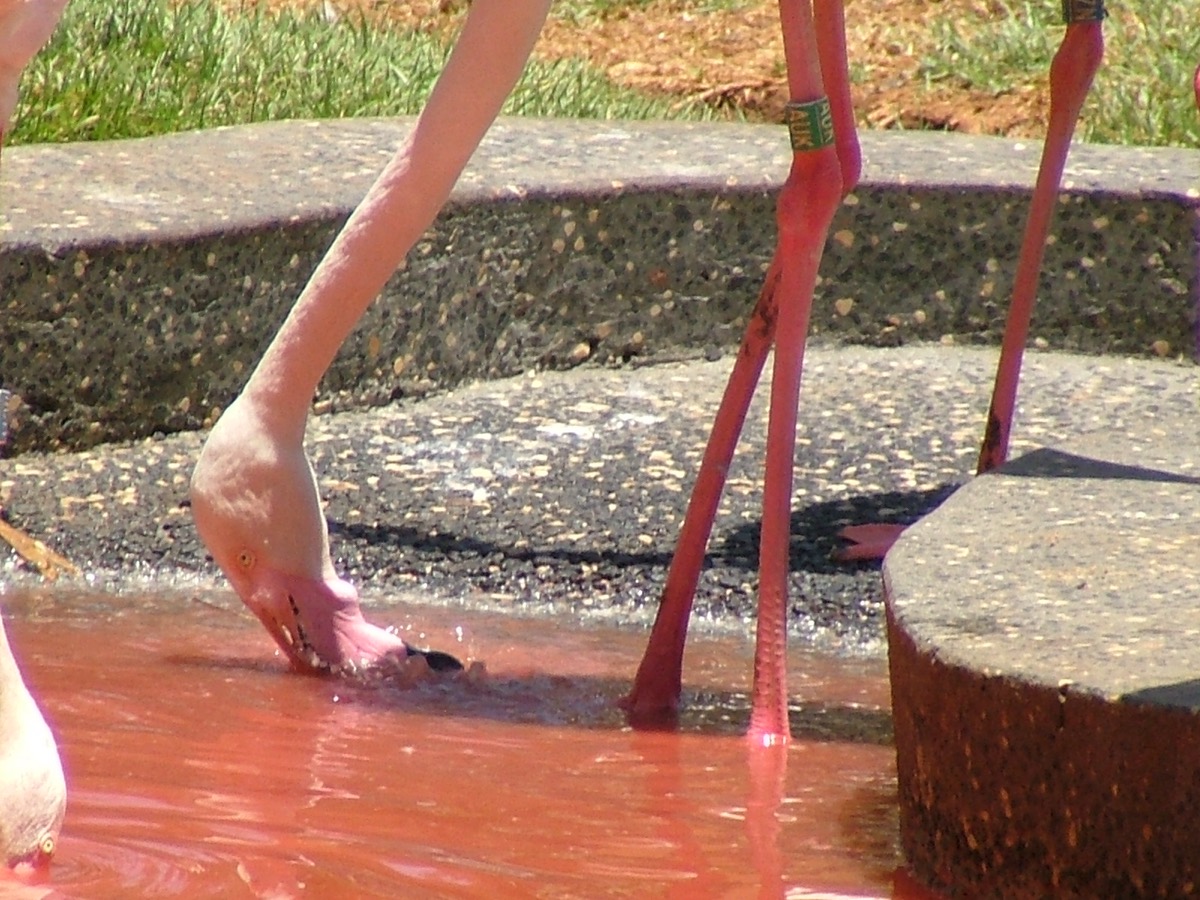
A flamingo feeds with its head upside down, filtering through comb-like with a piston of a tongue. The equipment is well described; the moves are not. Nobody could say what the L-shaped beak, the S-curved neck, the stomping feet or the habit of feeding into the current are for. Ortega-Jimenez and colleagues filmed live birds with brine shrimp and ran the fluid dynamics. What is the bird doing to the water?
Building traps out of it. Pulling the head back fast, around forty centimeters a second, raises tornado-like vortices that lift sediment and live shrimp off the bottom, helped by the L-shaped beak. Asymmetric chattering of the beak underwater, at about twelve hertz, drives directional flows of roughly seven centimeters a second. The throw off horizontal eddies while stomping. A collection system built on the chattering improved capture about sevenfold.
Flamingos have one of the most sophisticated filter-feeding systems among birds: they feed upside down, strain water through comb-like lamellae, and pump with a piston-like tongue. That much has been described for a long time.
What has stayed mysterious is the rest of the performance. The beak is L-shaped, the neck S-curved, and the birds stomp in the mud and prefer to feed facing into the flow. None of those had a hydrodynamic explanation, and they look like quirks until somebody measures the water.
Ortega-Jimenez and colleagues did, combining live flamingos feeding on brine shrimp and passive particles with bioinspired physical models and three-dimensional simulations. Retracting the head rapidly, at around forty centimeters a second, generates tornado-like vortices that stir up and upwell bottom sediment along with live shrimp, with the L-shaped beak shaping the flow. Asymmetric at about twelve hertz drives directional currents of roughly seven centimeters a second.
The feet contribute their own , creating horizontal eddies during stomping that lift and concentrate sediment and shrimp while trapping fast-swimming invertebrates, which a printed morphing foot model confirmed. Skimming at the surface produces a recirculation zone at the beak tip. A flamingo-inspired particle collection system showed beak chattering improving capture rates about sevenfold, which is why the authors present the whole arrangement as design principles rather than as a curiosity.
wat. It does not chase the shrimp. It stirs the water into a trap and lets the shrimp arrive.
wat wat
Every part of the posture that looked like an oddity turns out to be fluid engineering, and the same principles are being offered for devices that collect particles out of water.
How do we know?
Ortega-Jimenez and colleagues combined experiments on live flamingos with brine shrimp and passive particles, bioinspired physical models including a printed morphing foot, and three-dimensional computational fluid dynamics.
What is still unknown
Live birds in experimental conditions with brine shrimp, plus models and simulations. The sevenfold gain comes from a flamingo-inspired collection system rather than from a measurement of what wild birds eat.
Learn something?
Where to next
 What sets the limit on how tall a tree can get?water
 What does it cost a flamingo to stand on one leg all night?flamingos
 Is there a best angle for skipping a stone?water