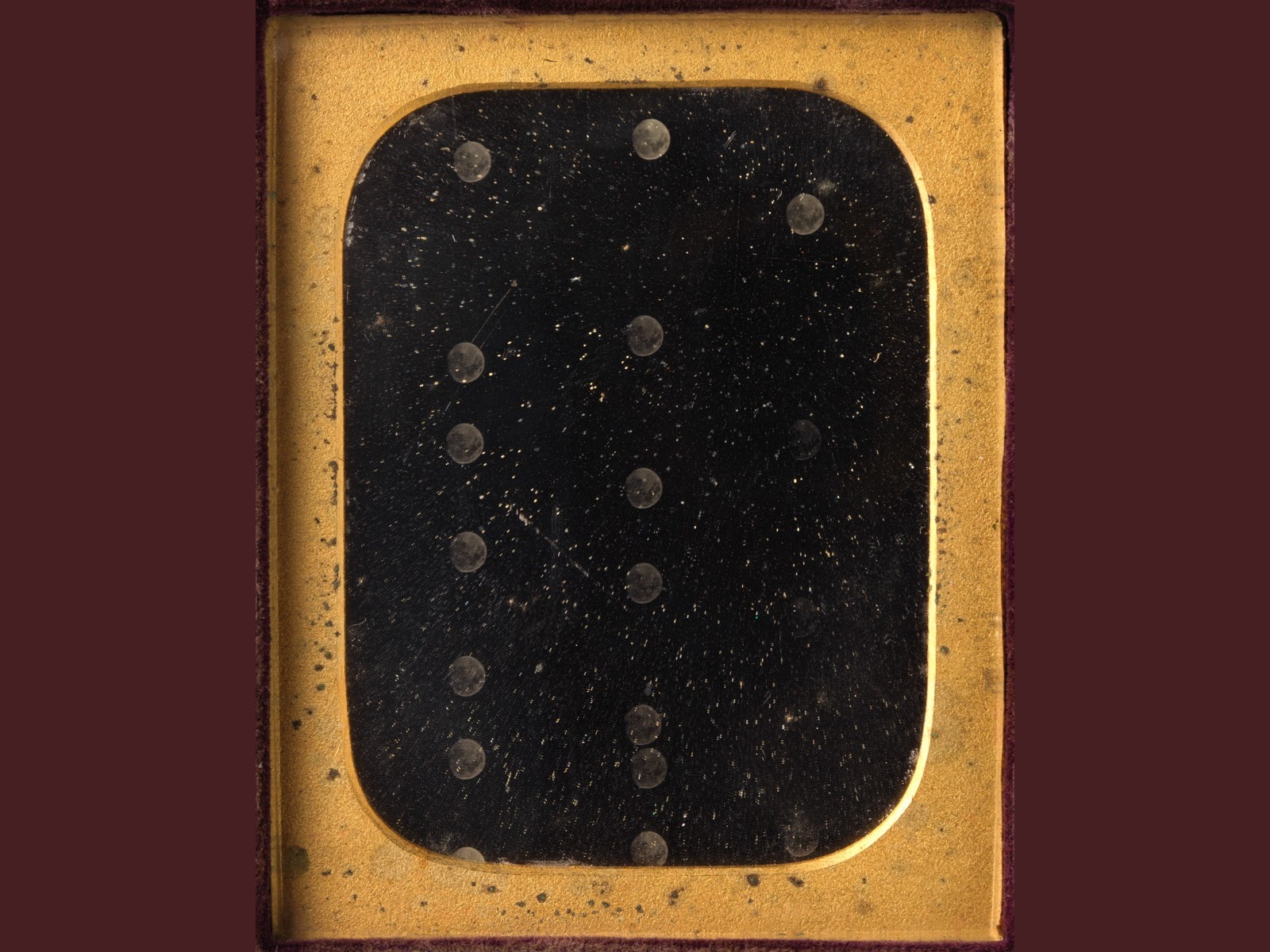
A of about two and a half inches by two, recently discovered and now at the Metropolitan Museum, carries eighteen tiny but detailed impressions of the moon scattered across its metal surface. It was made somewhere between eighteen forty-six and eighteen fifty-two, when photography was barely a decade old. Why eighteen of them on one plate?
, on a plate that could not be wasted. The images were captured by exposing the same metal surface repeatedly rather than once, which puts eighteen separate attempts on a single support. The Met attributes it to Antoine-Francois-Jean Claudet, a Frenchman working in London and one of the first studio daguerreotypists there, who experimented with recording .
The object is small: a plate of about six and a half by five centimetres, housed in a case roughly the size of a hand. Across its metal surface are eighteen tiny yet detailed impressions of the moon, captured by means of multiple exposure. The plate was recently discovered and was acquired by the Metropolitan Museum in two thousand nineteen.
The date sits in the first years of the medium. It was made between eighteen forty-six and eighteen fifty-two, probably in England, by a Frenchman working there. Antoine-Francois-Jean Claudet was among the first studio daguerreotypists in London, and his interests ran beyond the portraits that paid for the studio.
What he chased with a camera was motion and light. Claudet experimented with recording ephemeral natural phenomena, including electricity, clouds captured instantaneously, and the sun viewed through fog. Photographing the moon repeatedly on one plate belongs to the same line of work: finding out what the process could register of something that will not stay still.
The attribution rests on circumstance. The plate is housed in a case bearing the London studio address, for eighteen forty-six to fifty-two, of John Jabez Edwin Mayall, who worked as an assistant to Claudet in eighteen forty-six. Claudet’s well-documented scientific experiments with photography, including a lunar daguerreotype he exhibited at the of eighteen fifty-one, make him the more likely author of the image.
wat. Eighteen attempts at the moon, kept on one plate, by somebody finding out what the new process could hold.
wat wat
Early photography is remembered for portraits because those are what survived in quantity. A plate of eighteen moons is somebody using the new medium as an instrument instead.
How do we know?
The Metropolitan Museum of Art’s catalogue record for the plate sets out the technique, the dating, the case it is housed in, and the reasoning behind the attribution.
What is still unknown
The attribution is an inference rather than a signature. The case carries another photographer’s studio address, and Claudet is named as the more likely author on the strength of his documented experiments.
Learn something?
Where to next
 Why is the day not the same length it has always been?moon
 How long does a footprint last where there is no weather?moon
 Why does the Moon turn red instead of going dark?moon