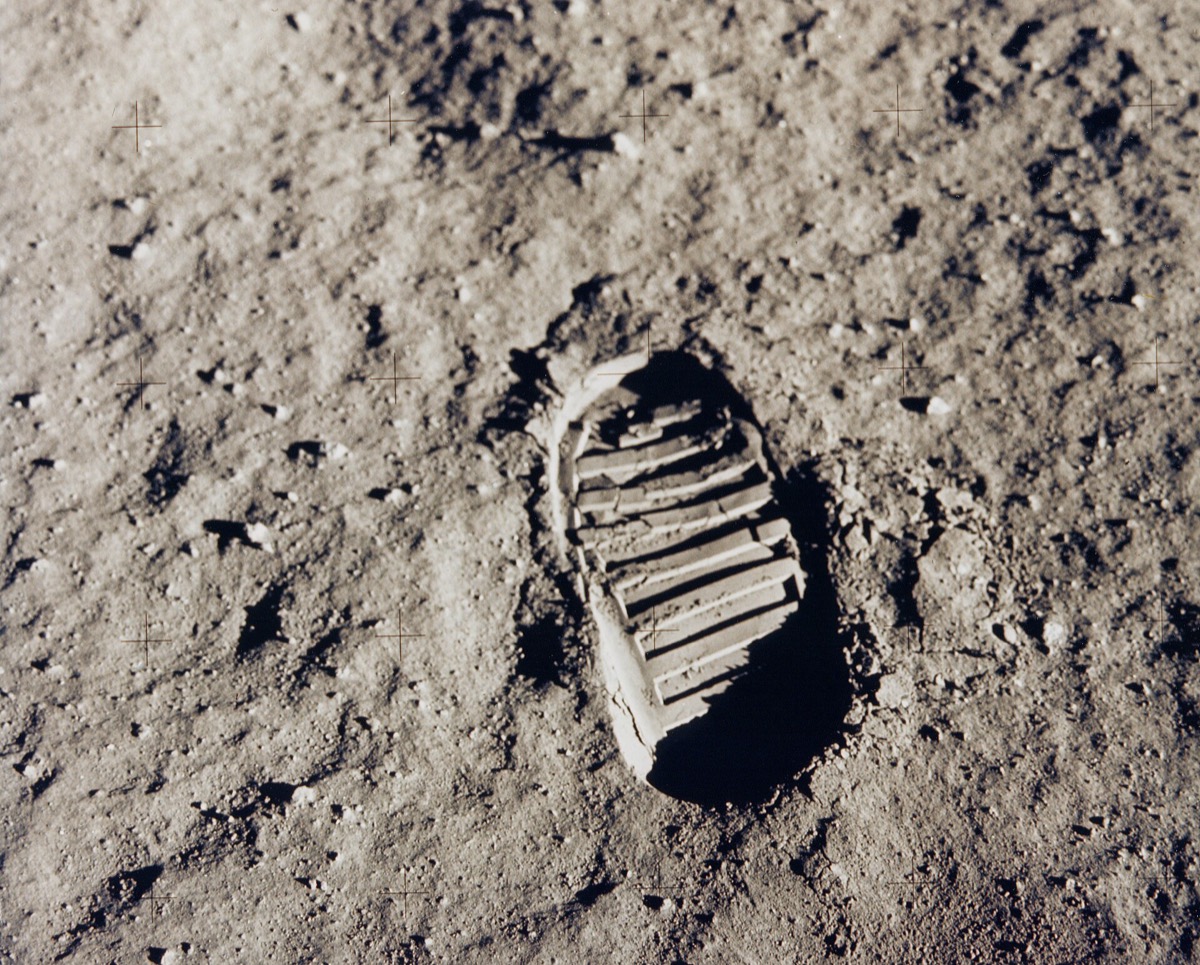
The photographs of boot prints in lunar dust are sharp enough to show the tread pattern, which tells you the surface takes an impression well. On Earth such a print would be gone in a season, erased by rain and wind. The Moon has neither. What it does have is a surface built entirely by something slower.
Only impacts erode the Moon, so a print survives until one finds it. The Moon retains that gas molecules at the surface move without colliding, and with no atmospheric shield countless bodies from asteroids down to tiny particles have struck and cratered it. That bombardment built the dust the print is in, and is the only thing that will remove it.
Start with what the Moon does not have. Because of its small size and mass, its surface gravity is only about one-sixth of Earth’s, and it retains so little atmosphere that the molecules of any gases present on the surface move without collision. There is no air to move, so there is no wind, and no rain either.
What it has instead is bombardment. In the absence of an atmospheric shield to protect the surface, countless bodies ranging in size from asteroids to tiny particles have struck and cratered the Moon. That process formed a debris layer, the , consisting of rock fragments of all sizes down to the finest dust.
So the dust a boot presses into is itself the product of impacts, and impacts are the only thing that will smooth it over again. Britannica states the consequence for the landscape in general: all lunar landforms have been eroded by the unending , which is why lunar mountains are tall without being steep or sharp-peaked.
The scale of that erosion is the point. The largest impacts made great basins, some later partly filled by enormous lava floods, forming the dark visible from Earth with the naked eye. The Moon presently has very slight seismic activity and little heat flow from the interior, indications that most internal activity ceased long ago. Nothing else is left to rearrange the surface, which is why an impression in the dust is a long-lived object.
wat. Nothing there will blow the dust back. The prints wait for a micrometeorite to find them.
wat wat
Erosion on the Moon has one mechanism instead of many, and it works on everything from mountains to boot prints at the same slow rate.
How do we know?
Britannica’s entry on the Moon, which gives the state of its atmosphere, the origin of its dust layer, and the fact that all lunar landforms have been eroded by the unending rain of impacts.
What is still unknown
An encyclopedia entry on the Moon rather than a measurement of any particular print. It establishes what can erode a surface there, not how many years a given impression has left.
Learn something?
Where to next
 Why is the day not the same length it has always been?moon
 Why are there eighteen moons on one early photographic plate?moon
 Why does the Moon turn red instead of going dark?moon