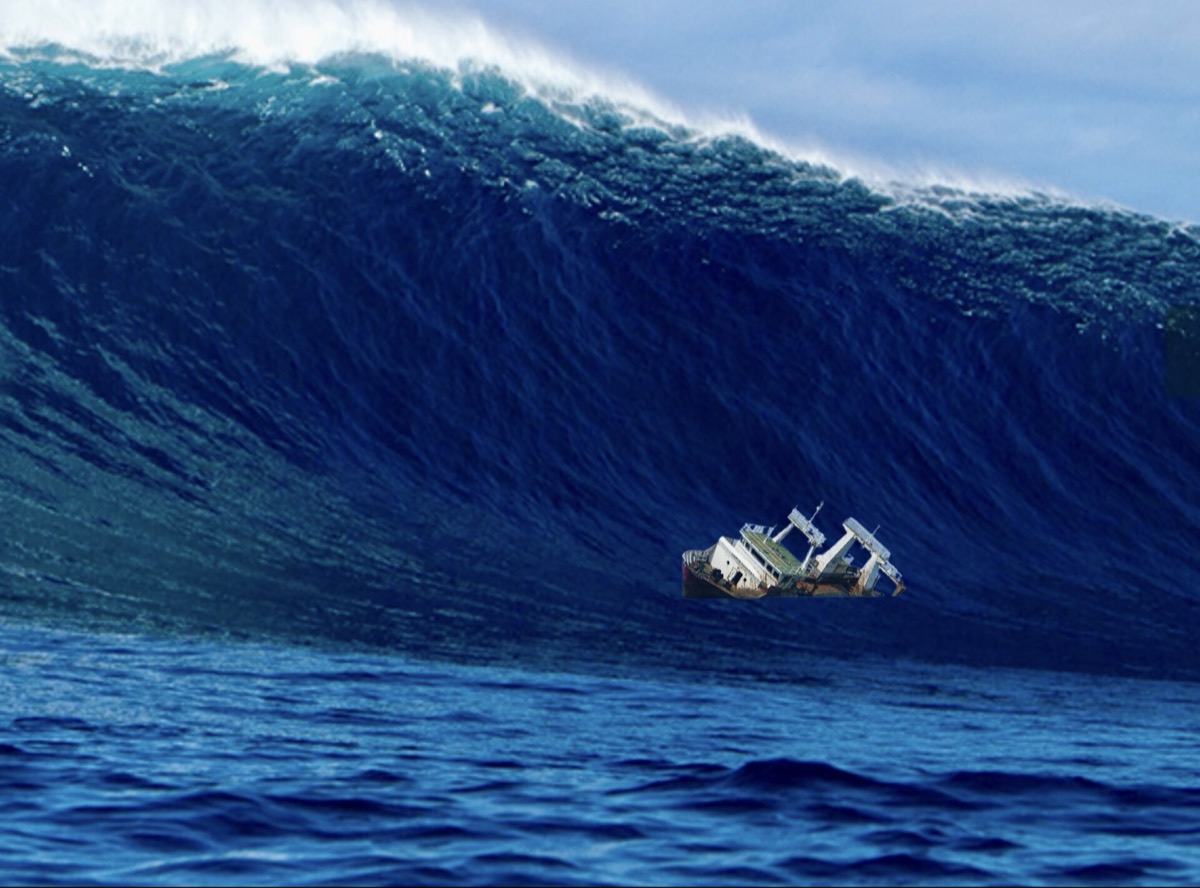
A measurement. Freak or rogue waves are so called because of their unexpectedly large size relative to the population of smaller waves around them. The 25.6 meter Draupner wave, observed in a sea with a of 12 meters, was one of the first confirmed field measurements of one. The mechanisms behind such waves are still contentious.
Draycott and colleagues tried to make one. Working in a circular wave tank, they recreated the full scaled crest amplitude and profile of the Draupner wave, including its . The aim was to find what directional conditions can support a wave that large and steep. The answer turned on waves arriving from two directions at once.
Freak or rogue waves get the name from their unexpectedly large size relative to the population of smaller waves in which they occur. For a long time they lived in sailors’ accounts rather than in data. The 25.6 meter Draupner wave, observed in a sea state with a significant wave height of 12 meters, was one of the first confirmed field measurements of such a wave.
Confirming that they exist is not the same as explaining them, and the physical mechanisms that give rise to waves like the Draupner wave are still contentious. Draycott, McAllister, Adcock, Taylor and van den Bremer approached it experimentally, attempting through physical experiments in a circular wave tank to recreate the wave measured at the platform.
They succeeded in a strong sense. The experiments recreate the full scaled crest amplitude and profile of the Draupner wave, including bound set-up, which is a harder target than crest height alone. That let them ask which directional conditions are capable of supporting a wave so large and steep.
The answer is about breaking. The onset and type of play a significant role, and differ significantly for crossing and non-crossing waves. Crucially, breaking becomes less crest-amplitude limiting for sufficiently large , involving near-vertical jets. In their experiments they were only able to reproduce the scaled crest and total wave height measured at Draupner where two wave systems cross at a large angle. One caution: a tank shows what conditions can produce such a wave, not which ones did on the night.
wat. Twenty-five and a half meters, in a storm whose waves should have been half that.
wat wat
The reason a 25.6 meter wave is startling is the sea it appeared in. A significant wave height of 12 meters is a severe storm, and the Draupner crest was far outside what that population of waves should produce.
How do we know?
Physical experiments in a circular wave tank attempted to reproduce the wave measured at the Draupner platform, with the directional conditions varied to find which ones could support a crest of that size and steepness.
What is still unknown
A wave tank reproduces a measured crest under controlled directional conditions, which shows what can produce such a wave rather than what did. The authors themselves note the physical mechanisms behind freak waves remain contentious.
Learn something?
Where to next
 What decides how thick a field of pancake ice ends up?waves
 Why does the ocean get colder the deeper you go?oceans
 Could you stand on the Great Pacific Garbage Patch?oceans