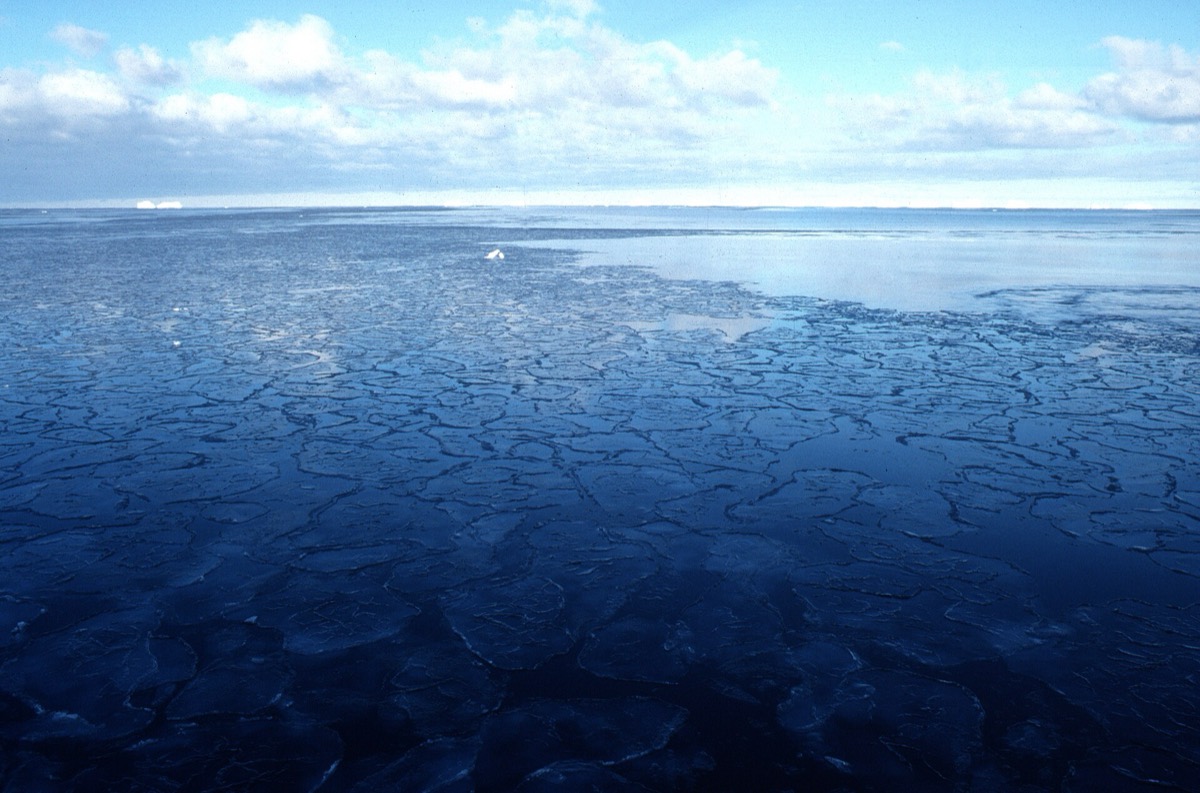
is the field of circular floes that forms when the sea freezes while waves are running. Cores drilled through such ice show distinct layering, which hints that the floes are being stacked by the waves rather than simply thickened by cold. Nobody had related the resulting thickness to the waves themselves. So the authors built a theory, then tested it in a tank and in simulation.
sets it, by a sharp formula. The theory predicts a final for a constant incoming wave. It is proportional to the square of the wave amplitude and the square of the floe diameter, and inversely proportional to the cube of the wavelength. It also gives the speed at which the boundary between single-layer floes and the rafted cover advances. Thermodynamic growth is not the main control.
Pancake ice, the circular floes that form during ice growth in a wave field, occurs across many polar and subpolar seas. Vertical thin sections of cores taken from these ice covers show distinct layering structure, which is a direct record of floes having been stacked on top of one another.
Those observations suggest wave rafting could matter far more than thermodynamic growth in setting how thick the cover becomes. Rafting is intuitively apparent from the layering, and no previous study had related the resulting ice cover to the characteristics of the waves producing it.
The authors used laboratory experiments with plastic model pancake ice to create rafting, and numerical simulations with a three-dimensional that follows disc-shaped floes moving in a wave field. Both were compared against a theory they propose.
The theory predicts a final equilibrium thickness, provided the incoming wave is held constant. That thickness is proportional to the square of the wave amplitude and the square of the floe diameter, and inversely proportional to the cube of the wavelength. It also provides a way to calculate how fast the boundary between single-layer pancake floes and the equilibrium rafted cover propagates. Note the simplifications: plastic floes stood in for ice, and a real sea delivers a spectrum of waves rather than one steady one.
wat. Pancake ice gets its thickness from waves stacking the floes, with amplitude and floe size squared and wavelength cubed against them.
wat wat
It replaces freezing with stacking as the main explanation for how thick this ice gets. Thickness set by wave amplitude and wavelength is a very different quantity to put in a model than thickness set by air temperature.
How do we know?
Dai and colleagues combined laboratory experiments using plastic model pancake floes with numerical simulations from a three-dimensional discrete element model of disc-shaped floes in a wave field, and compared both against their theory.
What is still unknown
The experiments used plastic model floes rather than ice, and the theory assumes a constant incoming wave. Real seas supply a changing spectrum of waves, which the equilibrium prediction does not cover.
Learn something?
Where to next
 What arranges stones into stripes and circles on cold ground?freezing
 Where does the water come from in a frost flower on sea ice?sea ice
 How does anyone know how thick Arctic sea ice is?sea ice