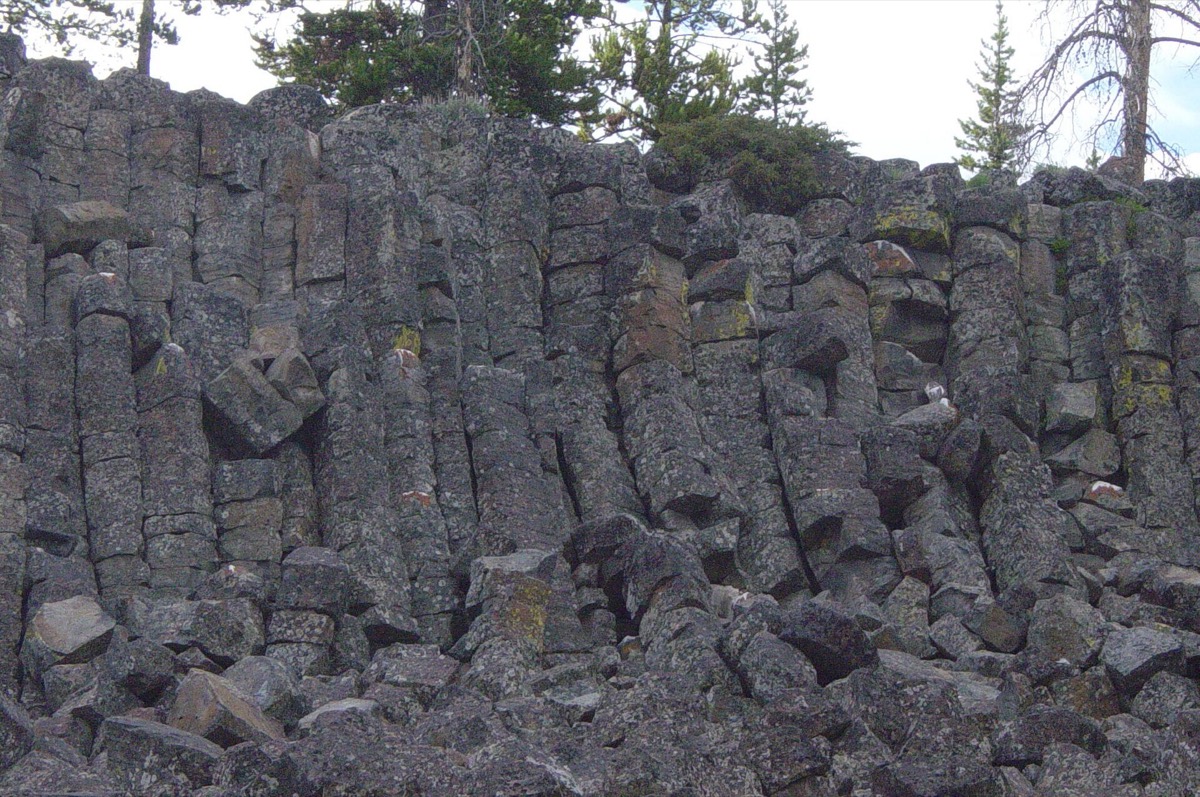
The Giant’s Causeway in Ireland and the Devil’s Postpile in California look built rather than cooled, rank on rank of near-regular columns. Nothing arranged them. A thick basalt flow simply loses its heat, and losing heat is not usually a shaping process. The Hawaiian Volcano Observatory describes what happens inside a flow as it solidifies. Where does the pattern come from?
Contraction, cracking inward from every cooled surface. A flow begins cooling from top, bottom and sides toward the center, where the heat lingers longest. Rock contracts as it cools and fractures, and each crack then grows toward the molten core, perpendicular to the surface it started from. Mathematics of the process predicts perfect hexagons, with sixty and one hundred and twenty degree angles, as the most effective way to relieve the stress.
Thick basalt flows tend to crack into as they cool, and the best-known results are the Giant’s Causeway in Ireland and the Devil’s Postpile in California. Hawaii has nothing on that scale, but a Mauna Loa flow exposed on the Wailuku River above Hilo shows the same thing in miniature, with a about thirteen meters high.
A flow starts cooling the moment it stops moving, from the top, the bottom and the sides inward. The bottom cools slowly, insulated by the ground beneath it. The top cools fast, exposed to cool air, wind, rain and sometimes standing water. That difference in rate produces two different patterns in the same flow.
The slower lower section forms thick, regular columns, which geologists call the colonnade. The faster upper section forms thinner and less regular ones, a hackly pattern called , which can be hard to recognize as columnar at all because the columns share no dominant orientation.
The cracking is not continuous. Studies of the cooling Kilauea Iki lava lake showed cracks growing in discrete events, each a sudden lengthening once enough had built up, audible to scientists and recorded on seismometers. On a fresh flow the same thing can be heard as popping and cracking at the surface. Mathematics predicts hexagons; what the rock delivers is whatever shape puts the stress away, with hexagonal symmetry overall.
wat. Nothing drew the hexagons. The rock shrank, and shrinking rock cracks wherever the stress most needs relieving.
wat wat
The column pattern is a record of how a flow cooled, so a geologist reading the columns is reading the thermal history of the rock.
How do we know?
The Hawaiian Volcano Observatory’s Volcano Watch column describes columnar jointing in a Mauna Loa flow exposed at Boiling Pots on the Wailuku River, alongside observations from the cooling Kilauea Iki lava lake.
What is still unknown
Few flows produce the perfect hexagons the mathematics predicts. Real columns take whatever shape relieves the local stress, so the pattern is a tendency rather than a rule.
Learn something?
Where to next
 What carves a canyon into thousands of stone spires?geology
 What did geologists do to the man who proposed continental drift?geology
 Why did Mount St Helens flatten a forest sideways instead of upward?geology