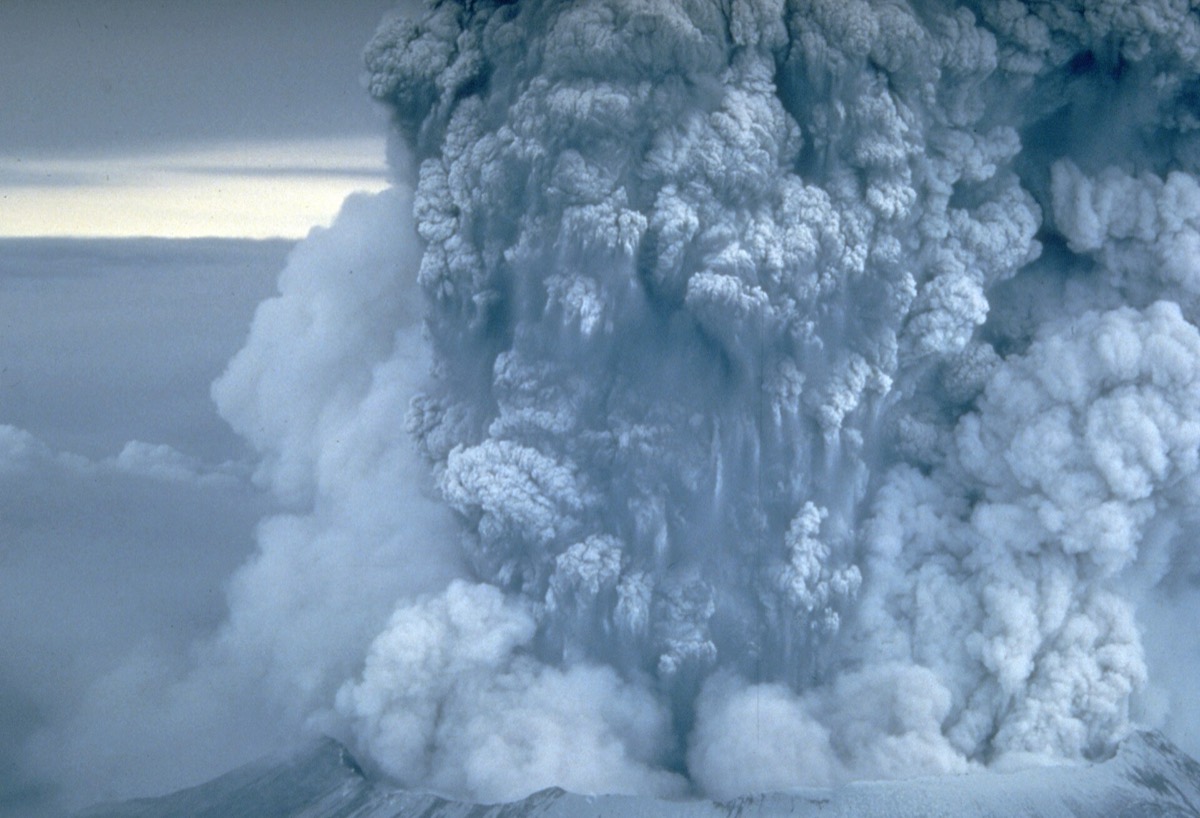
A volcano is supposed to go up. On the eighteenth of May, nineteen eighty, the north flank of Mount St Helens slid away as a , and the climactic eruption began within seconds of it. Trees lay flattened in parallel rows as far as nineteen miles out, pointing away from the mountain. What direction did the explosion travel, and why?
Sideways, because the landslide uncorked it. Removing the upper north flank released the pent-up pressure in an instant: high-temperature steam in cracks and voids, and gas dissolved in the magma of the bulging , expanded almost instantaneously. The of rock, ash and hot gas devastated about two hundred and thirty square miles in a fan north of the volcano. To the south, damage barely left the summit.
The climactic eruptions of the eighteenth of May began within seconds of the debris avalanche. Sudden removal of the upper part of the volcano released the pressure beneath it. High-temperature, high-pressure steam in cracks and voids expanded almost instantaneously, along with gases dissolved in the magma that formed the cryptodome. The USGS compares the uncorking to taking a thumb off a shaken bottle.
The blast started later than the avalanche and was far faster, so it soon overtook it. Calculations put its initial velocity at about two hundred and twenty miles an hour, rising quickly to around six hundred and seventy. The average stayed below the speed of sound, which fits the absence of reported sonic booms from observers in a light plane overhead and survivors on the ground.
Damage fell into three rough rings. The innermost direct blast zone, averaging about eight miles in radius, had virtually everything natural or manmade obliterated or carried away, with the flow unaffected by the shape of the land. Beyond it the channelized blast zone reached as far as nineteen miles, flattening everything and following the topography, leaving large trees toppled in parallel and snapped at the base. Outermost came the seared zone, where trees stayed standing but were singed brown by hot gas.
The blast was heard hundreds of miles away, in British Columbia, Montana, Idaho and northern California, while Portland, only fifty miles off, heard nothing. That silent ring around the mountain became known as the . A similar lateral explosion happened at Mount St Helens about eleven hundred years ago, narrower and pointed northeast. The nineteen eighty blast traveled at least three times as far. So a sideways eruption was not unprecedented at this volcano; its power and the scale of the destruction were.
wat. The mountain did not blow its top so much as lose its side, and everything inside came out through the gap.
wat wat
The lateral blast, the debris avalanche and the mudflows caused most of the casualties and destruction that day. Ash fallout downwind, which is what people picture, was minor by comparison.
How do we know?
The U.S. Geological Survey’s general interest publication on Mount St Helens describes the lateral blast, its calculated velocities, the three concentric damage zones and the quiet zone around the mountain.
What is still unknown
Velocities are calculated rather than measured, and the account is reconstructed after the event from the damage, the survivors and a handful of observers who happened to be nearby.
Learn something?
Where to next
 How does a cloud of dry ash throw lightning with no rainstorm?volcano
 Did a giant eruption bring down a kingdom in East Asia?volcano
 What carves a canyon into thousands of stone spires?geology