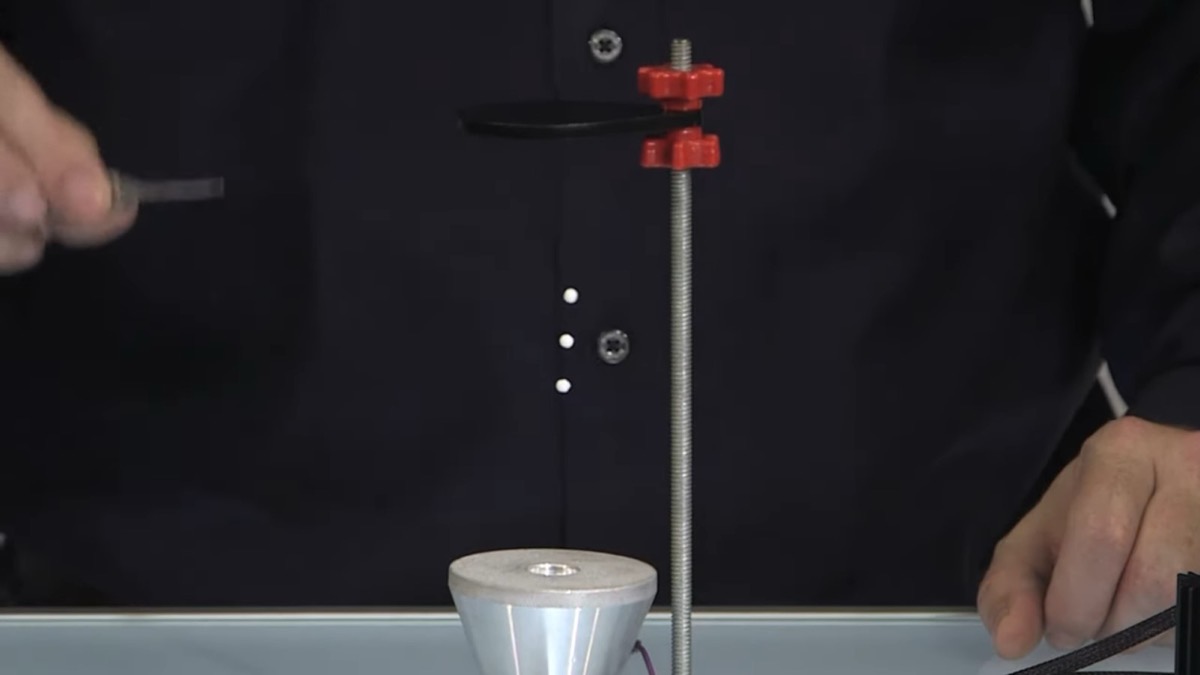
Two things a solid sphere will not. trapped in an spin rapidly about an axis parallel to the trapping plane, and coaxially spinning droplets form long chains aligned with their common axis of rotation. Solid spheres in the same trap do something different: they form close-packed planar crystals.
The chains then interact with each other hydrodynamically, merging into longer chains or gathering into three-dimensional bundles. The authors show the transition between the two behaviors with a model system in which fluid emulsion droplets can be into solid spheres without significantly changing their other material properties.
A standing sound wave can hold a small object in mid-air, at a point where the acoustic forces balance. The question this study asks is what happens next, and specifically whether it matters that the thing being held is liquid. The answer is that it matters a great deal.
Emulsion droplets trapped in an ultrasonic levitator behave in two ways that solid spheres do not. Individual droplets spin rapidly about an axis parallel to the trapping plane. And coaxially spinning droplets form long chains aligned with their common axis of rotation, rather than gathering into a layer.
Those chains are not static either. Acoustically organized chains interact hydrodynamically, either merging into longer chains or forming three-dimensional bundles of chains. Solid spheres under the same conditions form close-packed planar crystals instead, drawn together by the sound-mediated .
The cleanest part of the work is how the two cases are compared. The authors show the chain-to-crystal transition using a model system in which fluid emulsion droplets can be photopolymerized into solid spheres. Other material properties barely change, so the difference in behavior follows from the change of state. One caution: an ultrasonic levitator is a strongly driven and specific environment, and these are findings about a model system in it.
wat. Held up by sound, droplets spin and link into chains; the same beads, once solid, pack into a sheet.
wat wat
Holding something in air with sound alone sounds like the end of the experiment. It is the beginning: once levitated, liquid and solid versions of the same particle organize themselves in completely different ways.
How do we know?
Droplets and spheres were levitated in an ultrasonic trap and observed. The same particles were then converted from liquid to solid by photopolymerization, so the change in behavior follows from state rather than from material.
What is still unknown
A study of a model system in an ultrasonic levitator, which is a specific and strongly driven environment. What droplets do when held by sound in a laboratory trap need not describe droplets anywhere else.
Learn something?
Where to next
 Which feather silences an owl in flight? There is no single answeracoustics
 Why does sand on a vibrating plate draw lines?acoustics
 Why is it so hard to hear a speech inside an old abbey?acoustics