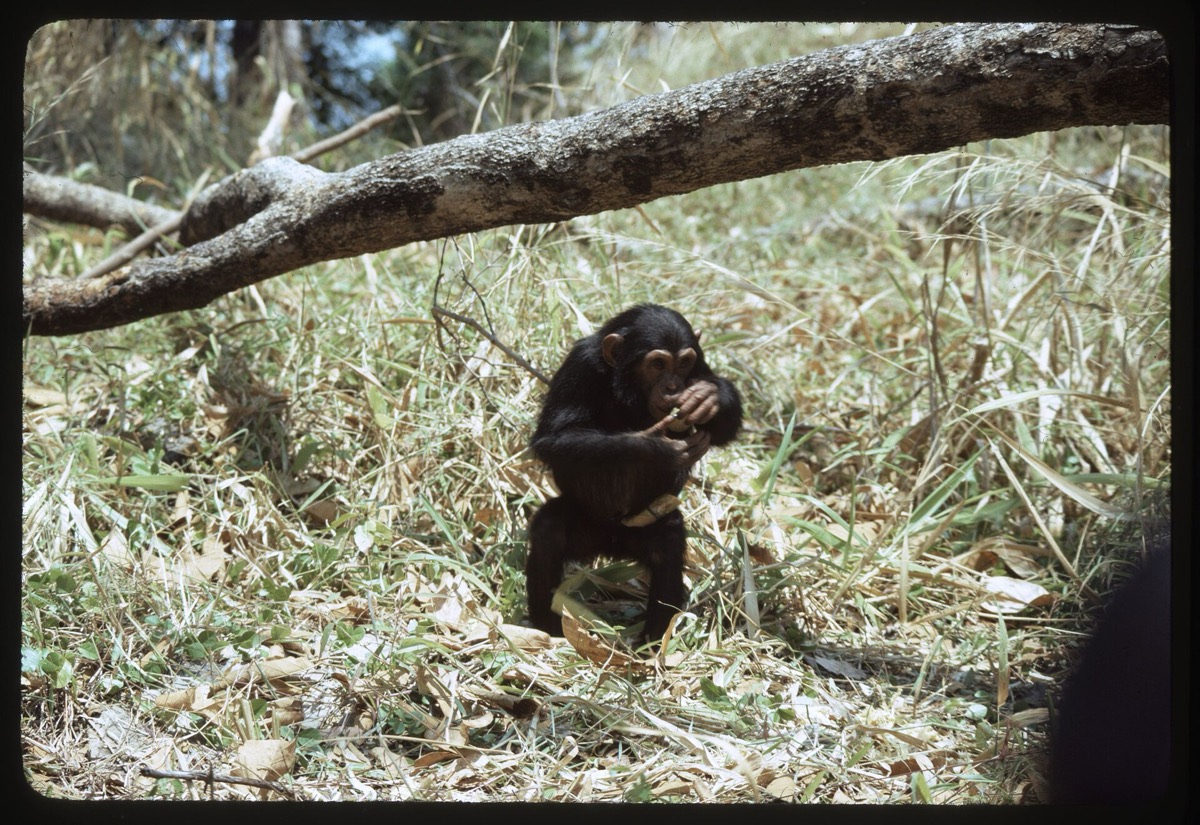
Wild chimpanzees sometimes eat things with no nutritional case for them: bark, dead wood, stripped pith, all low in nutrients and often loaded with bioactive toxins. Calling that has been easy to say and hard to show, because the alternative is simply that animals eat odd things. Freymann and colleagues watched two Budongo communities for eight months, noted who was ill, and took the plants to a laboratory. Do the plants do anything?
Several of them are genuinely potent. Of fifty-three extracts screened for antibacterial activity, forty-five inhibited growth by at least forty percent against multidrug-resistant clinical isolates, including . Alstonia boonei dead wood and Khaya anthotheca bark and resin were the strongest, and heavily parasitized individuals were seen eating both. In the anti-inflammatory screen, seventeen of fifty-one extracts inhibited by half or more.
Wild chimpanzees eat a wide range of plants, and most of it makes dietary sense. Some does not: bark feeding, dead wood eating and pith-stripping deliver little nutrition and often carry bioactive toxins, which makes the behavior costly. Those are the items long speculated to be medicinal.
Freymann and colleagues worked in the Budongo Forest in Uganda with two habituated communities, collecting seventeen botanical samples from thirteen species. Some were chosen for the behavior attached to them, others for the state of the animal eating them: elevated parasite load, abnormal urinalysis, an injury. Three extracts of different polarities were prepared from each.
In the antibacterial screen, forty-five of fifty-three extracts inhibited growth by at least forty percent against a panel of multidrug-resistant clinical isolates, and forty-one of those stayed active in dose-response testing. The strongest were an Alstonia boonei dead wood extract against Staphylococcus aureus and Enterococcus faecium, and a Khaya anthotheca bark and resin extract against E. faecium and pathogenic Escherichia coli. The researchers saw heavily parasitized individuals eating both species.
The anti-inflammatory results point the same way. Seventeen of fifty-one extracts inhibited COX-2 by half or more at low concentration, with the Khaya anthotheca extract most potent and the fern Christella parasitica next. An injured individual ate that fern, in a feeding event documented only once before in this population. Integrated with eight months of behavioral data, that is a stronger case than either strand would make alone, and it is the interdisciplinary approach the authors argue needs.
wat. The bark the parasitized ones chose turned out to kill bacteria that defeat our own antibiotics.
wat wat
Pairing eight months of health monitoring with laboratory pharmacology is what separates a sick animal seeking a remedy from an animal that eats bark anyway, which is the problem the field has always had.
How do we know?
Freymann and colleagues collected seventeen botanical samples tied to self-medication behaviors or to sick individuals in two Budongo chimpanzee communities, and tested three extracts of each against resistant bacteria and for COX-2 inhibition.
What is still unknown
Activity in a dish is not a cure in an animal. Nothing here measures the dose a chimpanzee absorbs or shows that any individual recovered because of what it ate.
Learn something?
Where to next
 Which animal grows a whole leg back, bone and nerves included?medicine
 Where exactly does an ant lose its footing on a pitcher plant?plants
 Can an ape treat its own injury with a plant?plants