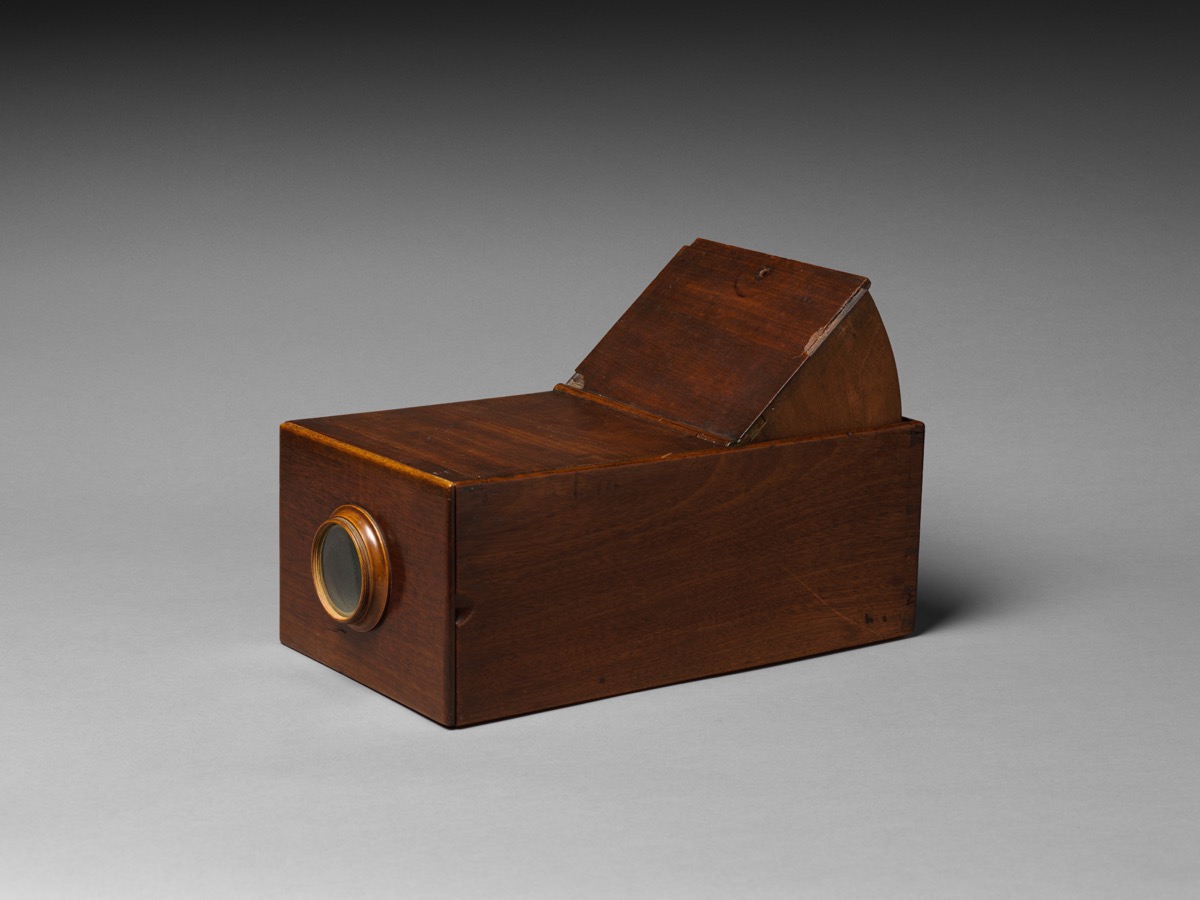
Artists, for centuries, through a box. The was a small wooden box with a lens at one end. It projected the scene in front of it onto frosted glass at the back, where an artist could trace the outlines on thin paper. The image was already there. What nobody could do was make it stay.
Talbot’s route to photography ran through his own failure as a draftsman. Sketching by in October 1833 with a , he found that what looked beautiful through the prism became, as he put it, melancholy to behold on the paper. That frustration sent him back to the camera obscura he had used ten years earlier, and to what he remembered about it.
In October 1833 a young English gentleman sat sketching by Lake Como on his honeymoon, one eye pressed to a camera lucida. The device was a simple draftsman’s aid: a metal arm fastened to the sketchbook at one end, holding a glass prism at the other. A refracted image of the landscape then appeared superimposed on the page. Tracing it looked easy.
It was not. When the eye was removed from the prism, in which all looked beautiful, Talbot found that the faithless pencil had left only traces melancholy to behold. He was a polymath, a Cambridge graduate, a member of Parliament and a fellow of the Astronomical, Linnean and Royal Societies, with four books and twenty-seven articles behind him. Drawing was simply not among his gifts.
The failure sent him back ten years, to another drafting aid. The camera obscura was a small wooden box with a lens at one end. It projected the scene before it onto a piece of frosted glass at the back, where the artist could trace the outlines on thin paper. It had left Talbot with unsatisfactory drawings too.
But it was not his own feeble drawings he remembered after a decade. He recalled instead the inimitable beauty of the pictures of which the glass lens of the camera obscura threw onto the paper. That is the thought photography came out of: the image was already perfect and already there, and the problem was that it vanished when you took the box away. One caution: this is a museum essay, and Talbot’s account of 1833 is his own recollection written later.
wat. The photograph existed long before anyone could keep one.
wat wat
It relocates the invention. Photography was not the discovery of the image but the capture of one artists had been tracing by hand for generations, which is why Talbot called what he was after nature’s painting.
How do we know?
The Metropolitan Museum’s essay on Talbot and the invention of photography describes the camera lucida and the camera obscura. It quotes Talbot’s own recollections, and traces how dissatisfaction with both led to his work on fixing the image.
What is still unknown
A museum essay rather than a research paper, written to introduce a collection, so it presents an established narrative and quotes Talbot’s own later recollections of events a decade past.
Learn something?
Where to next
 How do you fit a sequence of portraits onto a single plate?photography
 How does a chameleon change color without making any new pigment?optics
 How can a distant ship look as though it is floating above the sea?optics