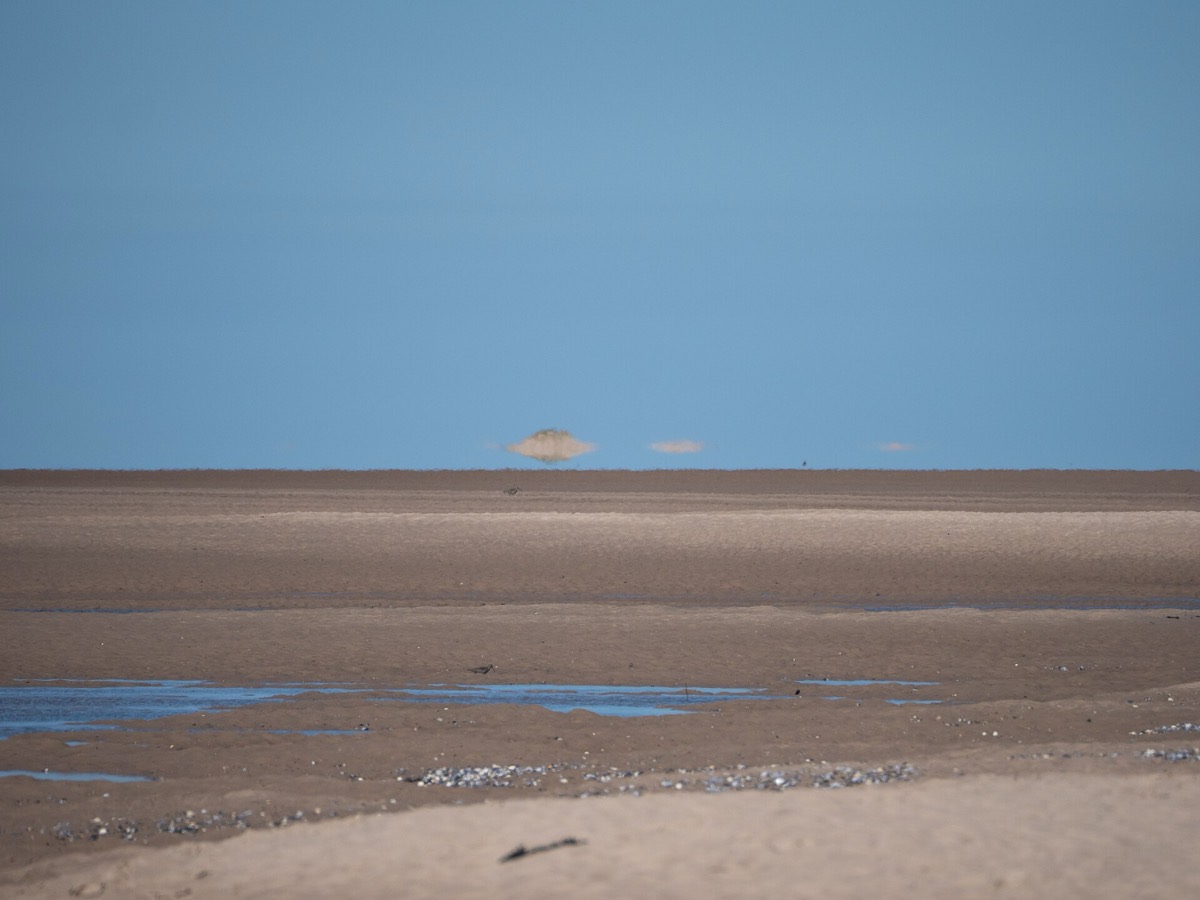
Light travels in a straight line, so a ship beyond the horizon simply cannot be seen. Sometimes it is seen anyway, hovering above the sea and stretched into layers. What bends the rays?
A gradient of air density. On a day of , cold dense air can be trapped beneath warmer air. then changes gradually with height, so rays arriving from a distant ship bend again and again instead of traveling straight. The eye as though they came from somewhere higher. The result is : layers, stretching and sometimes inverted images that appear suspended above the horizon.
A ship that appears to hover above the sea is not a trick of the imagination but the result of a curved path of light.
On a day of temperature inversion, cold dense air is trapped beneath warmer air, the reverse of the usual order. That state also stabilizes the layers and prevents mixing, so the difference holds.
Light moves more slowly in dense air, so a ray passing between the layers bends gradually instead of traveling straight, and can follow the curvature of the Earth for a long distance.
The eye does not know this. It continues the ray backward in a straight line and places the object higher, which produces layers, stretching and sometimes inverted figures. The same principle affects navigational sightings and astronomical measurements. The display changes within minutes, and a single photograph is not enough to reconstruct the layers of air that produced it.
wat. A hovering ship is an optical figure whose light path curved inside layers of air at different temperatures.
wat wat
The same principle affects navigational sightings, astronomical measurements and what we think lies beyond the horizon.
How do we know?
Models of atmospheric refraction reconstruct the distortions from the profile of temperature and density above the surface of the sea.
What is still unknown
The display changes within minutes, and a single photograph is not enough to reconstruct precisely the layers of air that produced it.
Learn something?
Where to next
 Why does the bright spot beside the sun always sit in the same place?optics
 Why is a rainbow in fog white?optics
 Why do the colored rings follow your own shadow and nobody else’s?optics