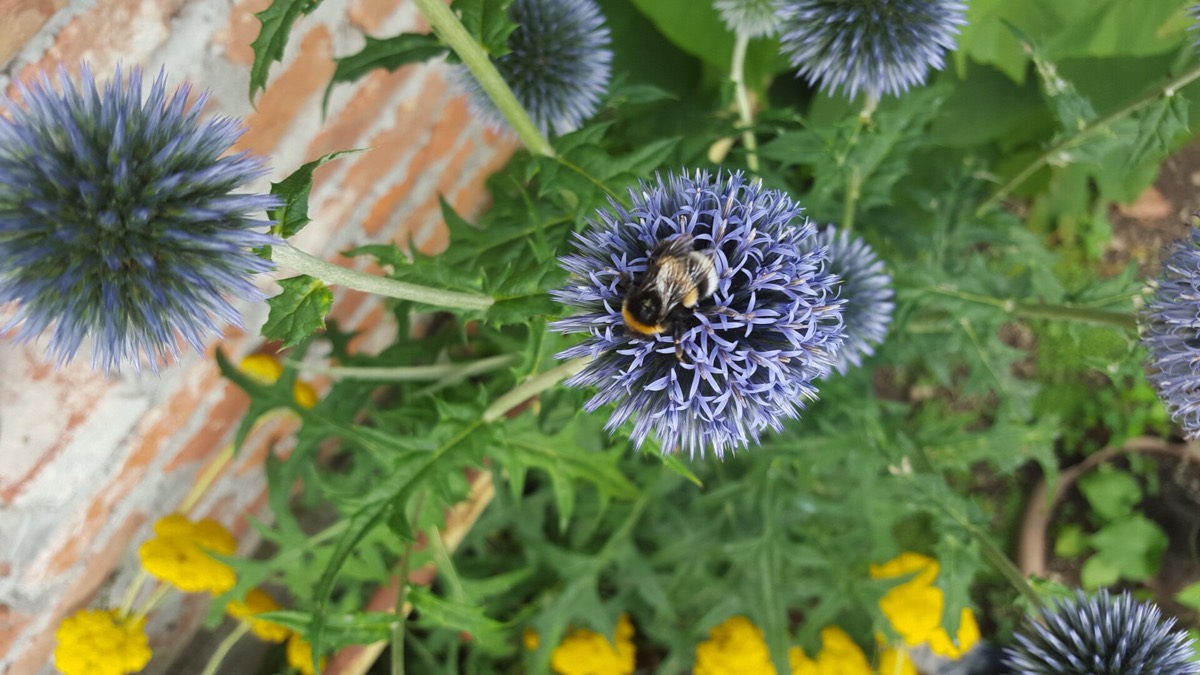
To reach a drop of sugar a bee had to move a blue tab first, which paid nothing at all, and only then push a red one. A first step with no reward is exactly the thing that cannot be learned alone. So what worked?
Watching another bee. Bees that saw no demonstration never found the sequence, even after many days. Of those that watched a trained demonstrator, some acquired the whole action, and some of them without ever getting the the researchers had to give the demonstrators themselves.
The accepted test for is a solution one individual would never reach alone, which nonetheless passes easily from one to another. This experiment built exactly that situation, and tried it in an insect.
To reach a drop of sugar the bee had to move a blue tab first, which gives nothing, and only then push a red one. The first stage is the trap: it pays nothing, so a bee trying alone gets no reason to repeat it.
And so it proved. , which saw no demonstration, did not solve the task across up to twenty-four days. that watched a trained bee acquired the whole sequence, some of them without ever receiving the intermediate reward the researchers had to give the demonstrators.
The caveat is about the size of the claim and not about the data. Five bees succeeding in a laboratory is not a culture. The task is artificial, the demonstrators were trained gradually in a way that does not happen in nature, and nobody has seen such a sequence spread through a colony. What the experiment shows is that acquiring behavior you could not invent alone is not reserved for mammals, and that is enough to change the question.
wat. A bumblebee never invented the two-step sequence by itself, and after watching another bee it performed the whole thing.
wat wat
Learning a solution that cannot be discovered alone was long held to be the foundation stone of cumulative culture. The experiment extends that ability to insects.
How do we know?
The researchers compared naive bees working alone against bees that watched a trained demonstrator. Five of the 15 watchers succeeded, while the control group never solved the task across up to 24 days of exposure.
What is still unknown
Five bees succeeding does not show that bumblebees have cumulative culture in the wild. This is an artificial laboratory task, with demonstrators trained in a way that does not happen in nature.
Learn something?
Where to next
 How did a small fish pass a mirror test that was thought to be almost human?cognition
 Can a flower hear a bee coming?bees
 Does a bee see the world differently once it starts moving?bees