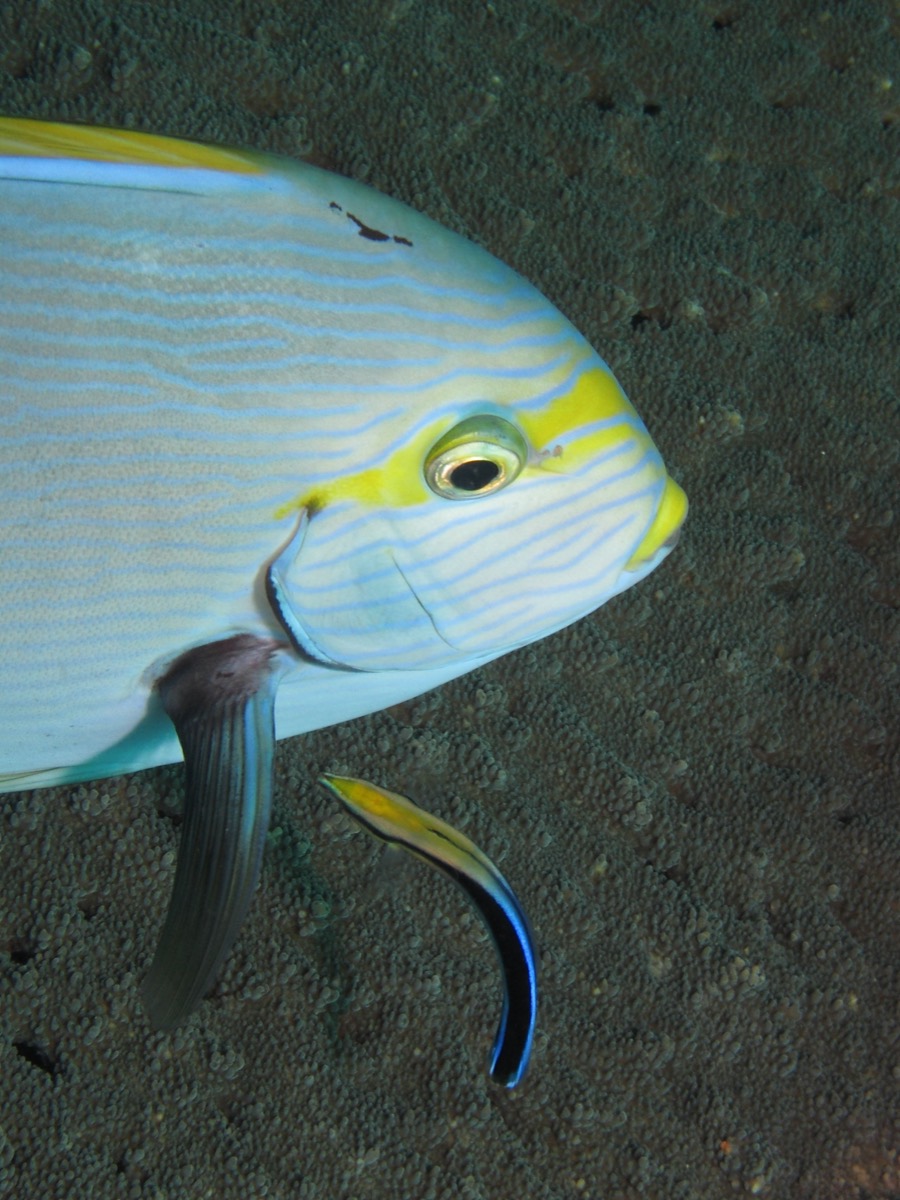
was long treated as a rare mark of self-recognition, reserved for a handful of animals. were exposed to a mirror, and then shown photographs of themselves and of strangers, and composites with one fish’s face on another’s body. How did they respond?
By the face. They attacked photographs of strangers, did not attack a photograph of themselves, and did not attack a composite carrying their own face on a stranger’s body. A still photograph removes any synchrony, so this is not a match between movement and reflection but something closer to . The interpretation remains contested.
The mirror test served for decades as a boundary line: great apes, elephants and dolphins on one side, and everything else on the other. So a fish passing it is not merely a headline but a conceptual problem.
The obvious criticism of the first result was that the fish is not really recognizing itself but only the synchrony. Something in the mirror moves exactly when it moves, from which it infers that it can touch the mark on its own body. That is a match, not awareness.
This study was designed to cut the argument exactly there. Instead of a mirror, still photographs, in which there is no synchrony at all. A photograph of the fish itself, of a stranger, and composites with one fish’s face on another’s body.
The responses differed systematically. The fish attacked photographs of strangers, did not attack a photograph of themselves, and did not attack one carrying their own face on a stranger’s body. Which is to say the face decided it. After a mark was placed on the throat they scraped themselves in front of the mirror, exactly as expected. And the interpretation stays contested, because is the hard part: this may be a distinction between familiar and strange, which is not self-awareness as we understand it.
wat. The fish did not have to understand philosophy. It had to know that this picture is of itself.
wat wat
The finding widens the argument about self-recognition past the groups taken to be "clever" in a human sense, and forces some precision about what a mirror test measures.
How do we know?
The researchers showed the fish photographs of themselves, of strangers and of composites, and recorded attacks and scraping behavior after a mark was placed on the throat.
What is still unknown
Reading a mind from behavior is the difficulty here, and the interpretation of the mirror test in animals is disputed. Recognizing an image of yourself is no simple proof of human self-awareness.
Learn something?
Where to next
 What can a bumblebee learn but never invent on its own?cognition
 Is handedness something only humans have?cognition
 Can a bird see what makes a square different from a lopsided shape?cognition