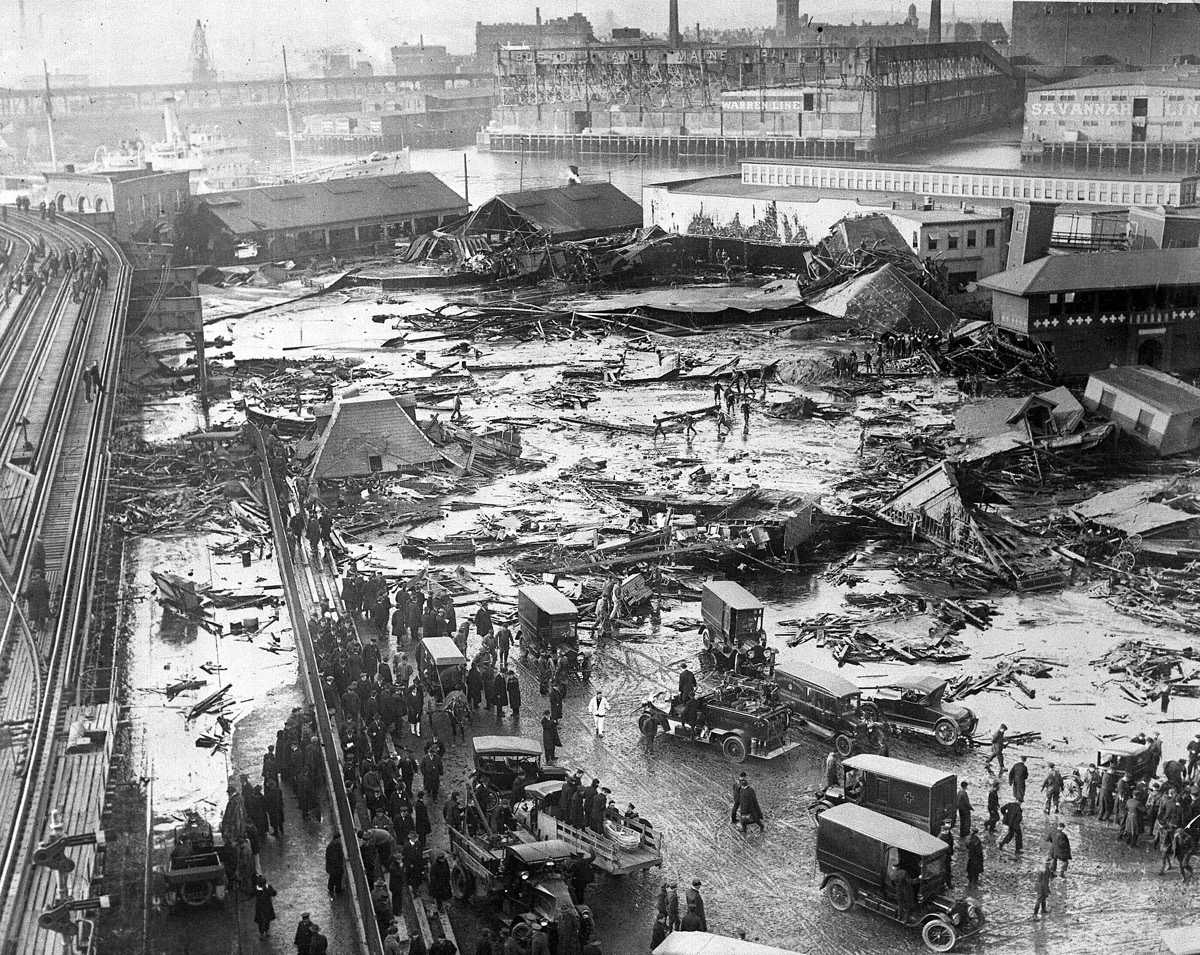
At about one in the afternoon on the fifteenth of January, nineteen nineteen, people out enjoying unseasonably warm weather in Boston’s heard a low rumble and took it for an approaching elevated train. A fifty-foot tank of industrial molasses had ruptured. Local residents already knew the tank leaked, and children had collected pails of it from the seams. How bad was it?
Two point three million gallons at about thirty-five miles an hour. The wave knocked an elevated train off its tracks, crushed buildings, shifted a firehouse off its foundations and suffocated people and animals. Twenty-one died and one hundred and fifty were injured, most of them laborers and drivers at the paving yard and the wharf, along with two ten-year-olds and a fireman.
The tank stood fifty feet tall in a crowded neighborhood, built by the only a few years earlier, in nineteen fifteen. It rose over the Boston Elevated Railroad tracks that ran beside it. Tankers delivered molasses to Copps Hill Wharf, where it was pumped in and held until rail cars took it on to distilleries.
Everyone nearby knew it leaked. Children of the North End collected pails of the sticky, sweet molasses, and when locals complained that they could see it seeping from the seams, the company painted the tank brown to disguise the ooze. later reported walls far too thin for the weight they held, with a chemical composition that left them vulnerable to cracking.
On the fifteenth of January, nineteen nineteen, shoddy construction, a sudden temperature change and a large new shipment combined. Two point three million gallons came out at about thirty-five miles an hour, knocking an elevated train from its tracks, crushing buildings, moving a firehouse off its foundations and suffocating people and animals. Twenty-one died and one hundred and fifty were hurt.
Cleanup was almost impossible until city workers found that saltwater broke the molasses down and began spraying the area with harbor water. The owners first blamed an anarchist bombing. An inquiry and a found otherwise, and in nineteen twenty-five a court-appointed auditor put the collapse down to the owners’ negligence. Out of it came requirements that engineers sign and seal plans, that inspectors examine projects, and that architects show their work.
wat. They painted the tank brown so nobody could see it leaking, which worked until the day it did not.
wat wat
The requirements that engineers sign and seal plans, that inspectors examine projects and that architects show their work came out of this, which makes a comic-sounding disaster the origin of ordinary building regulation.
How do we know?
The Boston City Archives account, published by the city for the centenary, draws on its own photograph collection, the inquiry and lawsuit that followed, and the work of the author Stephen Puleo.
What is still unknown
A city archive summary written for an anniversary rather than an engineering report. The structural findings are relayed from the inquiry and the lawsuit, not reconstructed here.
Learn something?
Where to next
 Why were so many people standing at the dock watching?disaster
 How do three people get home from the Moon with the power failing?engineering
 What are the white lumps inside Roman concrete actually doing?engineering