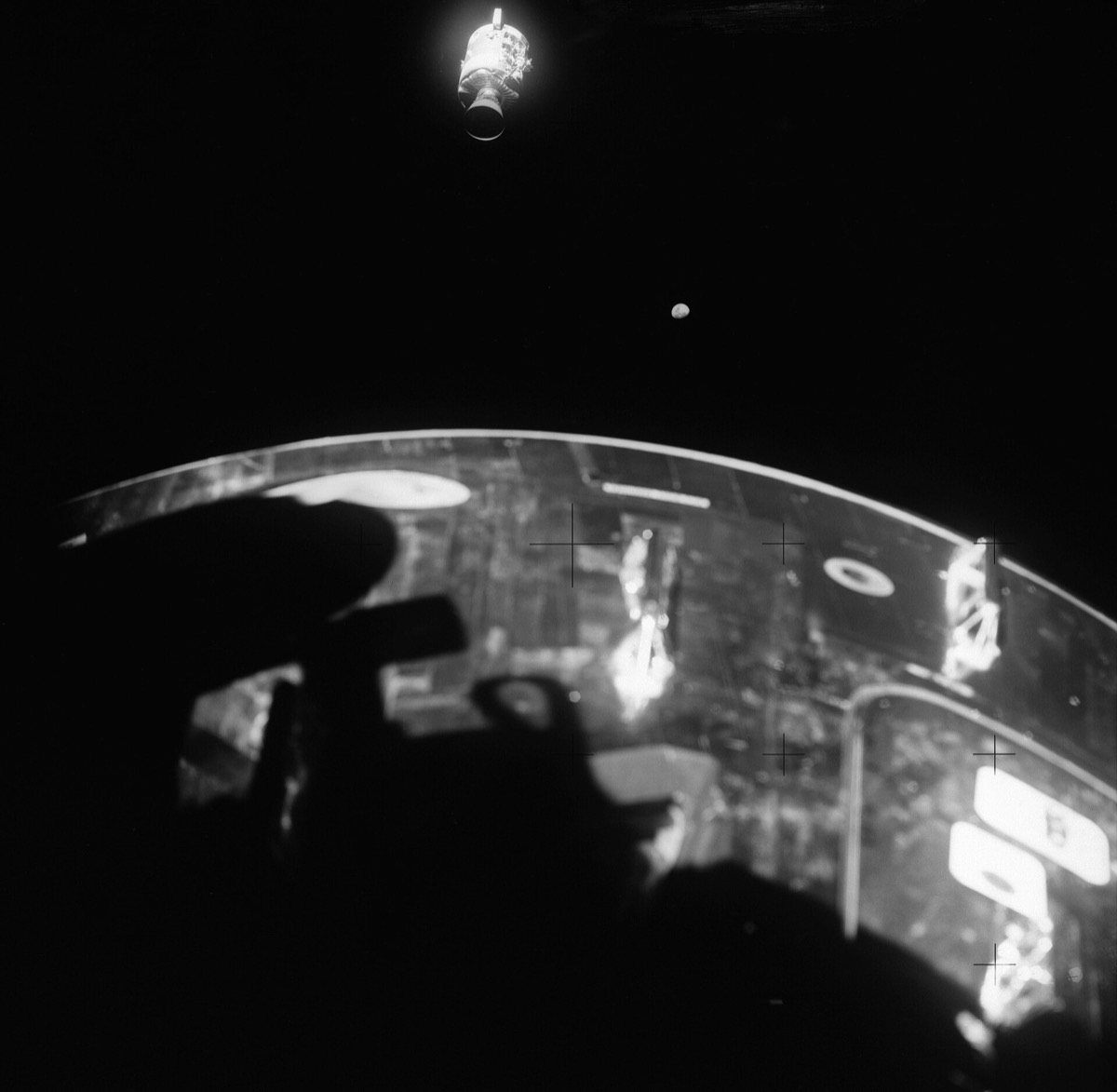
Two days out from Earth, Apollo 13 was coasting toward the Moon on a trajectory so accurate that two planned course corrections had been cancelled. On the evening of the thirteenth of April nineteen seventy, with the crew checking the lunar module for a landing, there was a loud explosion. Within eight seconds one of the two cryogenic oxygen tanks had dropped to zero pressure.
They moved into the lander and used it as a lifeboat. Those oxygen tanks fed the , which supplied electrical power, breathing oxygen and drinking water, so the crew shut the command module down to save its batteries for reentry. They powered up instead and rode it around the Moon and home.
The mission launched from Cape Kennedy on the eleventh of April nineteen seventy on a Saturn V, bound for the difficult Fra Mauro region of the Moon. The flight went so precisely that planned course corrections kept being cancelled. On the evening of the thirteenth, as Lovell moved back through the connecting tunnel from Aquarius to Odyssey, a loud explosion was heard, and Haise and Lovell noticed a main electrical system degrading.
What followed became the most quoted exchange in spaceflight. Lovell told Houston they had a problem and a main bus undervolt. Within eight seconds of the explosion, pressure in one of the service module’s two cryogenic oxygen tanks had fallen to zero. About an hour later mission control announced it was looking at an alternate mission, swinging around the Moon and using the lunar module power systems. The landing was gone.
The return ran on the lander. Still three days from Earth, the astronauts moved into Aquarius and powered it up, shutting down Odyssey to save its batteries for reentry. They transferred back onto a in the early hours of the fourteenth. They passed behind the Moon at an altitude of two hundred and sixty-four kilometers, setting the record for the farthest humans have flown from Earth, four hundred and one thousand kilometers. The lunar module cooled to three degrees Celsius and condensation covered its walls. Soviet, French and British ships moved toward the recovery area. Splashdown came on the seventeenth, one hundred and forty-two hours and fifty-five minutes after launch, with no lasting ill effects on the crew.
NASA set up a review board under the engineer Edgar Cortright, and it investigated for about two months. Its conclusion was that all indications pointed to an electrically initiated fire in oxygen tank number two in the service module. The board judged that the accident was not a chance malfunction in a statistical sense but resulted from an unusual combination of mistakes, coupled with a somewhat deficient and unforgiving design. Two on the tank heater had been welded closed during ground tests. The tank had been jarred at the contractor’s plant, loosening a fill tube. And nobody reviewing the documentation caught that the switches were rated for the wrong voltage.
wat. The lander was never meant to fly anybody home. For three days it was the only part of the ship still working.
wat wat
The board was explicit that this was not bad luck. It called the accident an unusual combination of mistakes coupled with a somewhat deficient and unforgiving design.
How do we know?
Britannica’s account of the mission and of the Apollo 13 Review Board, the inquiry NASA set up under the engineer Edgar Cortright, which spent about two months on the investigation before publishing its report.
What is still unknown
An encyclopedia account built on the official inquiry. It gives the board’s findings on the tank and its switches without the engineering detail of how the fire propagated inside the tank.
Learn something?
Where to next
 How did a tank of molasses kill twenty-one people?engineering
 What are the white lumps inside Roman concrete actually doing?engineering