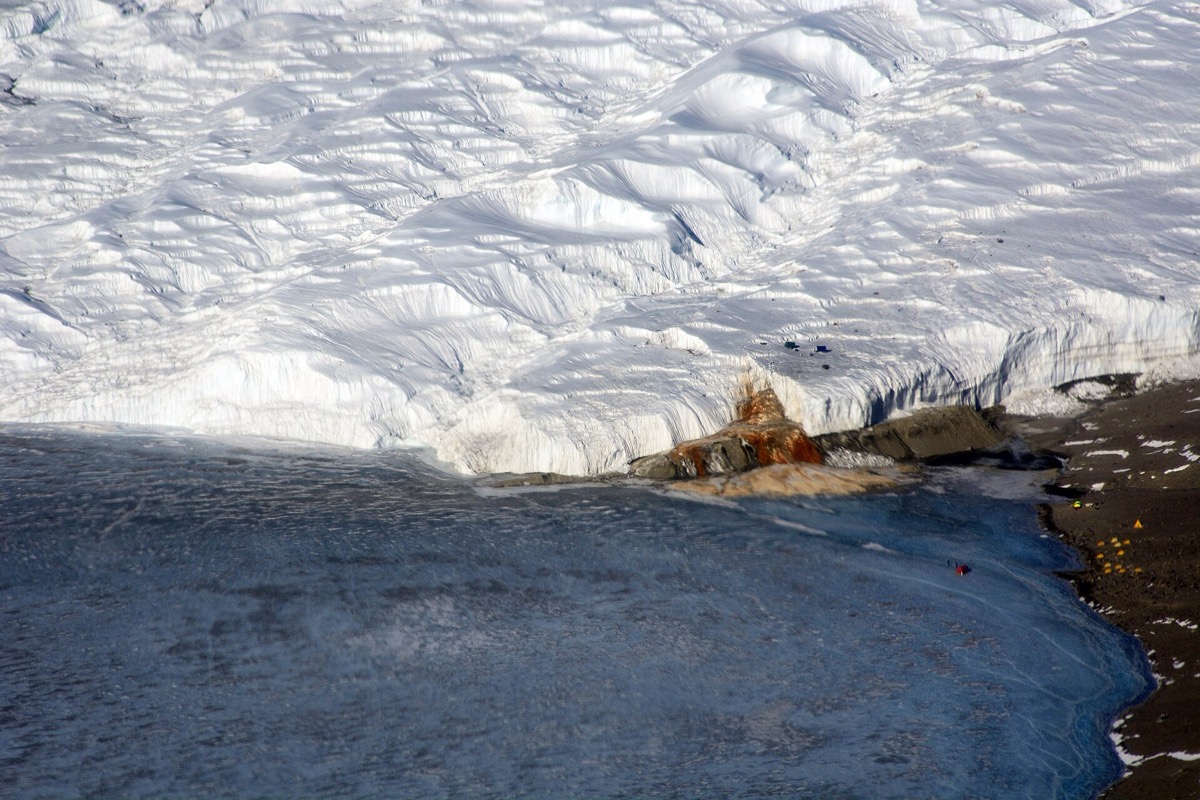
Blood Falls is a rust-red fan spreading from the terminus of Taylor Glacier in Antarctica, fed by that discharges irregularly from beneath the ice. Red usually means iron oxide, and iron oxide usually means identifiable crystalline minerals. The site also doubles as a , so the mineralogy matters beyond curiosity. A battery of techniques was pointed at the surface material.
No crystalline iron oxides at all. The mineralogy is dominated by the calcite and aragonite, with quartz, feldspar, halide and clay minerals alongside. There is no strong evidence for crystalline iron oxide or hydroxide phases. What the samples do contain are compositionally and morphologically diverse iron- and chlorine-rich , which form when dissolved iron in the subglacial fluid meets air.
Aperiodic discharge of brine at Blood Falls forms a red-tinged fan at the terminus of Taylor Glacier, Antarctica. The site is studied as a Martian analogue as well as for its own sake, so what the red material actually is matters for interpreting measurements made a long way from Antarctica.
Environmental samples were collected in the field and then analyzed in the laboratory with an unusually wide range of methods: Fourier transform infrared, Raman, visible to near-infrared and Mössbauer spectroscopies. They were further characterized using microprobe and inductively coupled plasma optical emission spectroscopy for chemistry, and x-ray diffraction with scanning and transmission electron microscopy for mineralogy, crystallography and chemistry.
The mineralogy turned out to be dominated by carbonates, calcite and aragonite, accompanied by quartz, feldspar, halide and clay minerals. There is no strong evidence for crystalline iron oxide or hydroxide phases, which is the opposite of what a rust-red deposit would suggest.
What the samples do contain are compositionally and morphologically diverse iron- and chlorine-rich amorphous nanospheres, present in many of them. The analyses suggest the red color arises from oxidation of dissolved ferrous iron in the subglacial fluid, which transforms on exposure to air to form these nanospheres. The authors present the work partly as a methodological lesson, showcasing the strengths and weaknesses of different analytical methods and the need for several complementary techniques at a locale this complicated.
wat. The red at Blood Falls is not rust crystals but amorphous iron nanospheres, forming the moment the brine meets the air.
wat wat
The absence is the finding. Looking for crystalline iron oxide and finding amorphous nanospheres instead is a warning for anywhere a single instrument reads a red surface, Mars very much included.
How do we know?
Sklute and colleagues collected environmental samples in the field and analyzed them with Fourier transform infrared, Raman, visible to near-infrared and Mössbauer spectroscopies, plus microprobe, x-ray diffraction and electron microscopy.
What is still unknown
Surface materials from one discharge fan at one locale, and the authors frame the paper partly as a demonstration that no single technique would have got the answer right.
Learn something?
Where to next
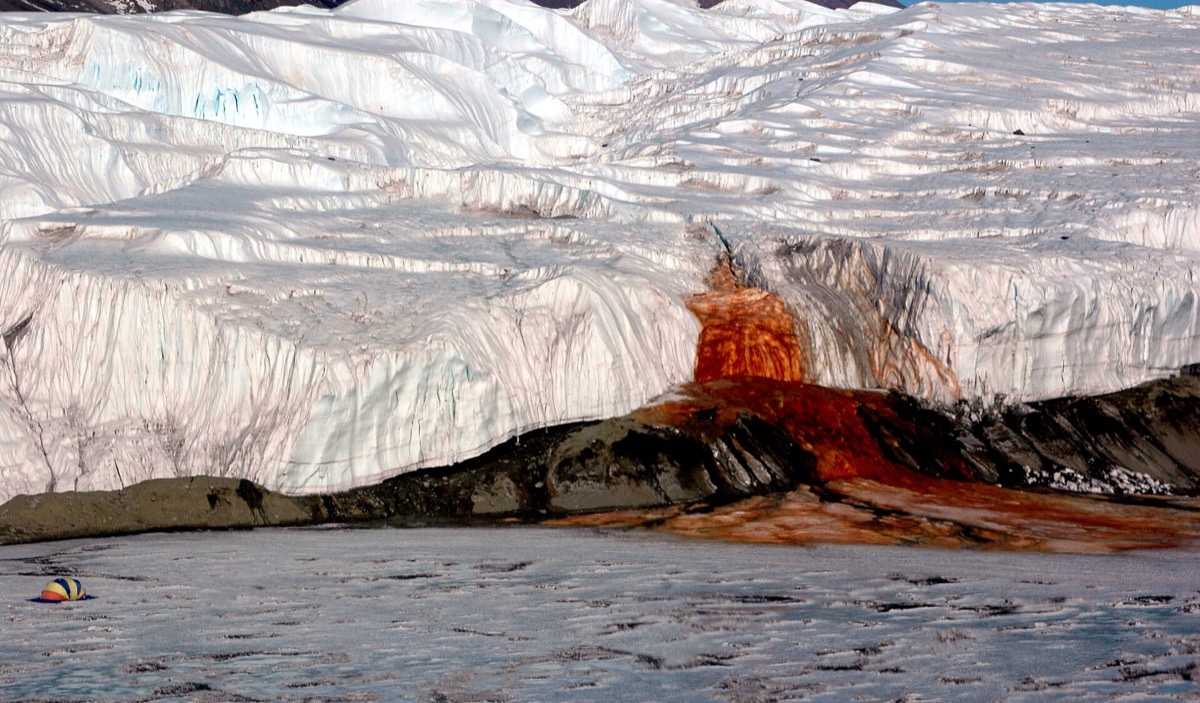 Why does a glacier in Antarctica run red?Antarctica
 Why does an ice shelf already floating in the sea still matter for sea level?Antarctica
 Does a crack race through sea ice as fast as through lake ice?brine