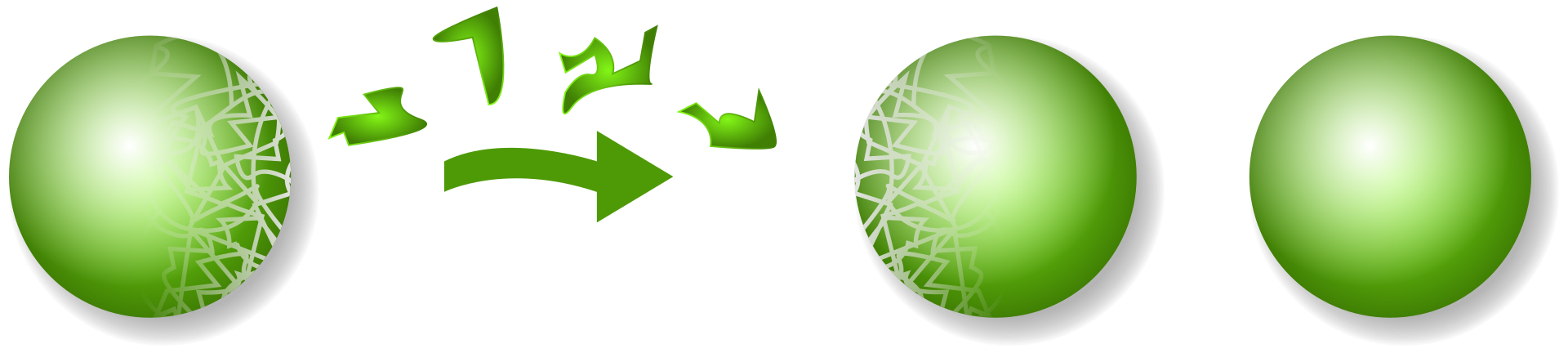
Cutting something up and putting it back together cannot change how much of it there is. That intuition is so basic it feels like arithmetic. Banach and Tarski published a result in 1924 saying that, for a solid ball in three dimensions, it is false.
In mathematics, yes. A solid ball has a finite partition into six pairwise disjoint sets of points that reassemble into two disjoint balls of the same size as the original, using only rotations and translations, with no scaling. Robinson later reduced the number of pieces to five, which is minimal.
The Banach-Tarski paradox concerns a solid ball in three dimensions. It has a finite partition into six disjoint sets of points, which reassemble into two disjoint balls of the same size as the original, a result Banach and Tarski published in 1924. behave very strangely once you are allowed to cut them like this.
The reassembly is as plain as it could be. It uses only , specifically rotations and translations, without scaling, so nothing is stretched or duplicated in any ordinary sense.
The count came down afterwards. Robinson reduced the number of pieces to five in 1947, although those pieces are extremely complicated, and five is minimal, with four sufficient if the single point at the center is neglected.
The escape from contradiction is in the measure theory. The proof uses the , and the pieces cannot all be measurable with respect to . If they were, finite additivity and invariance under rigid motions would force equal total volumes, so this is no physical cutting procedure.
wat. Six pieces in, two identical balls out, and no contradiction anywhere.
wat wat
It marks the exact point where the mathematics of sets stops matching the physics of stuff.
How do we know?
Wolfram MathWorld states the theorem, the reduction in piece count, the role of the axiom of choice and the reason the result does not contradict the ordinary rules for volume.
What is still unknown
Not a physical cutting procedure: the pieces cannot all be measurable, so nothing here applies to actual matter.
Learn something?
Where to next
 How does a thin film solve a geometry problem without calculating?geometry
 Why were geometry problems hung in temples in Japan?geometry
 Can one shape tile a floor that never repeats?geometry