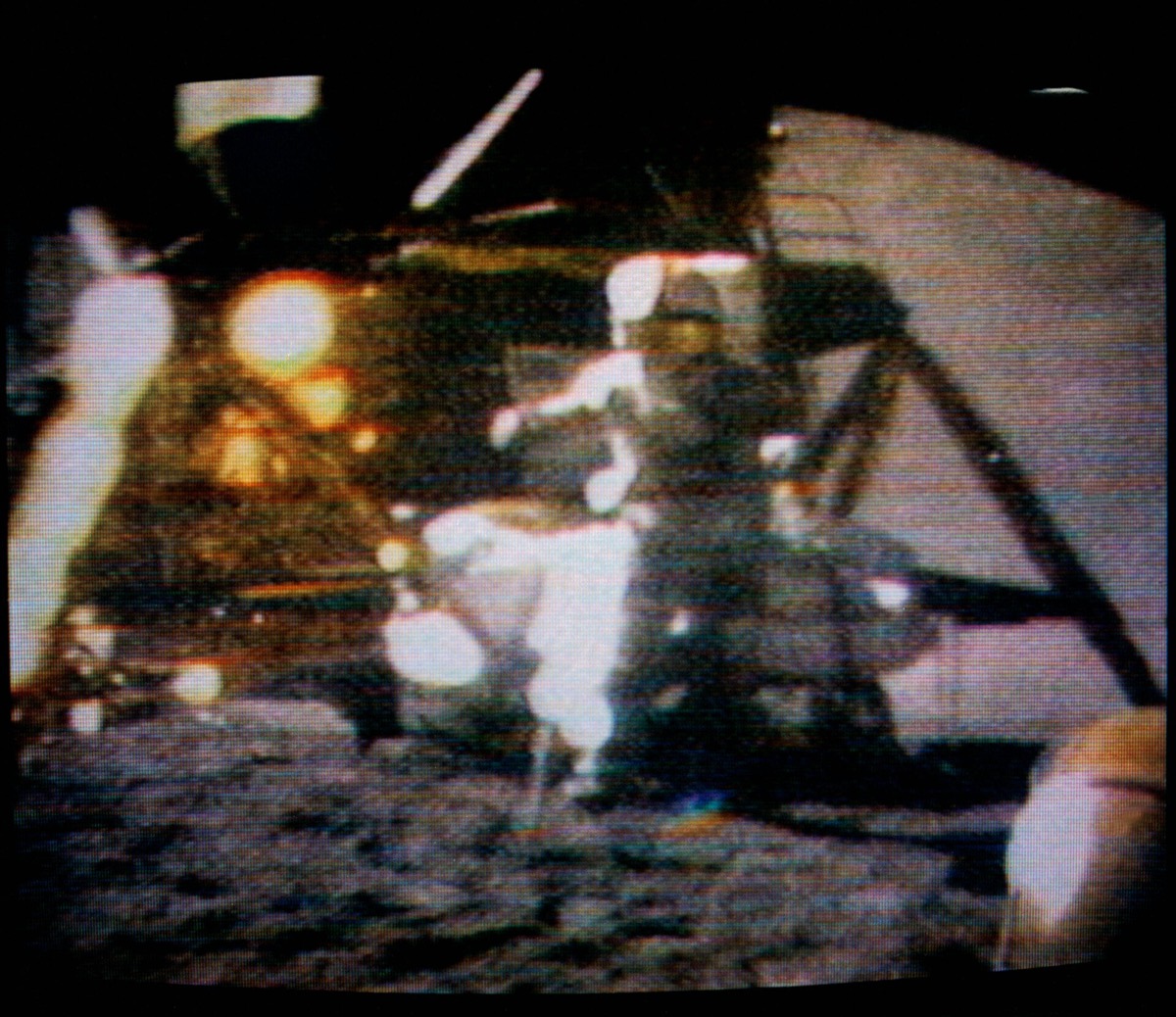
Everyone is taught that gravity accelerates all objects equally, and everyone has also watched a feather drift while a hammer drops. Air resistance accounts for the difference, which means the claim can only be tested somewhere without air. In August nineteen seventy-one the commander of Apollo fifteen was standing in exactly such a place, holding both objects.
They hit the ground together. On the second of August nineteen seventy-one, David Scott dropped a one point three two kilogram aluminum and a point zero three kilogram on the surface of the Moon. They fell at the same rate, which is what the in gravity means. The two differ in mass by a factor of more than forty, and it made no difference.
The prediction is older than the means to test it. A body’s weight is the force needed to prevent its downward acceleration, and because that force is proportional to its mass, the acceleration itself does not depend on the mass at all. Air ruins the demonstration, since drag depends on shape and area rather than on weight, so a feather on Earth will always lose.
The Moon removes the air. It also changes the strength of the pull. The Moon has about one eighty-first of the Earth’s mass and a radius about zero point two seven of ours, so a body on its surface has about of its Earth weight. The Apollo astronauts showed that simply by moving around.
Apollo fifteen launched on the twenty-sixth of July nineteen seventy-one with David Scott, lunar module pilot James Irwin and command module pilot Alfred Worden. After a three and a half day trip Scott and Irwin landed at the base of the Apennine Mountains, near the gorge called Hadley Rille. They drove about twenty-eight kilometers on three separate treks in the Lunar Roving Vehicle, and spent more than seventeen hours outside their lunar module.
On the second of August, before leaving, Scott dropped the hammer and the feather together. They landed together, which is what it means to say objects undergo the same acceleration in gravity. Britannica files the image under Newton’s law of gravitation and calls it the Apollo fifteen gravitation experiment. The mission returned to Earth on the seventh of August.
wat. A geologist’s hammer and a falcon feather, let go at the same moment on the Moon, landing at the same moment.
wat wat
The experiment is Galileo’s, and it took until nineteen seventy-one to run it properly, because every previous attempt had to be made at the bottom of an atmosphere.
How do we know?
Britannica’s biography of David Scott, which records the demonstration, the masses of the two objects and its date, alongside the rest of the Apollo fifteen mission.
What is still unknown
A demonstration rather than a measurement. It shows the two objects falling together to the eye and to the camera, without the precision that laboratory tests of the equivalence principle reach.
Learn something?
Where to next
 How is the distance to the Moon known to the millimeter?gravity
 What is pulling the Milky Way, and why can we not see it?gravity
 Why is the day not the same length it has always been?moon