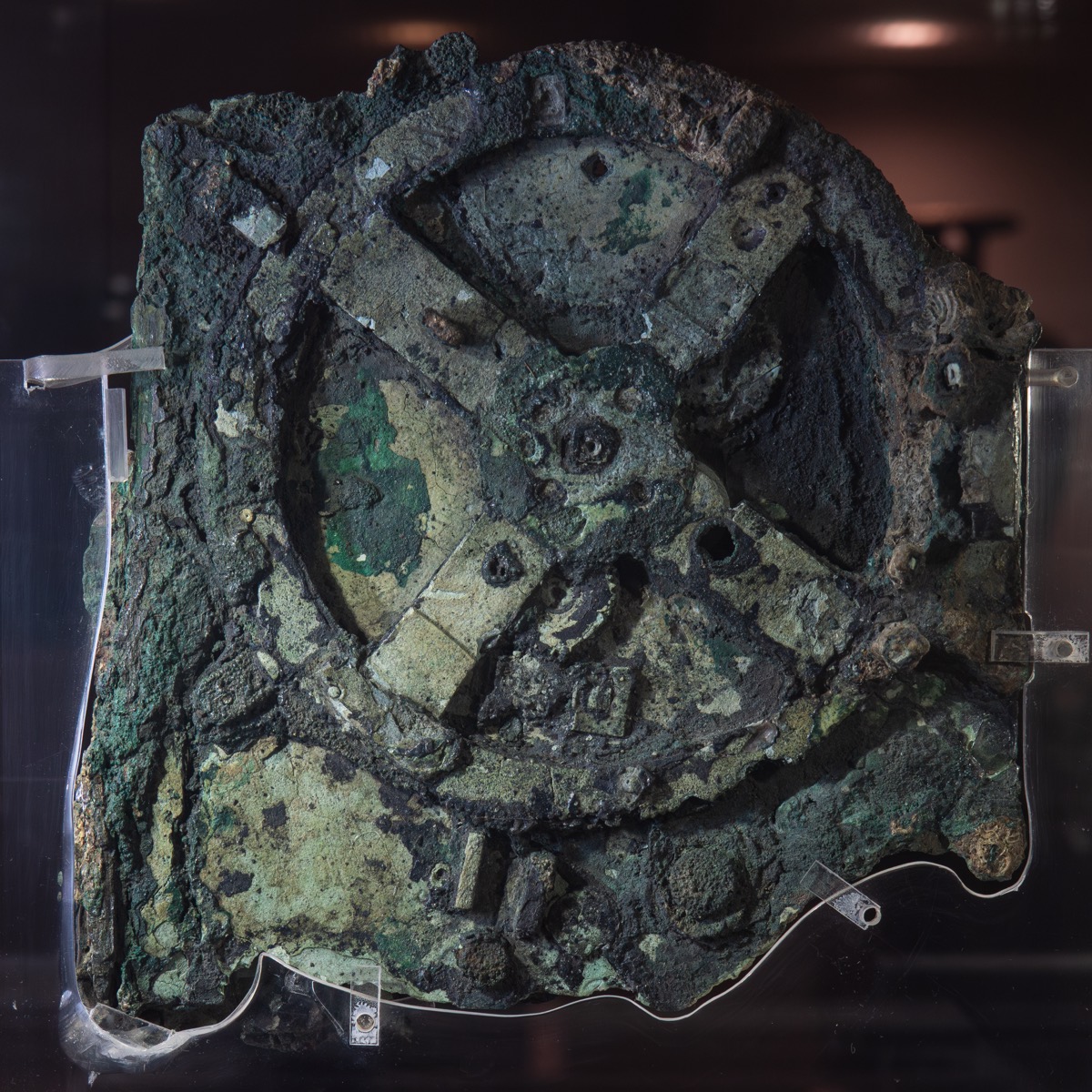
In nineteen hundred, sponge divers sheltering from a storm off the tiny island of found a wreck full of Greek treasures. One recovered lump, about the size of a large dictionary, drew no attention beside the marble sculptures. Months later, in Athens, it broke apart. Inside were bronze gearwheels the size of coins. What is it?
A geared astronomical calculating machine. Gears of that precision were not supposed to exist anywhere for centuries after the wreck, which is dated to between sixty and seventy BCE, though other evidence points to a build around two hundred BCE. The device tracked the positions of the sun and moon and predicted where the planets would sit along the . The original mass has since split into eighty-two fragments.
The diver Elias Stadiatis came up shaking and talking about a heap of dead naked people. They were marble sculptures on the seafloor, scattered through the most significant ancient wreck found up to that point, off the island of Antikythera. The corroded lump that mattered most was set aside until it split open in the National Archaeological Museum in Athens and showed bronze gearwheels the size of coins.
Nothing in the historical record allowed that. Gears of such precision should not have appeared in Greece, or anywhere, until many centuries later, and the find generated huge controversy. The wreck dates to between sixty and seventy BCE; other evidence suggests the mechanism itself may have been made around two hundred BCE. Over the decades the original mass has broken into eighty-two fragments.
Its job was prediction. Greek astronomers watched the sky from a geocentric position and had to account for the wanderers, the planets, which move forward against the stars, stop, reverse, stop again and resume. Much of the design draws on Babylonian work: the nineteen-year of the moon, a Greek refinement of it, and the for eclipses all appear in the numbers inscribed on the fragments.
Albert Rehm was the first to read it as a calculating machine, between nineteen oh five and nineteen oh six. Derek de Solla Price and the radiologist Charalambos Karakalos then obtained x-ray scans in the early nineteen seventies and found thirty distinct gears, twenty-seven in the largest fragment alone. The scans were flat and the tooth counts partly guessed, yet Price could still trace a gear train computing the average position of the moon along the ecliptic. A paper by Cicero describes a machine of Archimedes that sounds very like this one.
wat. Twenty-one centuries ago somebody cut bronze teeth fine enough to predict a planet, and we lost the knack for over a thousand years.
wat wat
The device sits a long way ahead of anything the historical record allows, which makes it less an isolated marvel than evidence that a whole tradition of Greek precision engineering has been lost.
How do we know?
Tony Freeth, writing in Scientific American, describes more than a century of work on the mechanism. That includes the x-ray scans of the nineteen seventies and his own group’s two thousand twenty-one analysis of the front gearing.
What is still unknown
The fragments are corroded and incomplete, so many tooth counts are inferred rather than counted. Parts of the front gearing remain unresolved, and the two thousand twenty-one account is a proposal rather than a reading.
Learn something?
Where to next
 Why did the calendar lose ten days at once?astronomy
 What is pulling the Milky Way, and why can we not see it?astronomy
 What shape did a Greek baby bottle take?ancient greece