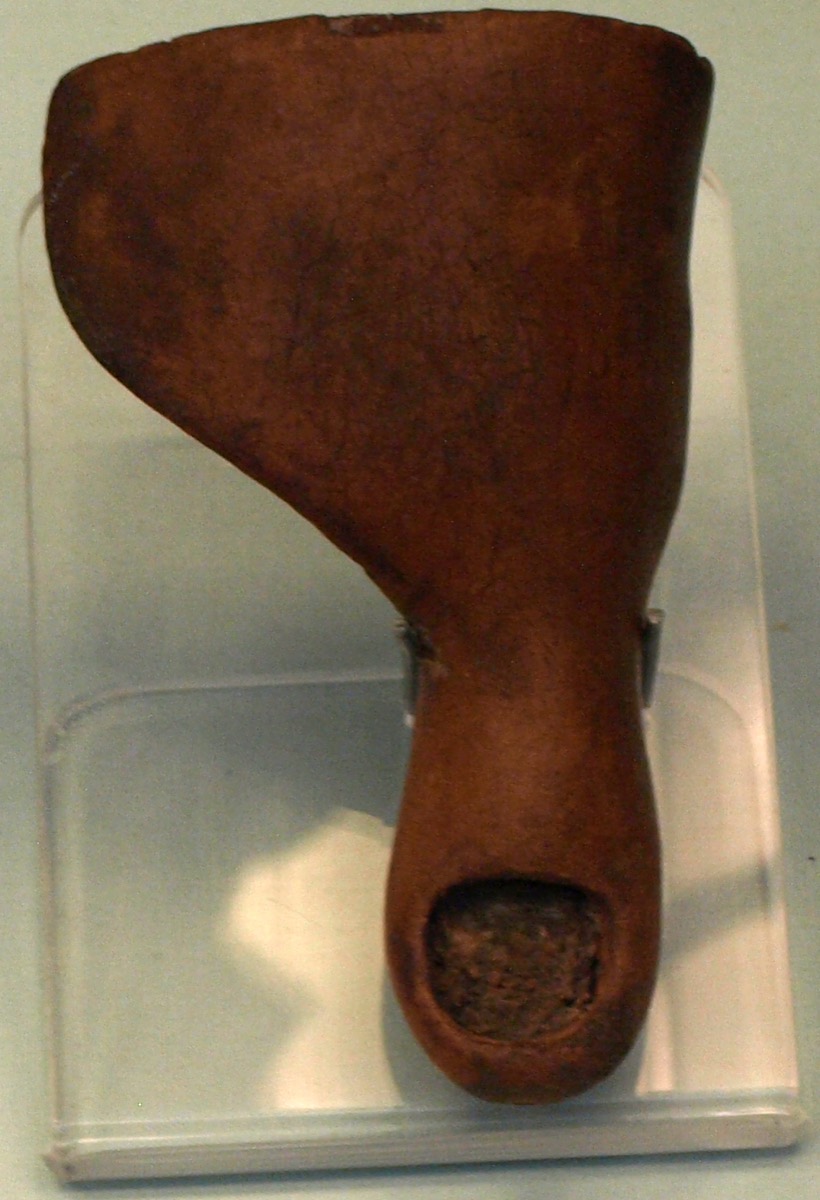
The British Museum holds an artificial big toe for the right foot, made from and dated to before six hundred BC, with distinct signs of wear. The Egyptian Museum in Cairo holds a second, found strapped to the right foot of a female mummy and made in three laced sections. It dates between nine hundred and fifty and seven hundred and ten BC. Wear suggests use. How would you test that?
Build replicas and walk in them. Finch and colleagues made copies of both and fitted them to two volunteers missing the big toe at the first joint, then ran computerized gait analysis against each volunteer’s own sound side. Both replicas gave satisfactory relative , reaching eighty-seven percent of the normal average range for one volunteer when worn with an Egyptian-style sandal.
Two objects are at issue. In the British Museum is an exquisitely crafted artificial big toe for the right foot, made from cartonnage and dated to before six hundred BC. Distinct signs of wear led one researcher to call it among the earliest working prostheses identified from the ancient world. In Cairo is a second, found strapped onto the right foot of a female mummy and built in three pieces joined by a complex series of laces. Dated between nine hundred and fifty and seven hundred and ten BC, it may be the oldest known limb prosthesis in existence.
Wear marks are suggestive and not decisive, so the researchers assessed function directly. They made design replicas of both and recruited two volunteers with complete disarticulation at the first metatarsophalangeal joint of the right foot. Computerized gait analysis then compared selected parameters against each volunteer’s own sound left side as a control.
The kinematic results were encouraging. Both replicas produced a very satisfactory level of relative dorsiflexion, especially for the first volunteer, who reached eighty-seven percent of the normal average range when wearing the prosthesis with an Egyptian-style sandal. Kinetic data showed no significant increase in between the affected and sound sides, with or without a sandal.
The sandal turned out to matter. When the volunteers wore sandals without the toe prosthesis, significant differences in peak pressures appeared, which indicates a real benefit to wearing the devices with Egyptian footwear. Both volunteers reported the three-part wooden replacement as the more comfortable of the two. The authors conclude that nascent prosthetic science was perhaps emerging in the Nile Valley as early as nine hundred and fifty to seven hundred and ten BC.
wat. Nobody could walk in the originals, so they built copies and measured two people walking in those.
wat wat
If these worked, prosthetic science was already beginning in the Nile Valley around a thousand years before the devices usually credited as the first.
How do we know?
Finch, Heath, David and Kulkarni made design replicas of both artifacts and assessed them on two volunteers with complete disarticulation at the first metatarsophalangeal joint, recording kinematic and kinetic data over ten trials each.
What is still unknown
Two volunteers wearing modern replicas, not the originals. The conclusion is that both devices could have afforded at least limited walking, which is weaker than saying either actually did.
Learn something?
Where to next
 What were ancient Egyptians doing when they played senet?egypt
 Why did Howard Carter wait five years to dig the most promising spot he had?egypt
 How do you find a color that has worn away?egypt