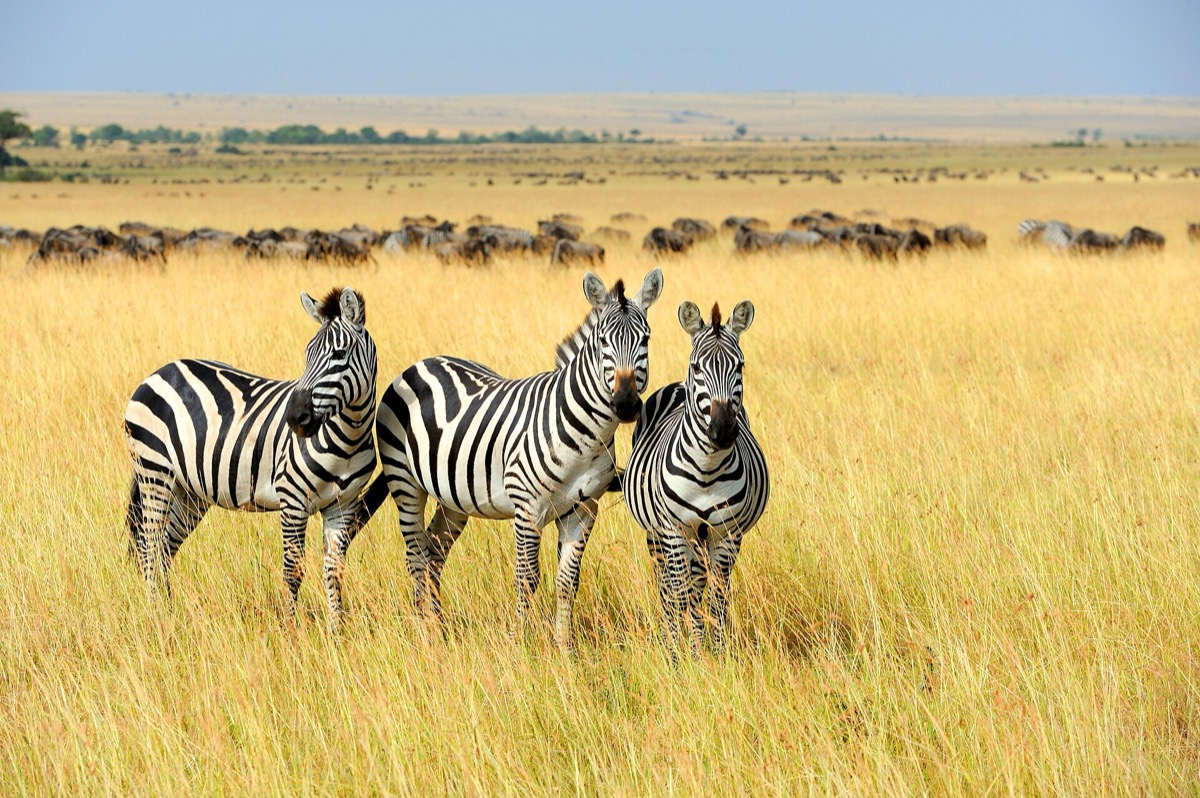
Repelling biting flies is the best-supported account of why zebra is striped, and the effect itself is solid. The mechanism is not, and most of the candidates assume the fly is put off at a distance. Tombak and colleagues released hungry flies in an enclosure with real pelts, zebra against plain tan impala, and counted the landings. At what range does the pattern work?
Up close, and the width of the bands does not matter. The flies strongly preferred to land on uniform tan impala pelts over striped zebra pelts, which holds the repellent effect up under field conditions. But they showed no preference between the zebra species with the widest stripes and the one with the narrowest. Whatever stripes do, they do it on the final approach.
Of the explanations offered for zebra stripes, camouflage and heat and social signalling among them, the one that keeps surviving tests is biting flies. Striped surfaces get landed on less. Why that should be has stayed open for decades, and the list of proposed mechanisms is long.
Most of them assume the fly is deceived from some way off, which puts the action at a distance. Tombak and colleagues took the opposite tack. In a Kenyan savannah they ran , releasing hungry Stomoxys flies into an enclosure holding real pelts rather than painted boards, and counted which surface the flies settled on.
Zebra pelt against uniform tan impala pelt was no contest, and the flies went for the impala. That holds the effect up under conditions much closer to the real thing than a striped drum in a laboratory, and it holds it up over a span of a few meters.
The second comparison is the one that cuts. Set the zebra species with the widest stripes against the one with the narrowest, and the flies had no preference at all. If band width makes no difference to a fly, then the variation in stripe width across zebra species is answering to some other , and the pattern only has to work close in.
wat. The pattern earns its keep at the moment of landing, not from across the savannah, and the width of a band turns out to be somebody else’s business.
wat wat
It clears out a crowded field of hypotheses in a single experiment: anything that needs distance to work can be set aside, which leaves the moment of landing.
How do we know?
Tombak and colleagues released hungry Stomoxys flies into enclosures in a Kenyan savannah holding paired pelts, zebra against impala and wide-striped zebra against narrow, and recorded where they landed.
What is still unknown
Pelts on a frame are not living animals, one fly genus was tested, and counting landings inside an enclosure says nothing about what a fly does across open ground.
Learn something?
Where to next
 Why do cicadas come out every 13 or 17 years exactly?evolution
 How does a small beetle fire liquid at boiling point?insects
 Do the black and white stripes really cool a zebra down?stripes