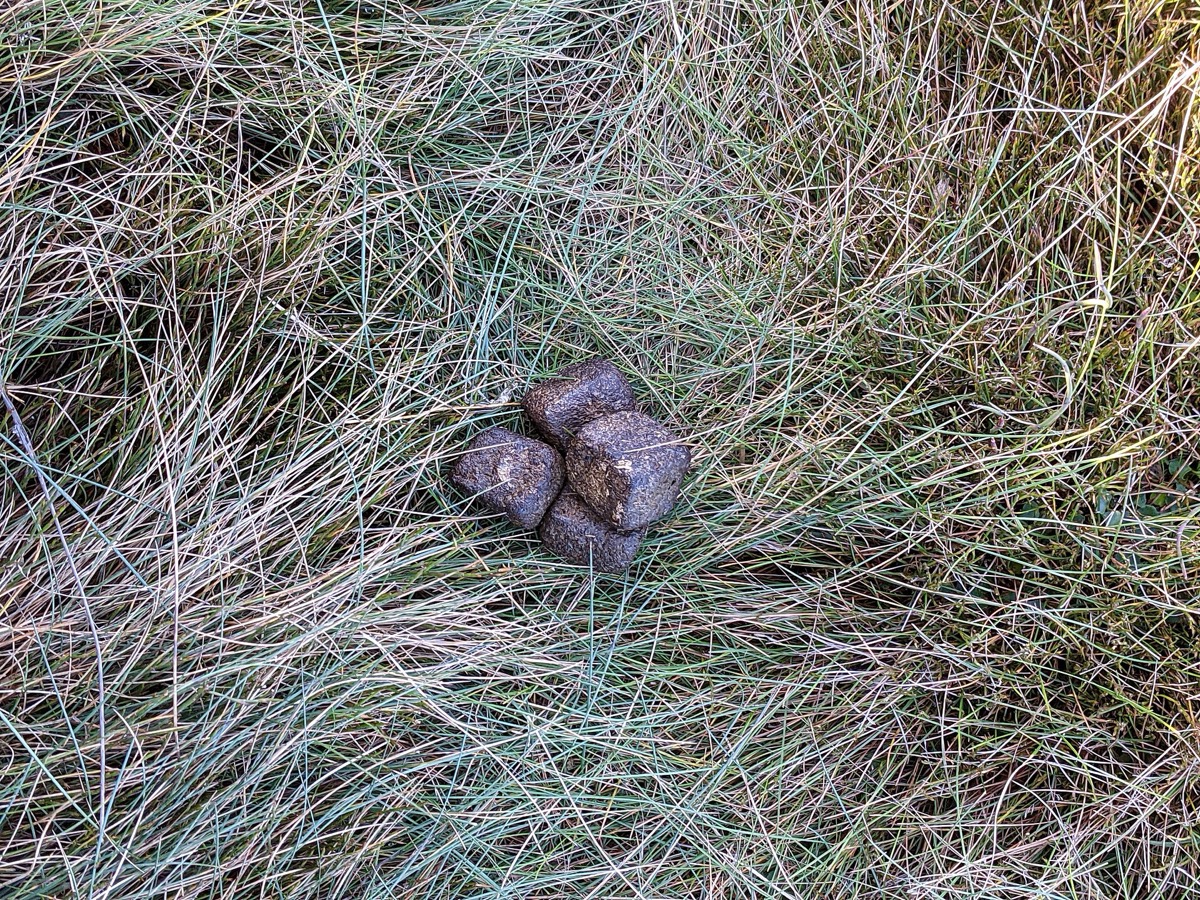
The is a burrowing Australian marsupial, renowned for leaving cubes. Nothing about a gut suggests cubes. It is soft, it is wet, and everything in it is pushed along by muscle contraction, which is a terrible way to make a corner. Yang and colleagues dissected wombats and then built a model. Where does the shape come from?
From a gut that is stiffer in some places than others. Dissection showed cubes forming within the last part of the intestine. Histology and found cross-sections with regions twice as thick and four times as stiff as their neighbors. When such a ring contracts, the stiff parts pull in faster and the soft centers lag, and that difference is what puts corners on the contents.
A cube is an odd thing for a body to produce. The bare-nosed wombat manages it, and the mechanism had stayed obscure, because the organ responsible is a soft intestine working in a highly environment where sharp features should smooth out rather than form.
Dissection localized the step. Cubes take shape within the last seventeen percent of the intestine, so whatever does it is happening late. Histology and tensile testing of the cross-section then found the asymmetry: certain regions of the wall are about twice as thick and about four times as stiff as the rest.
The model does the explaining. The authors simulated a series of azimuthal contractions of a damped elastic ring built from alternating stiff and soft regions. A greater stiffness ratio and a higher Reynolds number produce shapes closer to square. Corners arise because the stiff regions contract faster while the centers of the soft regions move relatively slowly.
The work took the Physics Prize, for studying how, and why, wombats make cube-shaped poo. It was shared between Patricia Yang, Alexander Lee, Miles Chan, Alynn Martin, Ashley Edwards, Scott Carver and David Hu. The authors themselves point at applications in manufacturing, clinical pathology and digestive health, which is the usual shape of an Ig Nobel: a silly question with a transferable answer.
wat. No mold and no press. Just a tube that squeezes harder in some places than others, over and over.
wat wat
A shape usually read as evidence of a mold turns out to come from uneven stiffness in a soft tube, which is a mechanism worth knowing wherever soft tissue shapes a solid.
How do we know?
Yang and colleagues combined wombat dissections, histology and tensile testing of intestinal tissue with a mathematical model simulating repeated contractions of a damped elastic ring made of alternating stiff and soft regions.
What is still unknown
The corner-forming step is shown in a simulation of an elastic ring rather than watched happening inside a live animal. The authors offer the stiffness pattern as a hypothesis that the model then supports.
Learn something?
Where to next
 Is there anything a beard is good for in a fight?biomechanics
 How does a small beetle fire liquid at boiling point?biomechanics
 How does a shrimp break a shell underwater?biomechanics