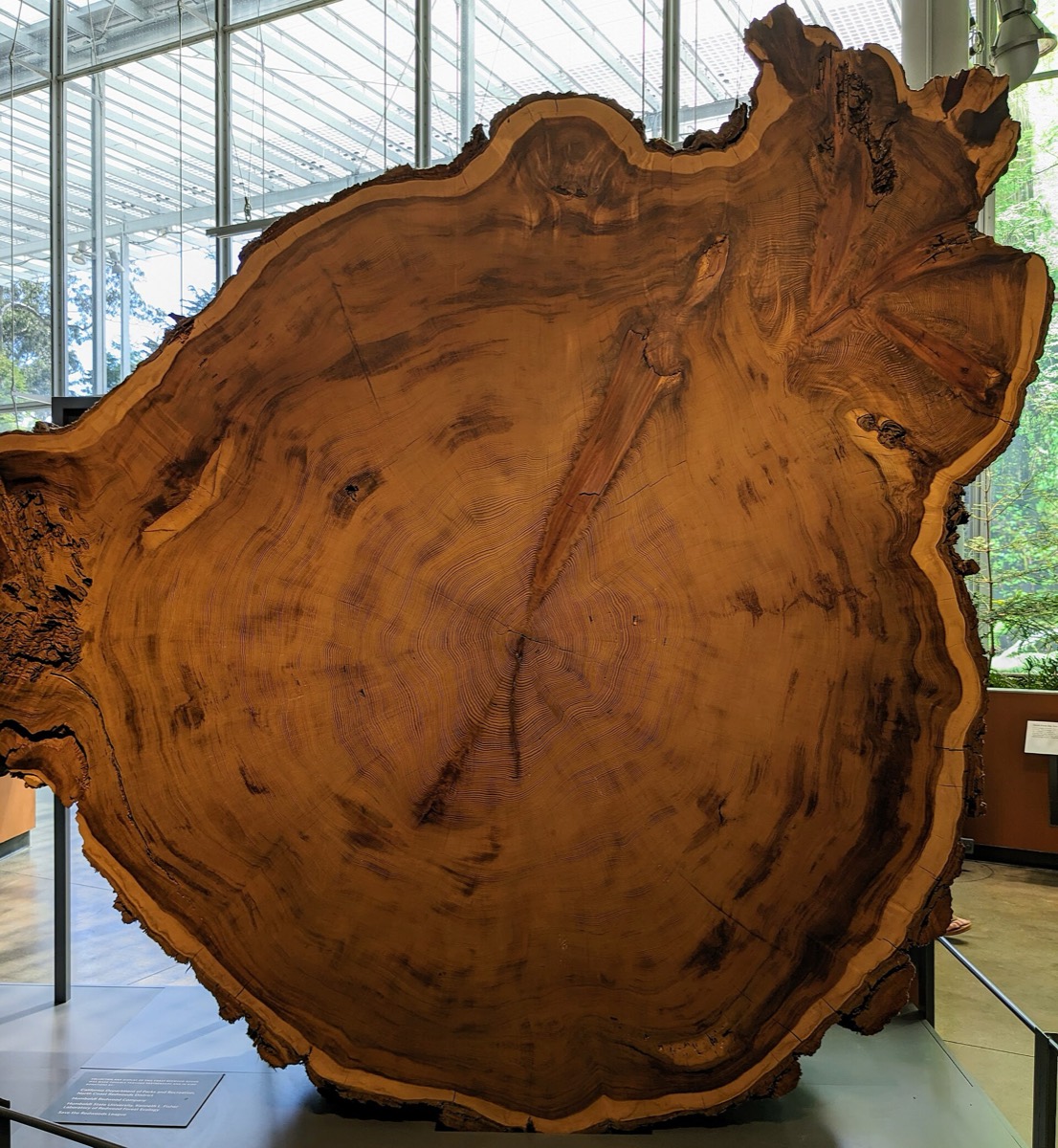
Most radioactive dating methods measure a daughter product and get an absolute age out of it. Radiocarbon cannot. The nitrogen produced by carbon-14 decay is not captured in most materials, and even if it were it would be swamped by the nitrogen everywhere else. So a radiocarbon measurement gives a number that is not yet a calendar age. What has to happen to it?
It has to be calibrated against something independently dated. Atmospheric carbon-14 concentration has fluctuated, so measurements are converted to calendar equivalents using a curve built from archives dated some other way. IntCal20 runs as a fully atmospheric record from tree rings back to about thirteen thousand nine hundred . Beyond that it integrates floating tree-ring chronologies, lake and marine sediments, and corals out to fifty-five thousand.
In most radioactive isotope systems a daughter product can be measured, so an absolute age falls out of the ratio. Radiocarbon is different, because the nitrogen produced by its decay is not captured in most materials, and even if it were, it would be lost among the nitrogen that pervades the Earth system itself. Calibration against measurements from known-age material is therefore not a refinement but a requirement.
What a corrects for is the atmosphere itself. The concentration of radiocarbon in the air has fluctuated over time, so the same measured activity means different calendar dates depending on when the organism actually died. These curves are built from independently dated archives, and they invariably require revision as new data arrive.
IntCal20 extends the Northern Hemisphere curve to fifty-five thousand cal BP. Back to about thirteen thousand nine hundred cal BP it is a fully atmospheric record from tree rings. Beyond that it statistically integrates floating tree-ring chronologies, lacustrine and marine sediments, speleothems and corals, with improved evaluation of each archive’s timescale and its offset from the atmosphere.
Two changes are worth noticing. New statistical methods refined the structure of the curves while keeping a robust treatment of uncertainty in the radiocarbon ages, the calendar ages and the corrections. And marine now come from a three-dimensional ocean circulation model rather than constant regional offsets, which means marine data are corrected according to where they came from. The authors discuss what that implies for archaeology and the geosciences, from the recent past back to the extinction of the Neanderthals.
wat. The laboratory gives you a measurement. Turning it into a year means consulting a curve that somebody is still rebuilding.
wat wat
Every radiocarbon date in archaeology is a translation, and the dictionary gets revised. Changing the curve quietly changes the calendar ages of everything that was dated against the old one.
How do we know?
Reimer and colleagues present the construction of the IntCal20 Northern Hemisphere calibration curve in the journal Radiocarbon, with the datasets, the statistical methods and the differences from the previous curve.
What is still unknown
The authors are explicit that calibration curves invariably require revision as new data arrive and understanding of the Earth system improves. IntCal20 replaced IntCal13, and will itself be replaced.
Learn something?
Where to next
 What pushed the arrival of people in America thousands of years back?radiocarbon
 Was pharaoh Ahmose’s great storm the eruption of Santorini?dating
 What did a scan that never touches the wall find in cave paintings?dating