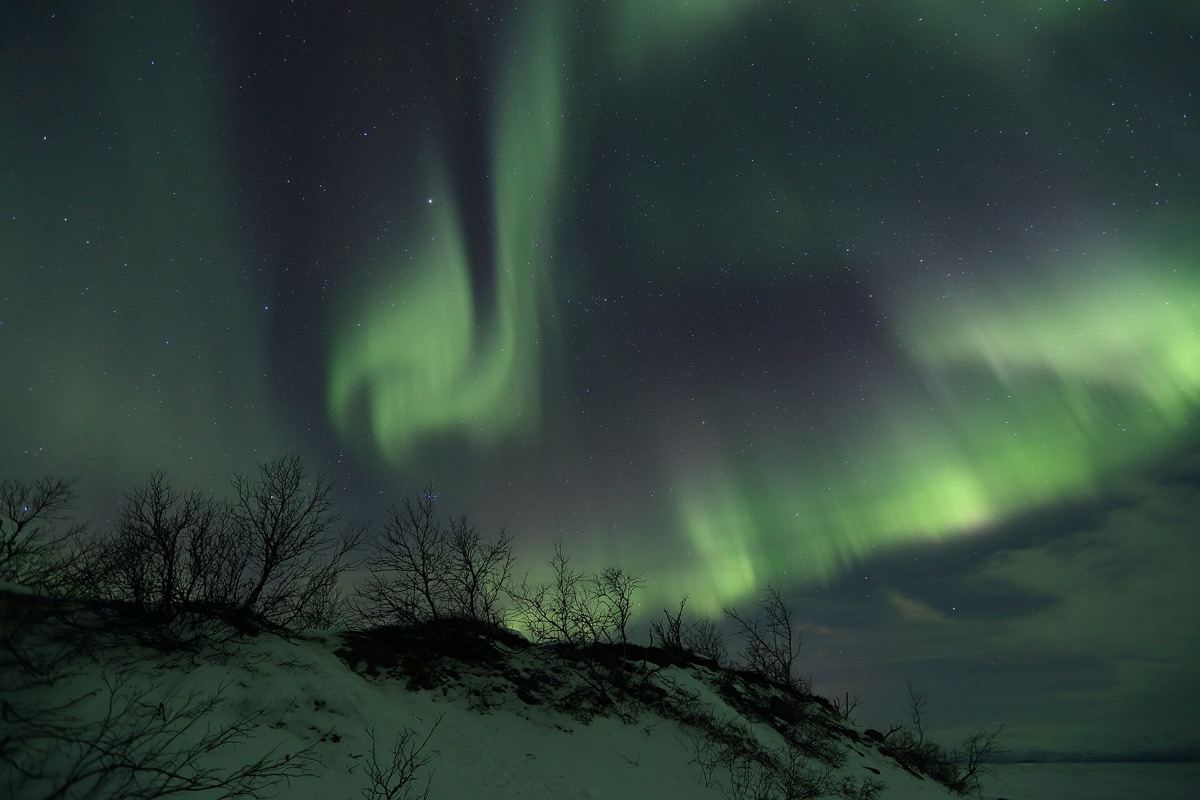
The Sun puts out a constant stream of charged particles called the , and the Earth’s deflects most of it well away from us. At the poles it does the opposite and funnels them in along the field lines. What happens when they reach the atmosphere?
They collide with atoms and hand over energy, and that lifts an electron to a higher level. Coming back down, the atom releases that energy as light of one particular color. Oxygen high up gives red, oxygen lower down gives green, and nitrogen gives the purples and blues. The light is made here, not sent from the Sun.
An aurora is not light arriving from the Sun. It is light made here, in our own atmosphere. What arrives from the Sun is energy in the form of charged particles, and the atmosphere is what turns it into light.
The way in runs through magnetism. The Earth’s magnetic field deflects most of the solar wind, but at the poles the field lines dive into the atmosphere, and particles travel down along them. That is why an aurora forms a ring around each pole rather than spreading evenly, and why in a strong storm the ring widens southward.
What happens at the meeting is atomic physics. The particle hands energy to an atom of gas, an electron jumps to a higher level, and on the way down a packet of light is released exactly the size of the gap. Because every gas offers its own gaps, the color reveals what was hit: oxygen high up gives red, oxygen lower down green, nitrogen the purples and blues.
Altitude decides as much as the gas. A more energetic particle penetrates deeper and excites lower layers, so color doubles as a measure of energy. And the practical side is not aesthetic: those same storms can disrupt satellites, navigation and power grids, which is why forecasts them like weather, and only a few days out.
wat. The green in an aurora comes from oxygen fairly low down, and the red from oxygen a great deal higher up.
wat wat
The same magnetic storms that make an aurora can disrupt satellites, satellite navigation and power grids, which is why a field called space weather forecasts them.
How do we know?
The colors match known wavelengths for energy transitions in oxygen and nitrogen, measured in the laboratory. Satellites measure the stream of particles arriving from the Sun at the same time.
What is still unknown
How bright an aurora is and where it appears depend on solar activity, and that cannot be forecast accurately more than a few days ahead.
Learn something?
Where to next
 Why does the storm at Saturn’s pole have six nearly straight sides?atmosphere
 What wraps a planet whose day side is permanently molten?atmosphere
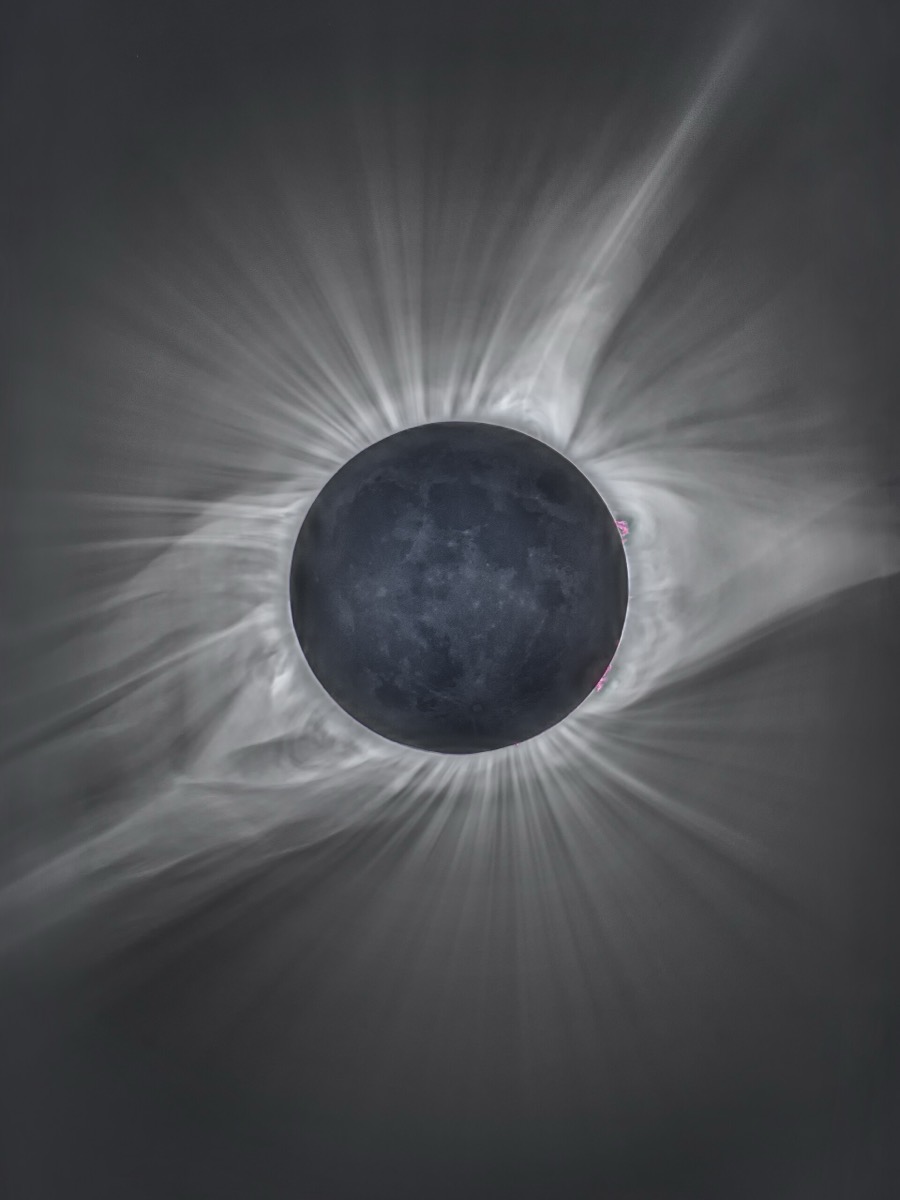 Why is the Sun’s atmosphere hotter than its surface?Sun