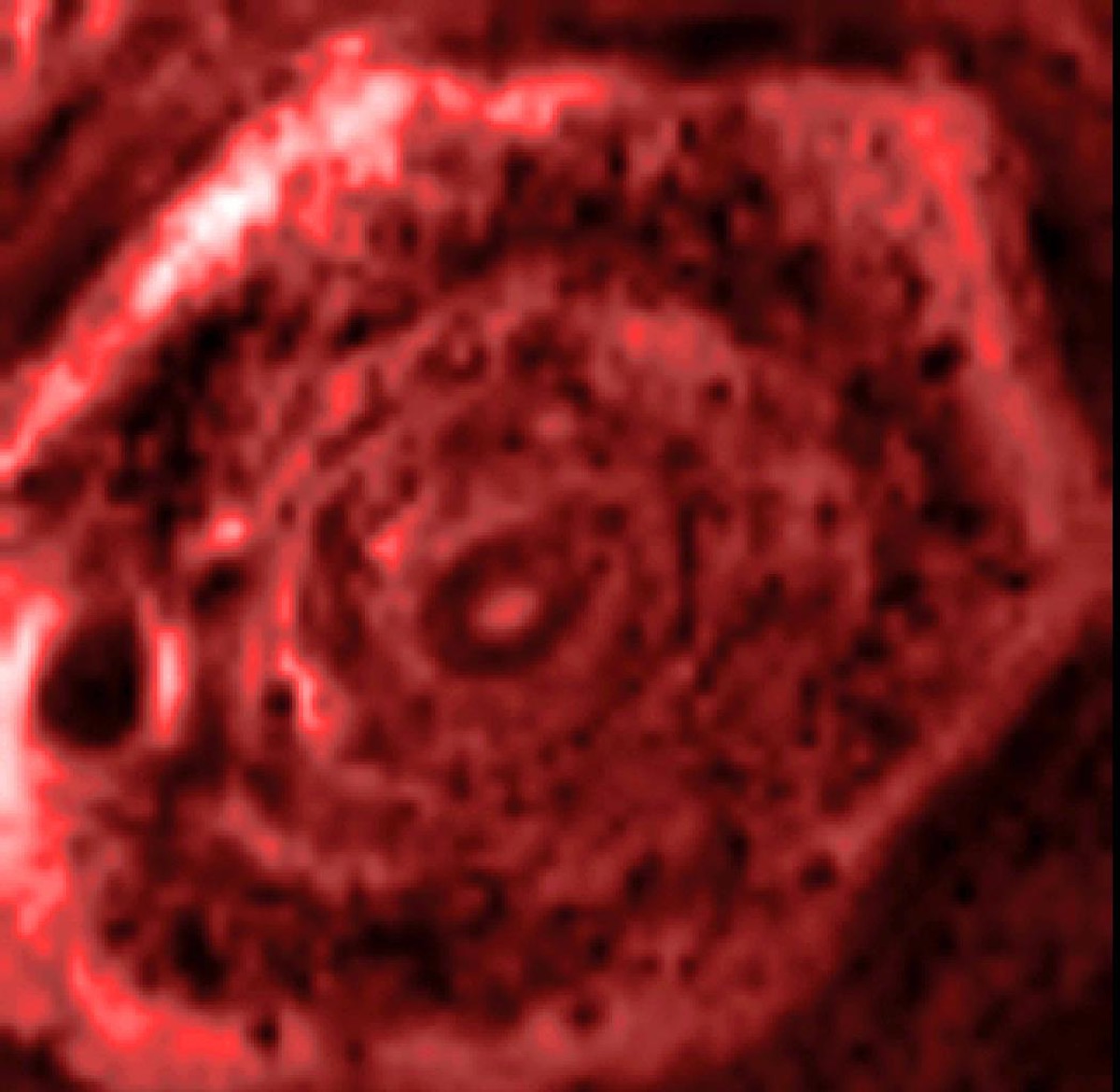
saw the same structure decades apart: Voyager found a nearly perfect hexagon around Saturn’s north pole back in the 1980s, and Cassini found it still there more than thirty years later. A geometric shape that stable in an atmosphere is a strange thing. What holds it?
A wave in a wind, not a wall. The hexagon is the path of a fast , and numerical simulations showed that an in a shallow jet can produce six stable meanders. The winds in the model affected both the shape and the speed at which the whole figure rotates.
A nearly perfect geometric shape at a planet’s pole looks like a structure, and it is the path of a fast jet stream.
What makes it a puzzle is its persistence. Voyager saw it in the 1980s, and Cassini found it still there more than thirty years later, which is a full Saturnian year and all of its seasons.
Numerical simulations showed that an instability in a shallow jet can produce six stable meanders. A stream going round a closed circle can hold only a whole number of waves along its length, so the number of sides is not arbitrary.
The depth of the stream turned out to be the decisive variable: it affects both the shape and the rotation speed, and a comparison with the speed measured in the images served as a test. Rotating fluids and gases produce orderly geometry this way with no solid template. The model reproduces the central features and does not prove this is the only mechanism.
wat. Saturn’s hexagon is a stable meander in a jet stream, not a structure with six walls.
wat wat
Rotating fluids and gases can produce orderly geometry with no solid template guiding them.
How do we know?
A numerical atmospheric model was compared with the shape, the winds and the speed of movement that the spacecraft images recorded.
What is still unknown
The model reproduces the central features, and it does not prove this is the only mechanism at work inside Saturn.
Learn something?
Where to next
 How long do Saturn’s rings have left?Saturn
 What is actually glowing when you see the northern lights?atmosphere
 What wraps a planet whose day side is permanently molten?atmosphere