
Songbirds hold a magnetic bearing to better than five degrees, which is the only reason an eleven thousand kilometer crossing works at all. The leading account puts the sensor in the eye, in light-sensitive proteins in the retina. But every simulation of it had produced a signal that changes gently with heading, nowhere near sharp enough. Hiscock and colleagues went back to the physics. What was missing?
Time. When the inside the molecule lasts longer than a few microseconds, the sensor output grows a sharp feature, which the authors call a . It comes from avoided crossings between quantum spin energy levels in the , and it is narrow enough to deliver a heading good to a few degrees. Earlier models had assumed the coherence died within about a microsecond.
Migratory birds carry a light-dependent magnetic compass whose primary receptors sit in the eyes, with the directional information handled in a small part of the forebrain. The evidence points to photo-induced radical pairs in cryptochrome flavoproteins in the retina, where levels of a signaling state depend on how the bird holds its head in the field.
The difficulty was never direction but precision. A bar-tailed godwit has been tracked flying from Alaska to New Zealand in a single nonstop crossing of eleven thousand kilometers, where an error of a few degrees is fatal. Experiments show migratory songbirds detecting the axis of the field lines to better than five degrees. Previous radical pair simulations gave only a weak, roughly sinusoidal dependence on heading.
Hiscock and colleagues simulated cryptochrome-inspired radical pairs with realistic multinuclear spin systems, and let the spin coherence live longer than a microsecond. Past that threshold the output develops a spike, arising from avoided crossings of the quantum spin energy levels of the radicals. The feature is sharp enough to deliver a heading precision that matches what birds achieve in the wild.
Three consequences follow. Evolution had room to tune the compass by tuning molecular structure and dynamics, since the spike depends on both. Weak electromagnetic noise of the kind humans generate could plausibly wreck a sensor that depends on coherence lasting microseconds, which would explain reports of disoriented migrants. And magnetoreception looks more like quantum biology than anyone had assumed.
wat. The needle is not iron and it is not in the beak. It is a pair of unpaired electrons in the eye, holding a note.
wat wat
If the compass needs coherence lasting microseconds, it is quantum mechanical in a strong sense, and it also becomes easy to spoil with weak electromagnetic noise at the wrong frequency.
How do we know?
Hiscock and colleagues ran coherent spin dynamics simulations on realistic multinuclear models of cryptochrome radical pairs, solving for how the reaction yield depends on the orientation of the molecule in a field of Earth strength.
What is still unknown
Simulation, not measurement. It shows that a cryptochrome-based sensor could in principle reach the precision birds display; it does not show that any bird’s cryptochrome actually holds coherence that long.
Learn something?
Where to next
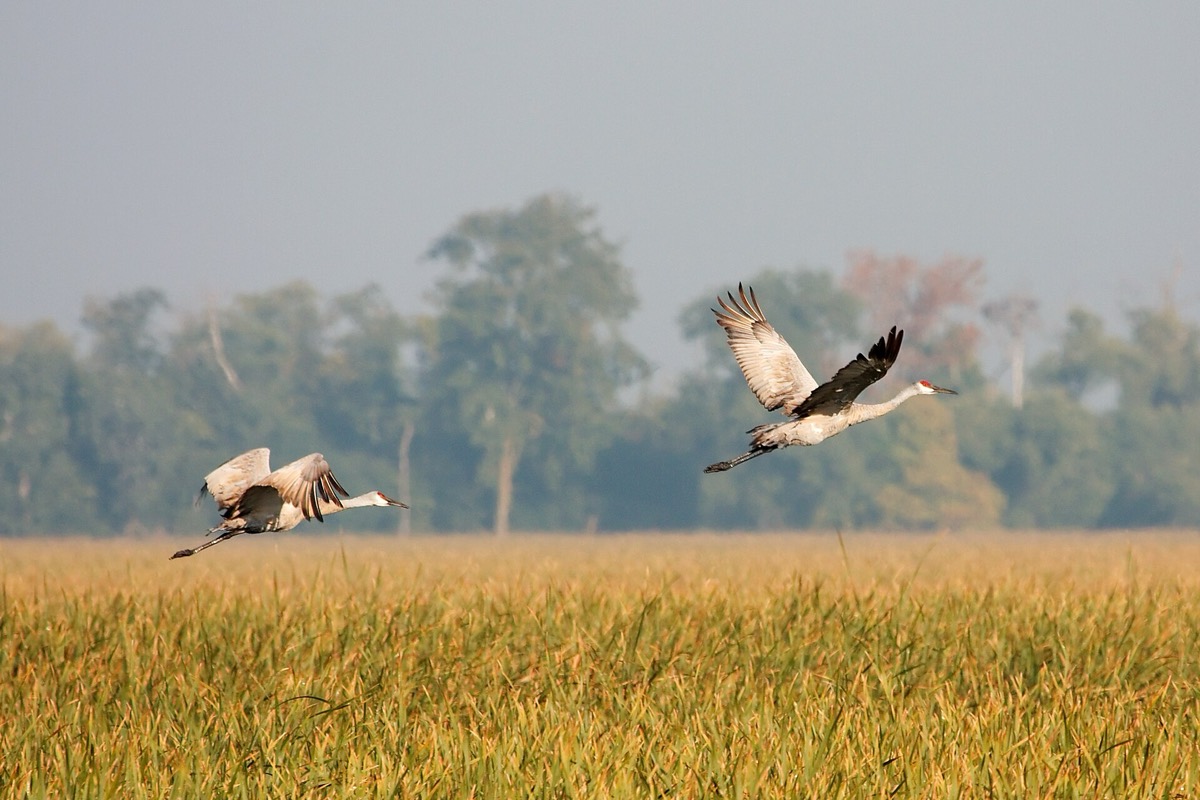 Do migrating birds actually see the magnetic field?migration
 Which bird travels between both poles every single year?migration
 What happened to the birds inside the two beams of light over Manhattan?birds