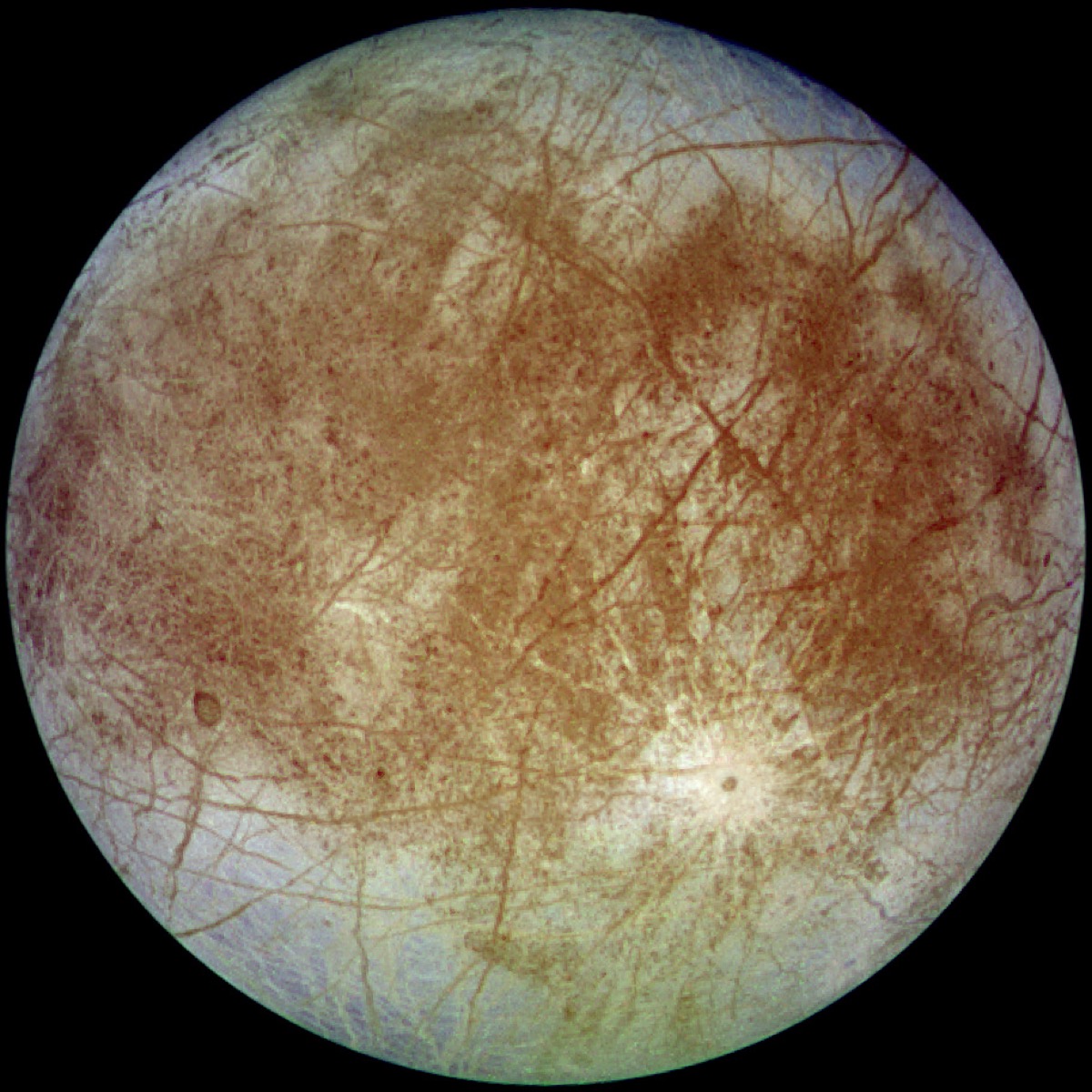
is a moon of Jupiter with an icy shell and a hidden ocean beneath it. Carbon dioxide has been identified on its surface, and it could have arrived from outside impacts just as easily as from within. How do you decide between the two?
By where it sits. Mapping with the James Webb telescope found the material especially concentrated in a region called , where the surface has been geologically resurfaced relatively recently. The researchers concluded that the source of the carbon is probably internal. The carbon dioxide may come from the ocean itself, or molecules rising from inside may have been altered on the ice by .
The question is not only whether there is carbon dioxide on Europa, but where it is. A broad, even spread would fit different stories than a concentration in terrain that has been geologically renewed.
with the Webb telescope found a high concentration of the material in Tara Regio. That region may expose material moving between the interior of the moon and the surface.
The authors read this as evidence of an internal carbon source, and propose the subsurface ocean as one possible origin. The alternative they leave open is carbon dioxide forming on the ice out of other materials that rose from the ocean.
The measurement does not reveal the composition of the whole ocean and identifies no biological activity. Future missions that approach the moon will be able to examine how the material moves and what lies under the ice.
wat. A patch of carbon dioxide on Europa’s ice may be an indirect window into the water below it.
wat wat
The composition of a surface may offer a clue to the chemistry of an ocean that is extremely hard to reach directly.
How do we know?
Spectral measurements from the Webb space telescope mapped the distribution of carbon dioxide across the surface of Europa.
What is still unknown
The mapping is not a direct sample of ocean water and is no evidence of life. The mechanism that forms the material at the surface also stays open.
Learn something?
Where to next
 What falls in Jupiter’s storms instead of ordinary hail?Jupiter
 What did Cassini find inside the ice grains fired out of a moon of Saturn?ocean
 What is left behind when a star swallows one of its own worlds?Webb telescope