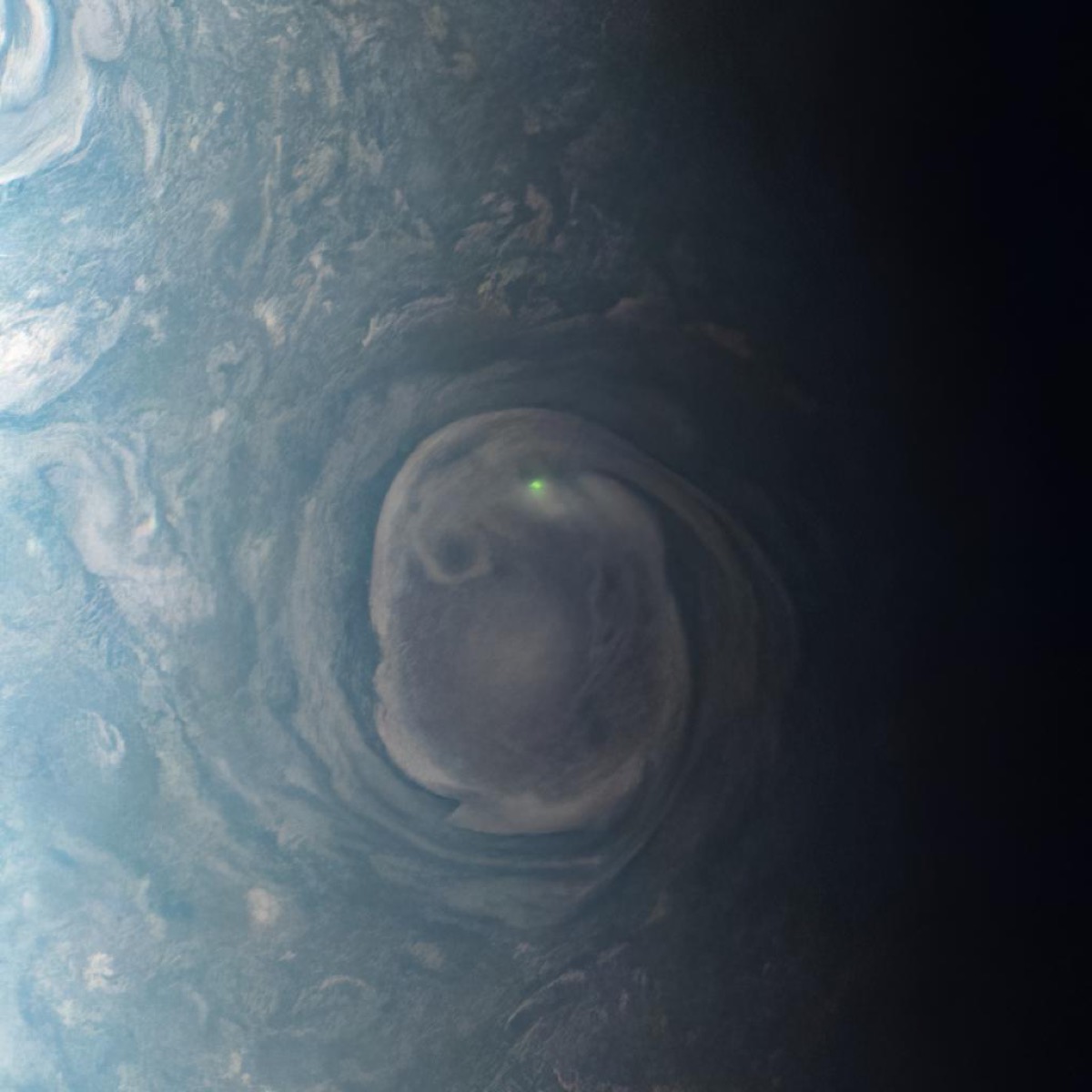
Juno’s revealed that ammonia is not spread evenly deep in Jupiter’s atmosphere, and in some layers it is simply missing. Something is carrying it downward. What falls there?
Soft, sticky hail. The proposed mechanism starts with storms lifting water ice crystals into a very cold region. and creates a liquid that glues crystals into . The balls sink, evaporate at a depth of 5 to 27 bar, and leave the layers above them poor in ammonia.
Microwave measurements, which penetrate below the cloud tops, revealed that ammonia is not spread evenly deep in Jupiter’s atmosphere. That is the puzzle demanding an explanation.
The proposed for it starts with storms lifting water ice crystals into a very cold region. There ammonia takes on the role of an antifreeze: it dissolves part of the ice and creates liquid at a temperature where everything ought to be frozen.
The liquid glues crystals together into hail-like balls, and the stickiness is what lets them grow large enough to sink rather than disperse.
They sink, evaporate at great depth, and leave the layers above them poor in ammonia, exactly as measured. Weather in a thin cloud layer moves material to enormous depth this way. The balls have never been photographed directly: this is a mechanism that fits the measurements and calls for further tests.
wat. In Jupiter’s storms, ammonia and water may turn into hail-like balls that sink tens of kilometers.
wat wat
Weather in a thin cloud layer can move material to enormous depth and change what a spacecraft measures.
How do we know?
A microphysical model was built to explain Juno’s measurements of ammonia, lightning and storms together.
What is still unknown
The ammonia balls have never been photographed directly; this is a physical mechanism that fits the measurements and needs further testing.
Learn something?
Where to next
 Where did the carbon dioxide on Europa come from?Jupiter