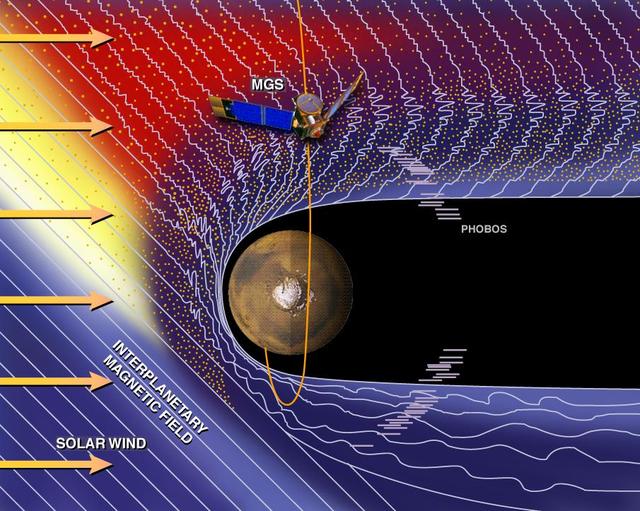
Comet tails point away from the Sun regardless of which way the comet is heading, and the Earth’s magnetosphere trails off in the same direction. Something is streaming outward past both of them, continuously, and it is not light. It comes off the Sun hot enough to escape the Sun’s own gravity. What is in it?
Charged particles, chiefly protons and electrons with some heavier nuclei. The high temperatures of the accelerate them to speeds that let them escape the Sun’s gravitational field. At the distance of the Earth, in a quiet period, the wind holds roughly one to ten protons per cubic centimeter moving outward at three hundred and fifty to seven hundred kilometers per second.
The solar wind is a flux of particles: chiefly protons and electrons, with nuclei of heavier elements in smaller numbers. What sends them on their way is heat. The high temperatures of the solar corona accelerate them to velocities large enough to escape the Sun’s gravitational field, which is a different mechanism from radiation pressure and gives a different result.
Its effects are visible from here. The solar wind creates the tail of the Earth’s magnetosphere and the tails of comets, both of which face away from the Sun whatever else is happening. At one during a relatively quiet period, the wind contains roughly one to ten protons per cubic centimeter. They move outward at three hundred and fifty to seven hundred kilometers per second, a positive ion flux of a hundred million to a billion ions per square centimeter per second. During solar flares the velocity, flux, plasma temperature and turbulence all increase substantially.
The Sun sends out . One is fast, uniform and steady, blowing at about eight hundred kilometers per second. The other is slow, gusty and sporadic at around half that speed. They originate at different places on the Sun and accelerate to their terminal velocities at different distances from it, and which of them dominates depends on where the eleven-year solar activity cycle has got to.
The wind ends a long way out. Where it meets the Earth’s magnetic field a shock wave forms, the nature of which is not fully understood. Spreading into an ever larger volume, its density and pressure fall until they are comparable with those of the interstellar medium, and at that boundary it slows. Voyager one and Voyager two measured the at about ninety-four and eighty-four astronomical units respectively.
wat. The Sun is slowly blowing itself away, and we live inside the draft.
wat wat
It is thin beyond any laboratory vacuum and still shapes the solar system. The tails of comets and the tail of our own magnetosphere are both made by it.
How do we know?
Britannica’s astronomy entry on the solar wind, which sets out its composition, its speeds and densities at the Earth’s distance, its two components, and where it finally stops.
What is still unknown
An encyclopedia entry. It gives the numbers for quiet conditions and notes that what happens when the wind meets the Earth’s magnetic field produces a shock wave whose nature is not fully understood.
Learn something?
Where to next
 How old is the sunlight falling on your face?sun
 Why does the bright spot beside the sun always sit in the same place?sun
 What makes the clouds on Neptune come and go?sun