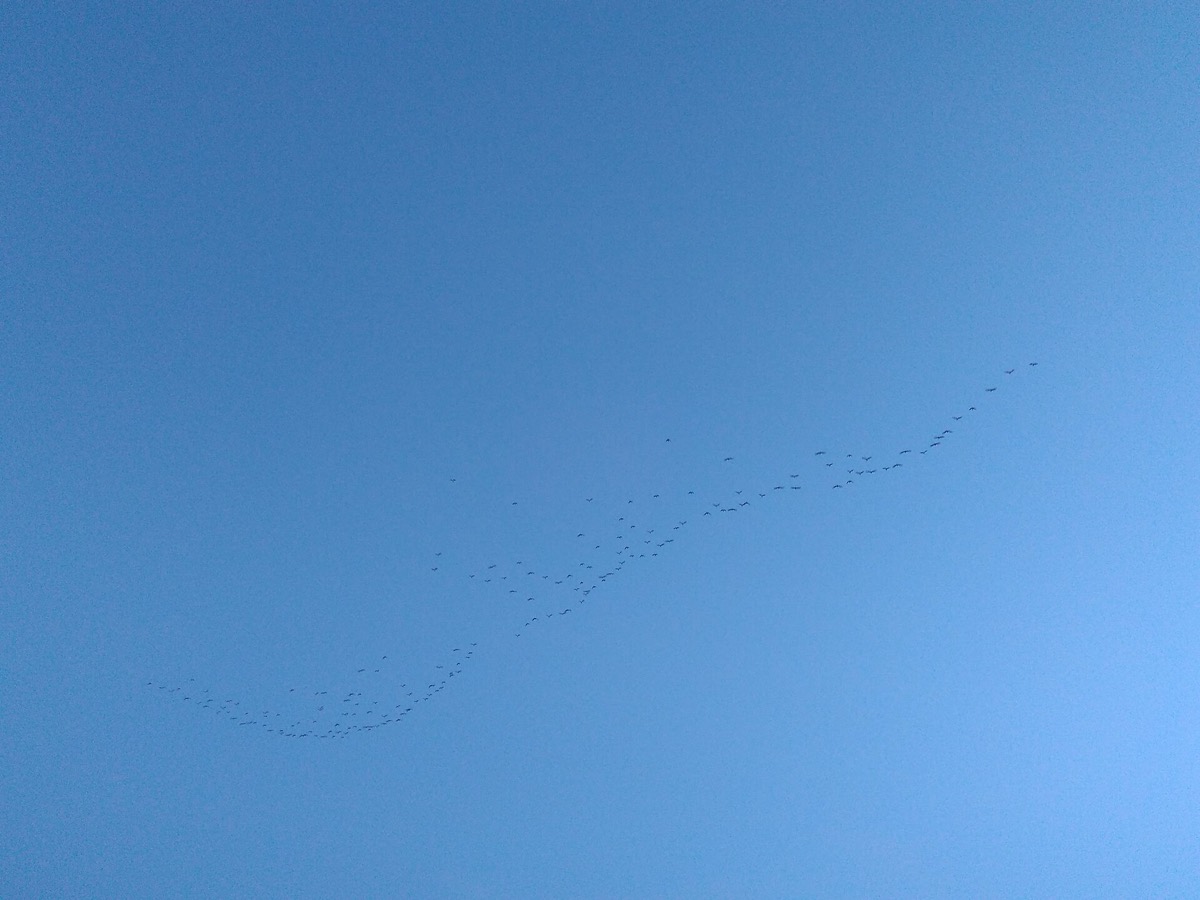
Nocturnal migrants crossing North America twice a year have to land somewhere to refuel, and where they land matters more than where they fly. Mapping those across a continent has been out of reach until recently. Horton and colleagues built seasonal maps of stopover density for the contiguous United States out of more than ten million observations. What predicts them?
Artificial light at night. emerged as a highly influential predictor in more than seventy percent of the models, and consistently a positive one: more light overhead goes with more birds coming down. That reads less like a benefit than a lure. Illuminated areas around the edges of cities may be acting as at continental scale, raising mortality among birds that stop there.
Billions of nocturnal migrants cross North America twice a year, and the airspace is the easy part. What they need on the ground is somewhere to restore energy reserves, so finding the stopover locations and working out why birds use them is a practical conservation question.
Horton and colleagues assembled more than ten million remote sensing observations into seasonal layers of migrant stopover density covering the contiguous United States. That turns a scattering of local studies into a continental picture that can be modeled against landscape variables.
Skyglow came out as a highly influential predictor in over seventy percent of the models, and the relationship was consistently positive. More artificial glow in the night sky above a place meant more migrants stopping there.
A positive association is not good news here. Birds are being drawn to peri-urban illuminated areas, which offer little food and plenty of hazards, so the attraction may function as one of those ecological traps operating at macroscale. The authors treat it as an expanding threat, which is also the point at which the finding becomes useful: unlike most drivers of habitat loss, this one has a switch.
wat. The glow above a city pulls migrating birds down into the one landscape least able to feed them.
wat wat
Light is the rare driver of habitat loss that can be switched off, so a predictor this strong is also a lever.
How do we know?
Horton and colleagues used over ten million remote sensing observations to build seasonal layers of migrant stopover density across the contiguous United States, then modeled which landscape variables predict them.
What is still unknown
The models identify association across a continent, not what any individual bird did or whether it survived. Calling peri-urban light an ecological trap is an interpretation the data support rather than settle.
Learn something?
Where to next
 Do migrating birds actually see the magnetic field?migration
 Which bird travels between both poles every single year?migration
 What happened to the birds inside the two beams of light over Manhattan?birds