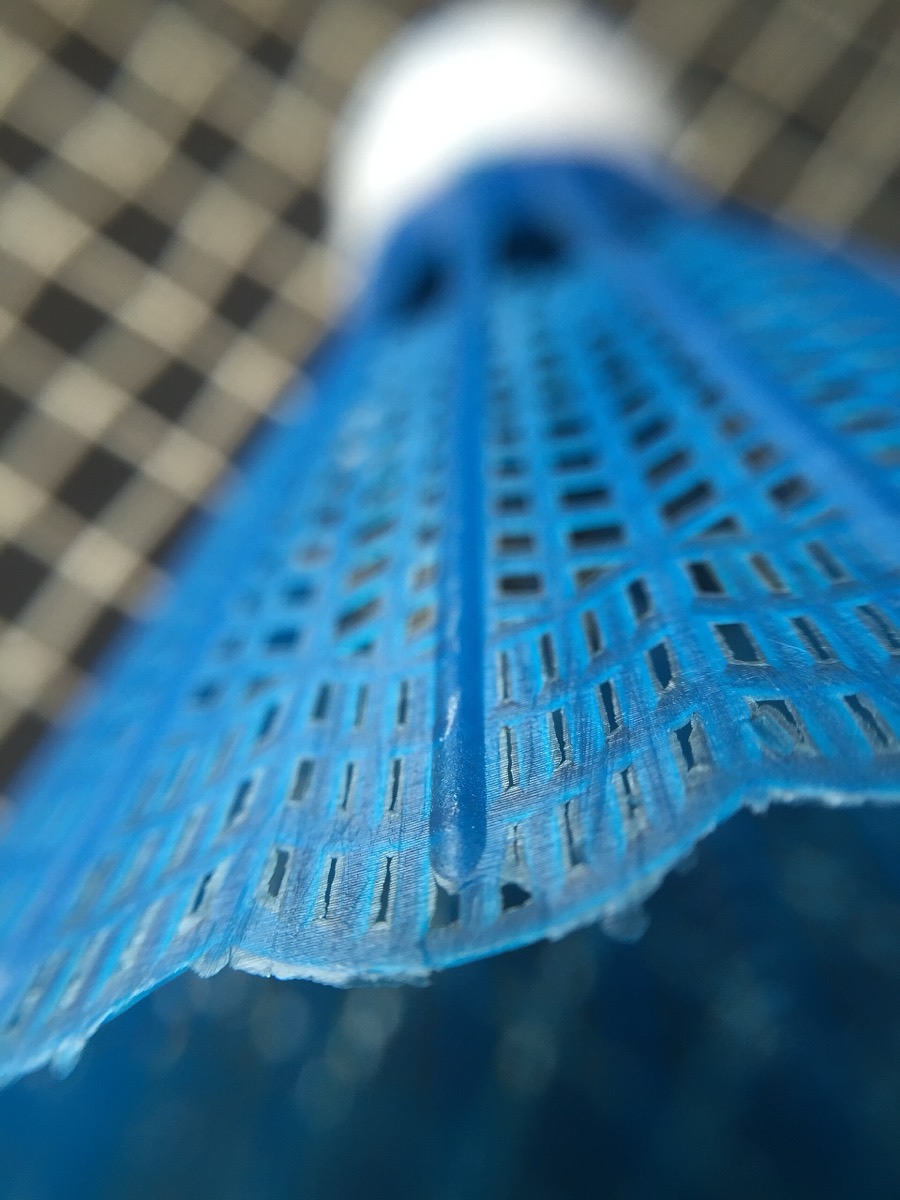
It halves its speed every 3.35 meters. Filming elite and international players with high-speed cameras on a badminton court, researchers found that feather shuttlecock trajectories show an in velocity and an exponential rise in time of flight with distance. Initial speeds can exceed five hundred kilometers an hour, and almost none of that survives the length of a court.
The decay matches the equation of motion for a projectile subject to , which is what a shuttlecock is built to be. The exact halving distance depends on the physical parameters of the shuttlecock, captured in what the authors call a . Spin matters too: the slice shots of left-handed players, or reverse slices from right-handers, slow the shuttlecock further.
A badminton smash leaves the racket faster than any other shot in sport, and then it stops behaving like anything else in sport. The authors analyzed high-speed video of smash and slice shots by elite and international players. Feather shuttlecock trajectories show an exponential decay in velocity, and an exponential increase in time of flight with distance.
Those are the fingerprints of high drag, and the measured trajectories agree with the equation of motion of a shuttlecock subjected to it. The numbers make the effect concrete. An initial speed that can exceed five hundred kilometers an hour is reduced by half every 3.35 meters, with the exact distance depending on the physical parameters of the shuttlecock, summarized in a speed index.
The material matters as much as the shot. The videos show that , which are more resistant than feather ones, deform at high speeds. Deformation changes their drag coefficient, which falls as speed rises, and that is what makes them unsuitable for high-level play: the projectile stops obeying the same law when struck hard.
Spin adds a further effect. The study shows that the spin induced by the slice shots of left-handed players, or the reverse slice shots of right-handed players, slows the shuttlecock down. One caution about the headline figure: the halving distance is a property of the shuttlecocks tested rather than a universal constant, and the measurements come from court video of a particular group of players.
wat. Leaves the racket at over five hundred kilometers an hour, and halves that every three and a bit meters.
wat wat
No other projectile sport works like this. A ball keeps most of its speed across a pitch, while a shuttlecock is engineered to throw its speed away, which is why the court can be so short.
How do we know?
High-speed cameras recorded smash and slice shots by elite and international players on a badminton court, and the resulting video was analyzed for velocity decay and time of flight against distance.
What is still unknown
Measurements from court video of a particular set of players and shuttlecocks. The authors tie the halving distance to the shuttlecock’s own parameters, so it is a figure for the ones tested rather than a constant.
Learn something?
Where to next
 How much time does a marathon runner save by staying inside a pack?aerodynamics
 How little air does a rider buried inside the bunch actually feel?aerodynamics