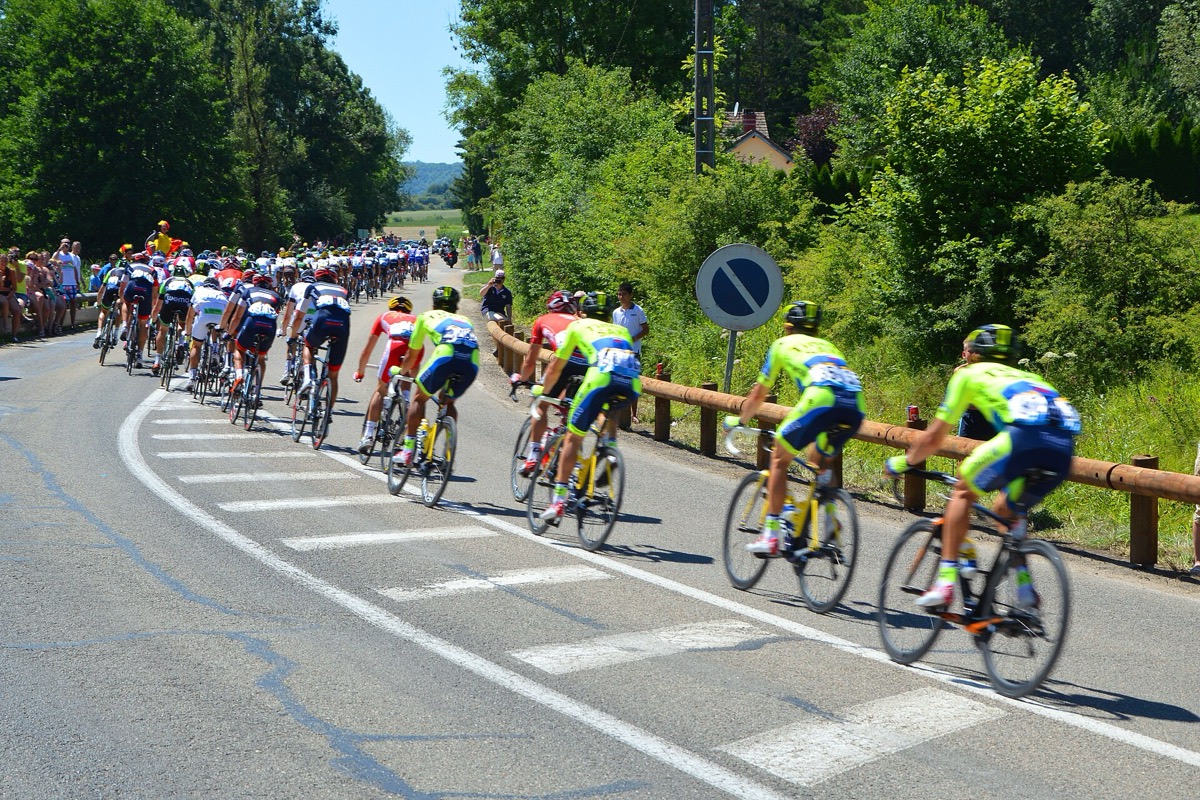
Every rider knows that sitting on a wheel saves air, and studies of small lines of riders had put the saving at somewhere between 30 and 50 percent of an isolated rider. A real bunch is nothing like a small line, since shelter arrives from several rows and from the sides. So researchers simulated two of 121 cyclists. What is left in the middle?
Between 5 and 10 percent. Deep inside the bunch the on a rider falls to a tenth or a twentieth of what an isolated rider meets at the same speed. The authors translate that into an equivalent speed 4.5 to 3.2 times lower. Every rider in the peloton experiences less drag than a lone rider does, and the sheltered positions are a different sport from the front.
Drafting experiments on small groups, riders in a single line, found a rider behind meeting roughly half to seven tenths of the drag of a rider alone. Those numbers then got applied to pelotons, which is where the trouble starts, because a peloton is not a line.
A real bunch shelters a rider from in front, from the sides and partly from behind, with several rows contributing. To find out what that adds up to, the team ran a of two pelotons of 121 cyclists, with cells 20 micrometers across against each rider.
In the middle and rear of the bunch, drag came out at 5 to 10 percent of an isolated rider at the same speed. The authors give the more intuitive version: it is like riding at a speed 4.5 to 3.2 times lower.
The result is validated rather than asserted, since four wind tunnel tests were run against the simulations, one of them with models of the riders. What it does not say is that drops by the same factor, since rolling resistance, climbs and constant accelerations remain, and a fixed formation in still air is not a race.
wat. A rider deep in a tight peloton may be meeting only five to ten percent of the drag that hits a rider alone.
wat wat
Position in the bunch is an energy resource, so the same rider at the same speed can be spending wildly different amounts of effort a few meters apart.
How do we know?
Blocken and colleagues ran high-resolution CFD simulations of two full pelotons, with cells 20 micrometers across next to each cyclist and nearly 3 billion cells in total, and validated them against four wind tunnel tests.
What is still unknown
The simulations hold the formation fixed and model air resistance alone. A real race adds crosswinds, corners, changing gaps and the risk of going down, and lower drag is not the same thing as lower effort.
Learn something?
Where to next
 How much time does a marathon runner save by staying inside a pack?aerodynamics
 Is the marginal gains idea actually new?cycling
 How fast does a smashed shuttlecock actually slow down?aerodynamics