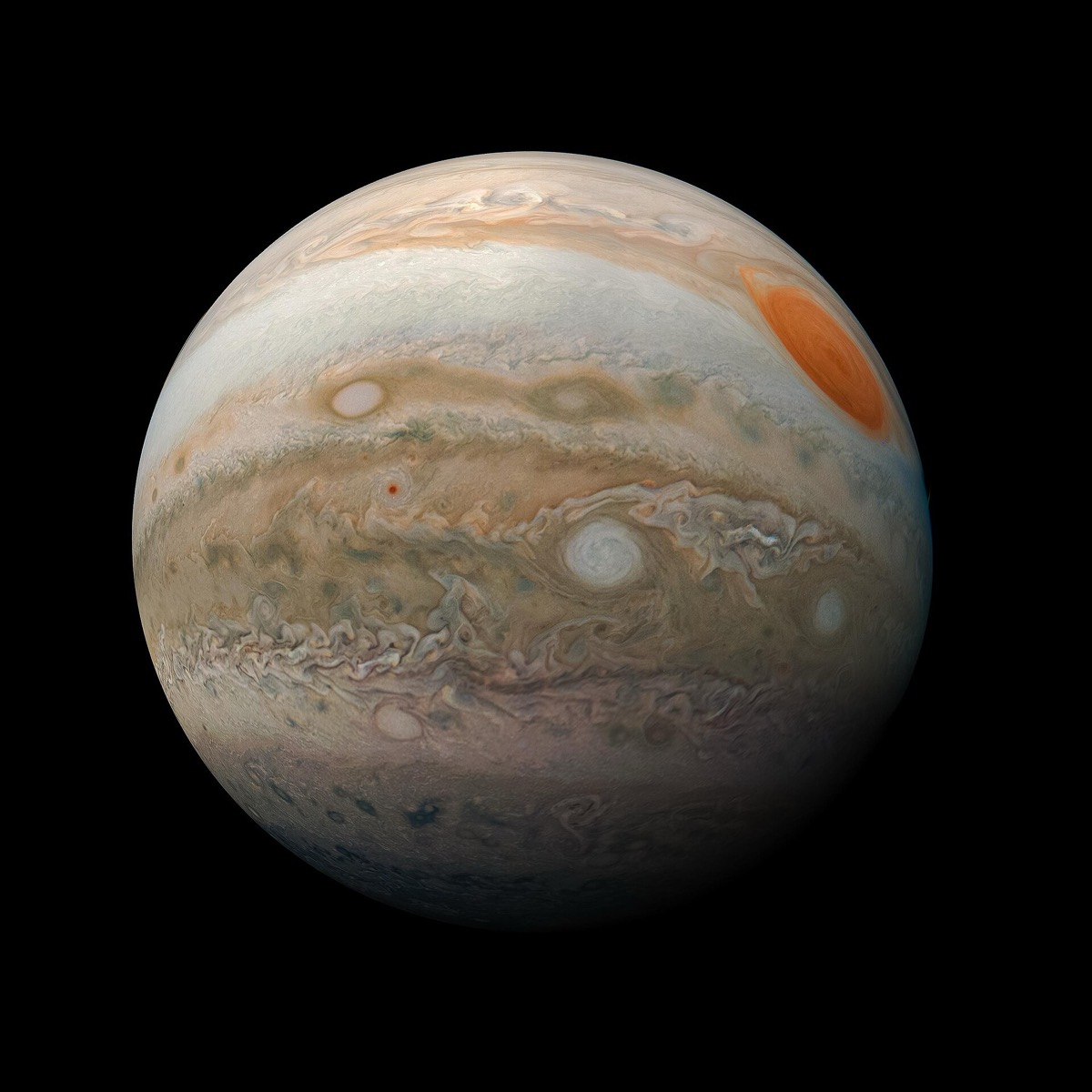
The Great Red Spot is an storm larger than Earth, a deep red eye set in swirling layers of pale yellow, orange and white, with winds reaching several hundred kilometres per hour. Astronomers have known since the 1930s that it is shrinking, which raises the obvious question of by how much.
By more than half since the 1800s. Observations in the late 1800s gauged it at about 41,000 km across, wide enough to fit three Earths side by side. The of 1979 and 1980 measured 23,335 km, and Hubble made it just under 16,500 km, the smallest diameter ever measured.
Jupiter’s trademark Great Red Spot is a swirling storm larger than Earth, and it is shrinking. The downsizing has been known since the 1930s, and it is changing the shape of the spot from an oval into a circle.
The historic numbers give the scale of the loss. Observations as far back as the late 1800s gauged the spot at about 41,000 kilometres at its widest point, wide enough to fit three Earths comfortably side by side.
Each later measurement is smaller. The Voyager fly-bys of 1979 and 1980 measured 23,335 kilometres across, and Amy Simon reported that Hubble observations put it at just under 16,500 kilometres, the smallest diameter ever measured.
The rate itself changed recently. Amateur observations starting in 2012 revealed a noticeable increase in the shrinkage rate, with the waistline now losing just under 1,000 kilometres per year. Very small feeding into the storm may be altering its internal dynamics, and references to a on Jupiter go back as far as the late 1600s.
wat. Three Earths wide once, barely one and a bit now.
wat wat
The shape is changing with the size, from an oval toward a circle, so the most famous feature on the planet is visibly not permanent.
How do we know?
Amy Simon and colleagues compared the Hubble measurements against the historic record and the Voyager fly-bys, using a full-disc image taken with Wide Field Camera 3.
What is still unknown
The cause of the shrinkage is not yet known, and the eddies thought to drive it are a hypothesis.
Learn something?
Where to next
 What happens when a comet is pulled apart and then swallowed by a planet?jupiter
 The sky looks like a rough sea seen from below. Is that really a new kind of cloud?meteorology