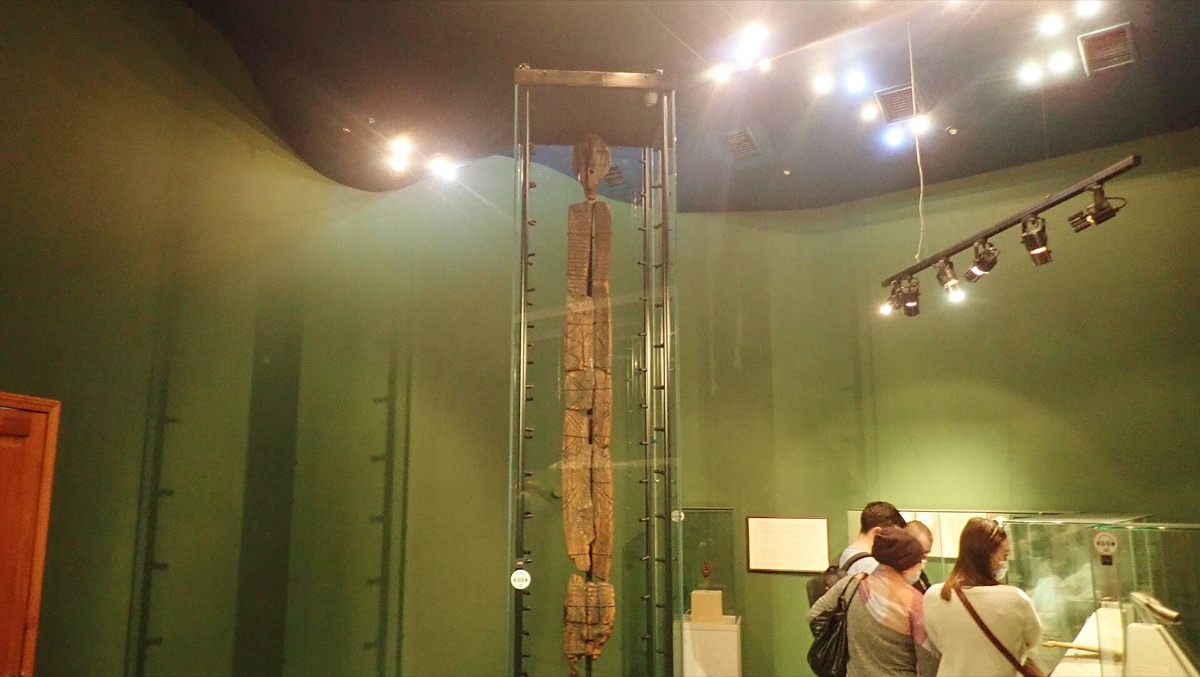
Gold miners pulled ten wooden fragments out of the peat bog north of Yekaterinburg in January of eighteen ninety-four, four meters below ground. Reassembled, they make a carved anthropomorphic figure that Tolmachev put at five point three meters in nineteen fourteen. Its character is so unusual that typology could not date it, and it sat undated for decades. Radiocarbon in nineteen ninety-seven put it in the Mesolithic. Then came a second attempt.
Older, and the surface was lying. Seven new accelerator dates spread across three thousand years, and they correlate with how deep in the wood each sample was taken: the closer to the surface, the younger the result. The figure had been repeatedly restored with wax and then, in nineteen ninety-seven, consolidated with butyl acrylate. The innermost samples are the reliable ones, putting the piece at about ten thousand two hundred cal BC.
The sculpture came out of the Shigir peat bog during gold mining on the twenty-fourth of January, eighteen ninety-four. Dmitri Lobanov first identified the ten fragments as a figure about two point eight meters high, and in nineteen fourteen Tolmachev reconstructed a much larger one using everything recovered. Some of those fragments have since been lost; the survivors are in the Sverdlovsk Regional Museum.
Dating it was the problem. Its unusual character ruled out any assignment by typology, and it stayed undated for decades. In nineteen ninety-seven two large wooden samples were taken from the middle and bottom of the figure for conventional radiocarbon dating. Three measurements put it in the Boreal Mesolithic, around seven thousand nine hundred to seven thousand six hundred cal BC. That already made it the oldest wooden monumental sculpture in the world.
The twenty fourteen program took seven samples instead of two. The results confirmed a Stone Age attribution and then disagreed with each other by up to three thousand years, which demanded an explanation rather than an average. The inner samples support a to early Boreal date, and the two deepest are older still.
The explanation is in the conservation history. The figure has been repeatedly restored since it was found, with wax used for repair in the late nineteenth and early twentieth centuries. In nineteen ninety-seven its outer surface was stabilized with butyl acrylate, and sampling cavities were filled with wood pigment and the same resin. Those are the problem. The AMS dates get older toward the inner part of the sculpture, correlating with distance from the treated surface. The two innermost samples are therefore the most reliable, and they date the find to about ten thousand two hundred cal BC.
wat. The dates got older the deeper they drilled, which is a property of the varnish rather than of the statue.
wat wat
Conservation is supposed to preserve an object, and here it quietly falsified one of its most important properties. Every sample taken near the treated surface came back thousands of years too young.
How do we know?
Zhilin and colleagues redocumented the sculpture in Yekaterinburg in June of twenty fourteen, inspected the wood and its working traces, ran a systematic AMS dating program and reinvestigated the tree-ring sequence.
What is still unknown
Some of the original fragments have been lost since nineteen fourteen, so reconstructions depend on earlier reports. The authors note that despite careful pretreatment, it is possible the consolidants were not completely removed.
Learn something?
Where to next
 Was pharaoh Ahmose’s great storm the eruption of Santorini?dating
 What did a scan that never touches the wall find in cave paintings?dating
 How do you date a painting that contains no carbon?dating