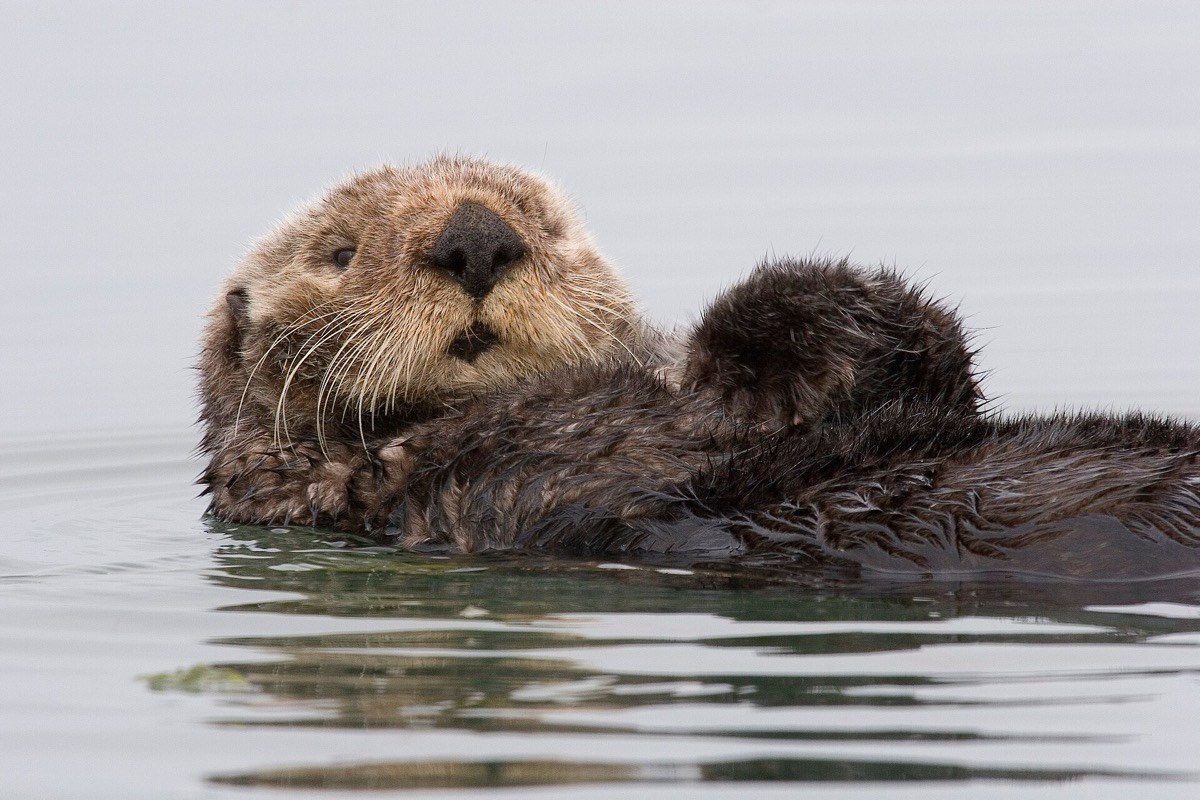
grow along the Pacific coast, giant algae that house hundreds of species, and sea urchins eat them. removed sea otters from whole regions. What happened to the forests?
They went. Otters eat urchins in quantity and hold their numbers down, so with the otters gone the urchin population exploded and the forests became bare rock. The chain has three links and it runs backwards too: where otters were protected and returned, the kelp recovered. A pattern that repeats and then reverses when its cause reverses is far stronger evidence than any single observation.
This story is read backwards, out of a disaster. Sea otters were hunted almost to extinction for their fur, and across whole regions of the North Pacific they were gone. Only then did it become clear what they had been holding up.
The chain is short, and it is a in three links. An otter eats sea urchins in quantity, and a sea urchin eats through the base of an alga and cuts it loose from the rock. With no otters the urchin population exploded, and the forests became bare rock surfaces known as urchin barrens.
What makes this evidence rather than an anecdote is that the pattern repeated across several regions, and in both directions: where the otters were protected and came back, the kelp recovered. A pattern that recurs, and inverts when its cause inverts, is much stronger than one observation.
Which is why this case is taught as the example of a : the otters are not numerous and are no great share of the system, and their effect is enormous. The qualification belongs here too. This is observational work in the wild and not a controlled experiment, and water temperature, currents, urchin disease and fishing are all at work alongside. The otter is not the only factor; it is the factor that can be put back.
wat. When the otters disappeared from whole regions, the sea urchins multiplied and the kelp forests turned into bare ground.
wat wat
It is the textbook case of a keystone species: one whose effect on a system is far larger than its numbers suggest, so removing it changes a whole landscape.
How do we know?
Comparing regions with and without otters over years, including regions where the otters came back, shows the same pattern again and again.
What is still unknown
This is observational work in the wild rather than a controlled experiment, and in a real system temperature, currents and fishing are all acting at the same time.
Learn something?
Where to next
 Do trees really help each other underground?ecology
 Is the water at the bottom of the deepest trench on earth standing still?ocean
 What is the foam piling up along the tide line made of?ocean