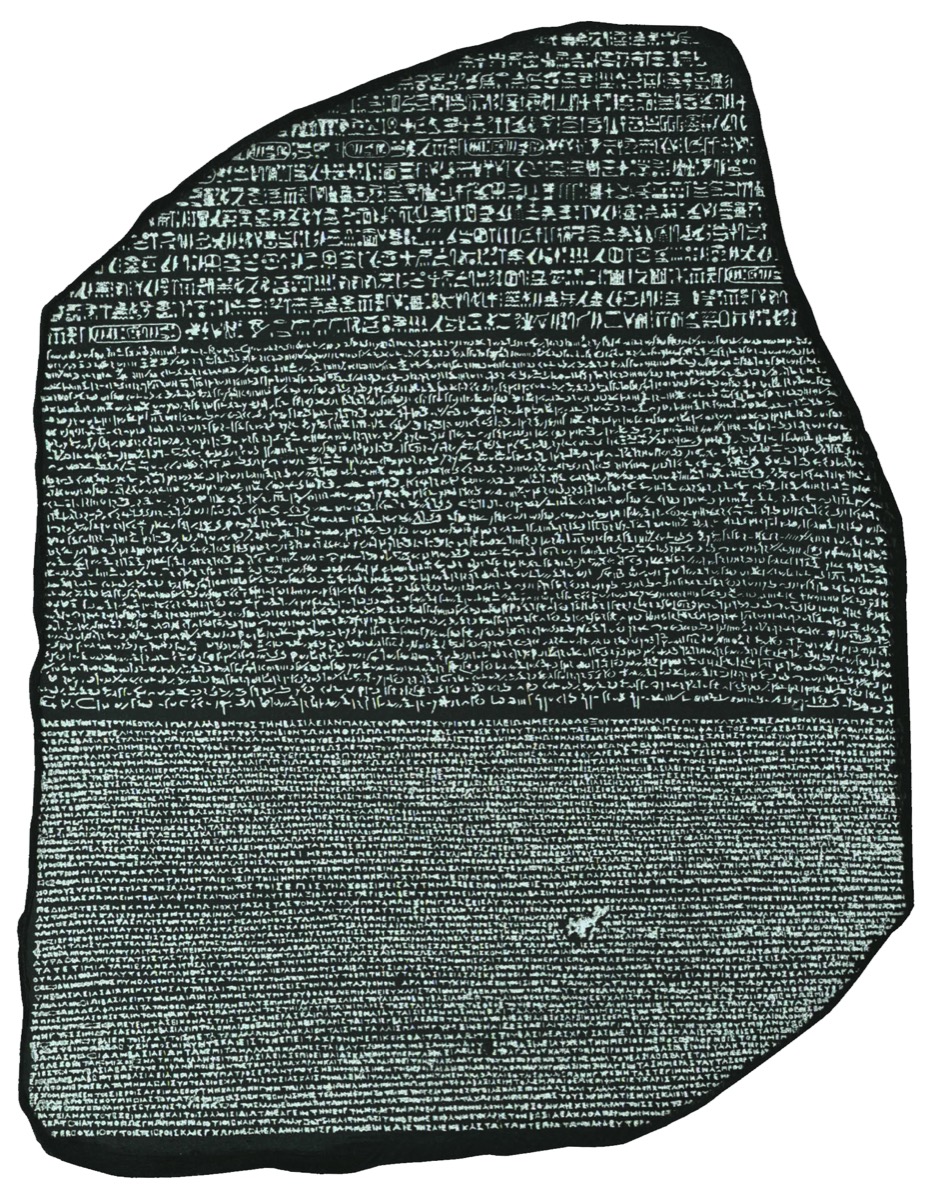
Knowledge of how to read and write hieroglyphs disappeared soon after the fourth century, and the script then sat unreadable for fourteen hundred years. In July of seventeen ninety-nine, French soldiers digging foundations for a fort near Rashid, on the Nile delta, turned up a broken slab built into an old wall. Their officer saw at once that it mattered. What made it the key?
Three scripts saying the same thing. The is inscribed three times over. It runs in hieroglyphs; in , the cursive everyday Egyptian whose name means language of the people; and in Ancient Greek, the language of Egypt’s Greco-Macedonian rulers. Scholars could still read Greek. Fourteen lines of hieroglyphs, thirty-two of Demotic, fifty-four of Greek, all carrying one message.
The Rosetta Stone is a broken piece of a larger , carved in one hundred and ninety-six BCE, which makes it over two thousand two hundred years old. The text is a decree passed by a council of priests, affirming the royal cult of the thirteen-year-old Ptolemy V on the first anniversary of his coronation.
It was not unique and was never meant to be. A copy was to be placed in every sizeable temple across Egypt, and twenty-nine such decree stones have since been found, twenty-two of them still in Egypt. Several of those have supplied hieroglyphic passages the Rosetta Stone itself has lost. The famous object is one survivor of a mass-produced run.
French soldiers found it in July of seventeen ninety-nine while digging foundations for an addition to a fort near Rashid, which the French called Rosetta. It had apparently been set into a very old wall. The officer in charge, Pierre-Francois Bouchard, recognized what it was. After Napoleon’s defeat the Stone passed to the British under the Treaty of Alexandria and reached the British Museum in eighteen oh two.
Breaking the script took two men and twenty years. Thomas Young, an English physicist, was among the first to show that some hieroglyphs on the Stone wrote the sounds of a royal name, that of Ptolemy. Jean-Francois Champollion then grasped that hieroglyphs recorded the sound of the Egyptian language, identified the signs used to write non-Egyptian rulers, and announced it in Paris in September of eighteen twenty-two. Young was in the audience. Champollion’s knowledge of , which descends from ancient Egyptian, let him begin reading the inscriptions fully.
wat. The same decree in three scripts, one of which was still being read, which is all a code needs to break.
wat wat
It is the clearest case of a code broken not by cleverness alone but by a crib: a text whose answer was printed alongside it.
How do we know?
The British Museum’s account of the Rosetta Stone sets out the inscription, the three scripts, the circumstances of the seventeen ninety-nine discovery, and the work of Thomas Young and Jean-Francois Champollion.
What is still unknown
The British Museum notes that accounts of the discovery are now rather vague. The Stone also arrived broken, and other copies of the same decree supplied the hieroglyphic text it was missing.
Learn something?
Where to next
 Why does almost every language name red before it names blue?language
 What does your brain already know about a word that escaped you?language
 What were ancient Egyptians doing when they played senet?egypt