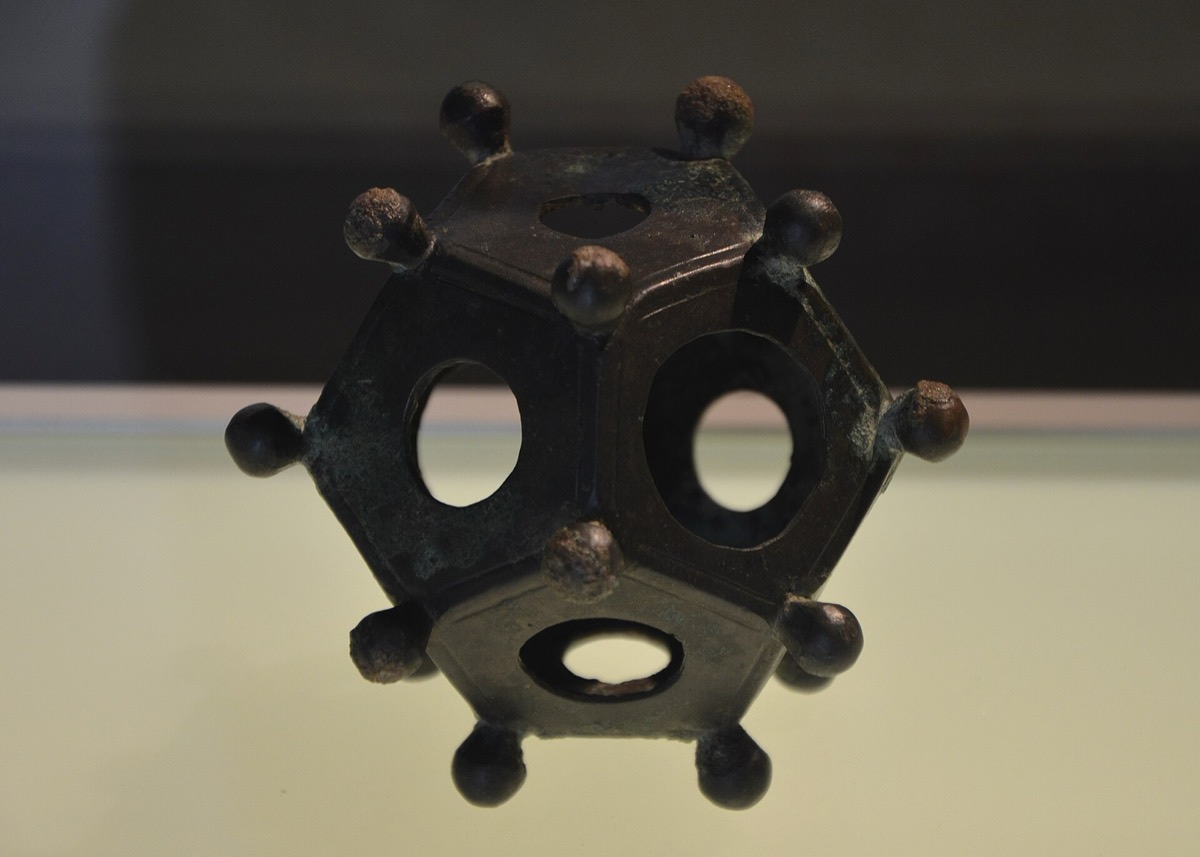
A Roman is a hollow twelve-sided object of , each face pierced with a hole and each corner carrying a knob. They are complex enough to need a skilled craftsman and enough metal to have been expensive, so they were probably made to order. Archaeologists have been puzzling over them since the 18th century, when the first was found. Nobody has settled what they are.
Nobody knows, and the refuse to help. Only 120 have been found across what was the Roman Empire, and none at all in Italy, Spain, Africa or the Mediterranean. The sites tell little about function or meaning. They are not specifically military or civilian, domestic or religious, urban or rural, and the objects turn up both in the living world and as gifts with the dead. Each one is unique.
The Roman dodecahedron has been puzzling archaeologists since the 18th century, when the first one was discovered. Only 120 have been found across what was the Roman Empire, which makes them some of the rarest and least understood objects to survive from the Roman world.
Each is unique and they share a consistent design. All have twelve sides, each with a hole in it and decoration, knobs on every corner, and all are made of copper alloy. They are complex objects, so a skilled craftsman would have been needed, and that skill together with the amount of metal means they would have been expensive and were likely made to order.
The distribution is part of the puzzle rather than a clue to it. None have been found in Italy, Spain, Africa or the Mediterranean, which is a striking absence for an object spread across the rest of the empire. And the archaeological sites where they do turn up tell little about function or meaning. They are not specifically military or civilian, domestic or religious, urban or rural, and the objects sit sometimes in the living world and sometimes among gifts left with the dead.
So the multiply. They range from a device for determining the optimal date for sowing winter grain to a candle holder, a sceptre head or a die. Others propose a range finder, a surveying instrument, a child’s toy, or even a frame for knitting gloves. English Heritage presents them side by side at Corbridge and invites visitors to vote for a favorite or propose their own, which is an honest way to display a question nobody has answered.
wat. One hundred and twenty Roman dodecahedra survive, none from Italy or the Mediterranean, and no theory about them has won.
wat wat
It is a reminder of how much an object can withhold. These are among the rarest and least understood things to survive from the Roman world, and the gap is not for want of examples or attention.
How do we know?
English Heritage’s exhibition page at Corbridge Roman Town sets out the shared features of the surviving dodecahedra and the distribution of find spots. It also covers what the archaeological contexts do and do not indicate, and the range of proposed theories.
What is still unknown
This is a museum exhibition page rather than a research publication, and it presents the theories without adjudicating between them. The exhibition itself invites visitors to vote for a favorite, which is a fair measure of how open the question is.
Learn something?
Where to next
 How did lead left in mud reveal when Naples repaired its water supply?Rome
 How can shards of Roman glass hint at ancient recycling?Rome
 What did the strongest SETI candidate ever recorded look like?mystery