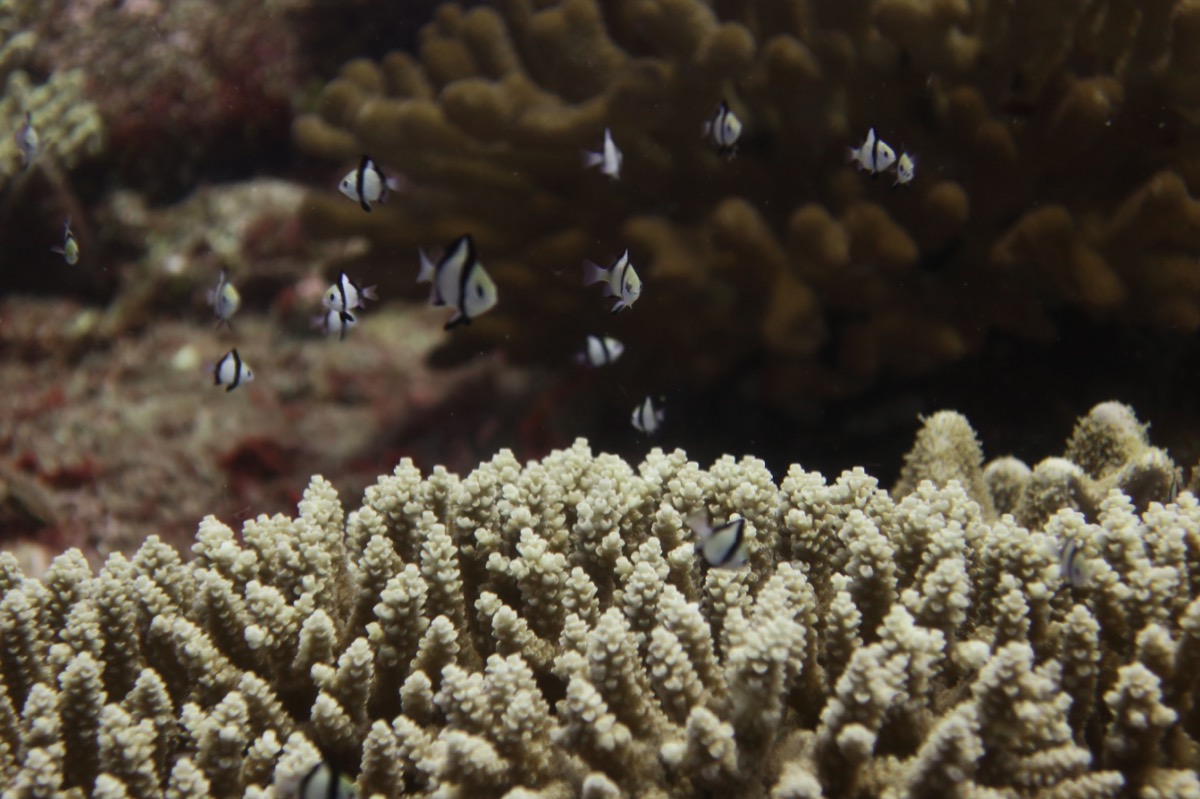
Small shelter among the branches of a coral colony, and their presence is known to help the coral along in ordinary conditions, through water movement and the nutrients they supply. Whether any of that matters when the water gets too hot is another question, since is a stress the coral meets on its own. Chase and colleagues tracked colonies with and without resident fish through a thermal bleaching event. Does the lodger help?
Measurably, before, during and after. Colonies with resident fish held higher densities and more chlorophyll under bleaching conditions, in the field and in experimentally induced stress, and higher protein concentrations in field colonies. In aquaria, inhabited colonies kept better both during the heat stress and through recovery afterwards. The fish are changing how severely their host bleaches and how well it comes back.
Environmental change can break species interactions that took a long time to settle, and on coral reefs one of those interactions is housing. Small fish living among the branches of a coral colony are known to promote the coral’s performance, and it had been hypothesized that the water flow and nutrients they supply might also ease bleaching.
Chase and colleagues tested it across a thermal bleaching event, comparing colonies that had resident damselfish against colonies that did not, before, during and after. The same comparison ran in the field and under experimentally induced bleaching in aquaria.
Colonies with fish carried higher Symbiodinium densities and more chlorophyll in both settings, and higher protein concentrations in the field. Those are measures of the tissue itself, not of how the colony looked, so the effect reaches the physiology rather than the appearance.
The aquarium colonies with damselfish also held better photosynthetic efficiency during the heat stress and through the recovery that followed. Symbiotic damselfishes, and the services they provide, therefore translate into measurable impacts on coral tissue and can shift both bleaching susceptibility and recovery. In a warming ocean, that makes the fish part of how the coral meets the heat.
wat. The fish pay rent after all, in water movement and nutrients, and the bill comes due in a heatwave.
wat wat
Bleaching is usually modeled as a coral meeting a temperature. If a resident fish shifts the outcome, then losing reef fish and losing corals are the same problem rather than two.
How do we know?
Chase and colleagues compared coral colonies with and without small aggregating damselfish, in the field and under experimentally induced bleaching, measuring symbiont density, chlorophyll, protein and photosynthetic efficiency.
What is still unknown
Field comparison plus aquarium experiments on small aggregating damselfish and their host corals. The mechanism, presumed to be water flow and nutrients, is inherited from earlier work rather than measured here.
Learn something?
Where to next
 Does being touched calm an animal down even when nobody is touching it?fish
 A fish has no cortex like ours. So how does it tell faces apart?fish
 Why would a fish choose the turbulent water over the smooth?fish