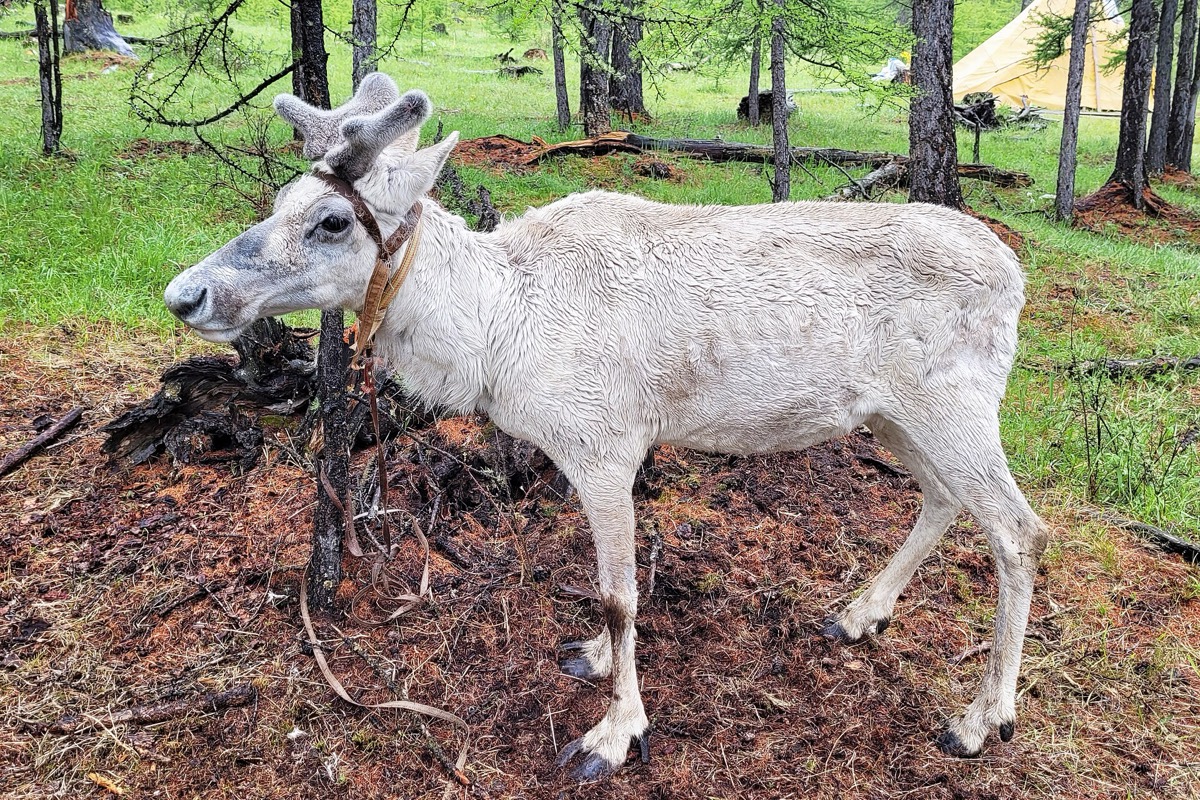
Arctic reindeer go from continuous summer daylight to continuous winter darkness, and an eye tuned for one is a poor instrument in the other. Behind their retina sits a , the mirror that throws a torch beam back out of an eye at night. Stokkan and colleagues compared that mirror in summer animals against winter ones. Does it stay the same all year?
It changes color. Golden in summer, deep blue in winter, with less light thrown back out of the eye. The blue reflection comes with markedly higher retinal sensitivity, and the color depends on inside the mirror: pack the fibers closer and the reflected wavelength shortens. Winter animals carry raised , probably from a permanently dilated pupil blocking drainage, which would do the packing.
An Arctic winter is not a long evening, it is months without a sunrise. An eye built for the glare of continuous summer daylight has to work the same season in near darkness, and most animals handle that with pupil size and with pigment rather than with structure.
Reindeer have a tapetum lucidum, the reflective layer that sends light back through the photoreceptors for a second pass. Stokkan and colleagues compared the layer in summer and winter animals and found it a different color: golden in summer, deep blue in winter, with less light leaving the eye.
The wavelength a tapetum returns depends on collagen spacing inside it, tighter spacing giving shorter wavelengths, and the winter animals had the tighter spacing. They also had significantly higher intra-ocular pressure, probably because a pupil held permanently open blocks ocular drainage, and that pressure is a plausible cause of the compression.
A blue mirror throws less light straight back out and scatters more of it sideways through the photoreceptors, which raises the number of photons caught and lifts retinal sensitivity. The price is , since a scattered image is a blurrier one. For an animal whose winter problem is noticing a predator moving in the dark, blur is a bargain worth taking.
wat. The mirror behind the eye gets squeezed tighter as the dark comes in, and a tighter mirror throws back blue instead of gold.
wat wat
This is the first description of a retina rebuilding its own structure to follow a season, rather than simply adjusting how the existing structure gets used.
How do we know?
Stokkan and colleagues compared the tapetum of reindeer taken in summer against winter, measuring the reflected wavelength, the collagen spacing, the intra-ocular pressure and the sensitivity of the retina.
What is still unknown
The chain from pupil to pressure to compressed collagen is inferred from measurements correlated across two groups of animals, not shown by intervening on any single step.
Learn something?
Where to next
 A fish has no cortex like ours. So how does it tell faces apart?vision
 Does a bee see the world differently once it starts moving?vision
 Why is a goat's pupil a horizontal slot?vision