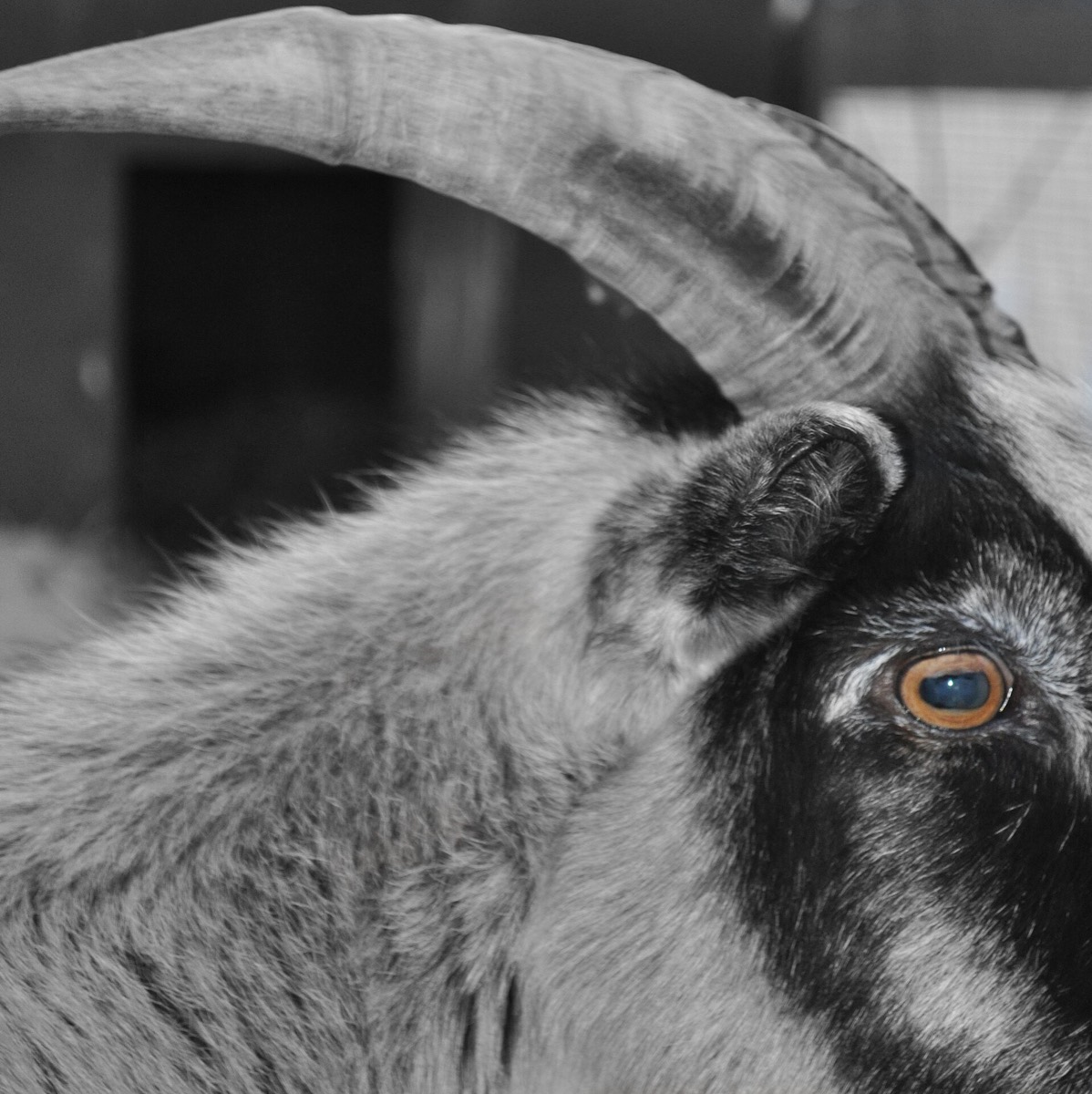
Pupils come in slits, slots, circles and rectangles, and the shape tracks the animal's way of life rather than its family: a cat's is vertical, a goat's horizontal, a human's round. Banks and colleagues sorted terrestrial species by pupil shape against how they feed and when they are active, then modeled what each aperture does to the image. What does a horizontal slot buy?
A panoramic strip in focus. A horizontally elongated pupil sharpens horizontal contours both ahead and behind. That gives a grazing animal a wide band of clear vision, useful for catching a predator from any direction and for placing its feet on broken ground. Vertical pupils do the opposite: they sharpen vertical contours and blur horizontal ones, which suits judging a distance.
Pupil shape does not follow the family tree. Cats and foxes carry vertical slits, goats and horses and sheep carry horizontal ones, and plenty of animals including us keep a plain circle. Whatever sets the shape is tracking something other than ancestry.
Banks and colleagues lined terrestrial species up against two things: how they get their food, and what time of day they are out. The correlation came out strong. Vertically elongated pupils went with ambush predators active around the clock, and horizontally elongated ones went with prey animals whose eyes sit on the sides of the head.
Then they worked out what each aperture does optically. A vertical slit creates a that differs by orientation: vertical contours stay sharp whether nearer or farther than the focused distance, while horizontal ones blur. That is the combination an ambush predator wants, using on the vertical edges and on the horizontal ones to judge how far off something is.
The horizontal pupil runs the same argument backwards. Keeping horizontal contours sharp ahead and behind builds a panoramic band of clear vision, which is exactly what a grazing animal needs: a predator can arrive from anywhere, and the ground underfoot is uneven. The shape is the niche, written into the aperture.
wat. The slot is not a style but an aperture, cut to keep in focus the one band of the world the animal actually needs.
wat wat
A feature that looks decorative turns out to be readable: name the pupil shape and you can guess how the animal eats and when it is awake.
How do we know?
Banks and colleagues compared pupil shape with foraging mode and activity time across terrestrial species, then modeled the optics of each aperture to see which contours it keeps sharp.
What is still unknown
The ecological pattern is a correlation across species and the optical account is a model, so neither shows that an individual animal performs better with the shape it happens to have.
Learn something?
Where to next
 A fish has no cortex like ours. So how does it tell faces apart?vision
 Does a bee see the world differently once it starts moving?vision
 Which way does a sleeping duck point its open eye?predators