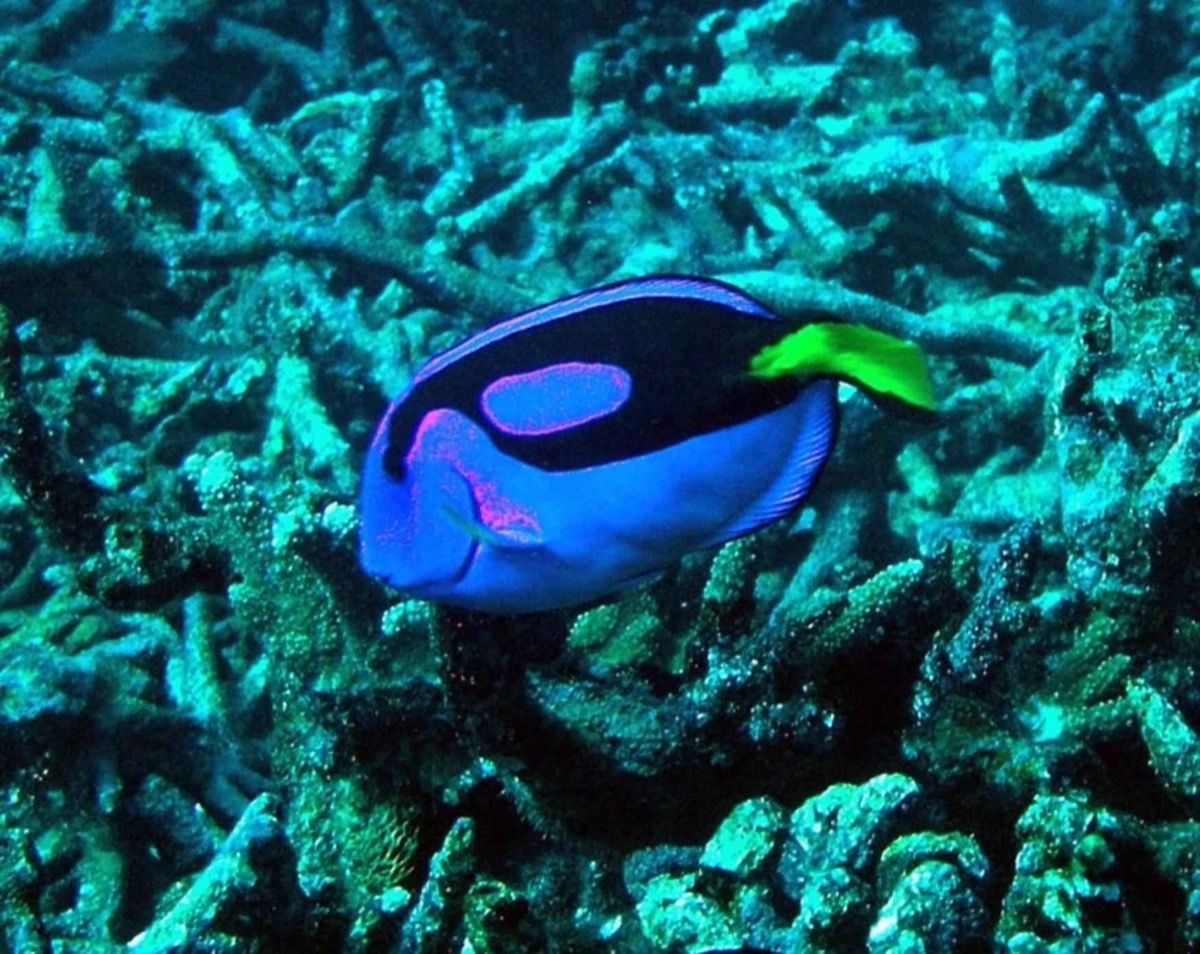
Carbon dioxide dissolving into the sea has driven fast enough to worry anybody who studies reefs. Several high-profile papers reported something stranger than physiological stress: fish under end-of-century conditions becoming completely attracted to the of their predators. Clark and colleagues set out to reproduce those behavioral effects, and to check the statistics behind them. Do the results hold up?
They do not reproduce. Across the behaviors that mattered, avoiding predator chemical cues, activity levels and left-right turning preference, end-of-century acidification levels had negligible effects on coral reef fishes. Data simulations then addressed the original numbers directly: the combination of very large and very small within-group variances reported earlier is highly improbable. Behavioral disruption looks unlikely to be a major consequence.
The partial pressure of carbon dioxide in the oceans has risen rapidly over the past century, driving acidification and raising real concern about marine ecosystems. Coral reef fishes were predicted to be especially vulnerable, on the strength of several high-profile papers.
Those papers reported profound behavioral and sensory impairments. The most striking was attraction to the chemical cues of predators under acidified conditions, which is not a degraded response but an inverted one. It became a widely cited illustration of what a high carbon dioxide ocean would do.
Clark and colleagues ran the experiments again, comprehensively and with the methods and data laid open. End-of-century acidification levels had negligible effects on the behaviors that matter: avoidance of predator chemical cues, activity levels, and .
They then turned to the earlier numbers themselves. Using data simulations, they showed that the large effect sizes combined with small within-group variances reported in several previous studies are highly improbable. The conclusion is narrow and important: the reported behavioral effects are not reproducible, so behavioral perturbation is unlikely to be a major consequence for reef fishes, whatever else ocean acidification does.
wat. The ocean is still acidifying. What did not survive is the claim that it makes a fish swim toward its predator.
wat wat
Ocean acidification is real and serious, and that is exactly why the specific claims attached to it need to survive replication rather than be repeated because they are alarming.
How do we know?
Clark and colleagues ran comprehensive, transparently reported experiments on coral reef fishes at end-of-century carbon dioxide levels, and used data simulations to test how probable the earlier reported results were.
What is still unknown
A failure to reproduce behavioral effects says nothing about the physiological, developmental or ecosystem consequences of acidification, which this work does not test and does not dispute.
Learn something?
Where to next
 Do grazing cows really line themselves up north to south?replication
 What happens to reef fish once the coral becomes rubble?reef fish
 What happened when the Dunning-Kruger effect was run on random data?replication