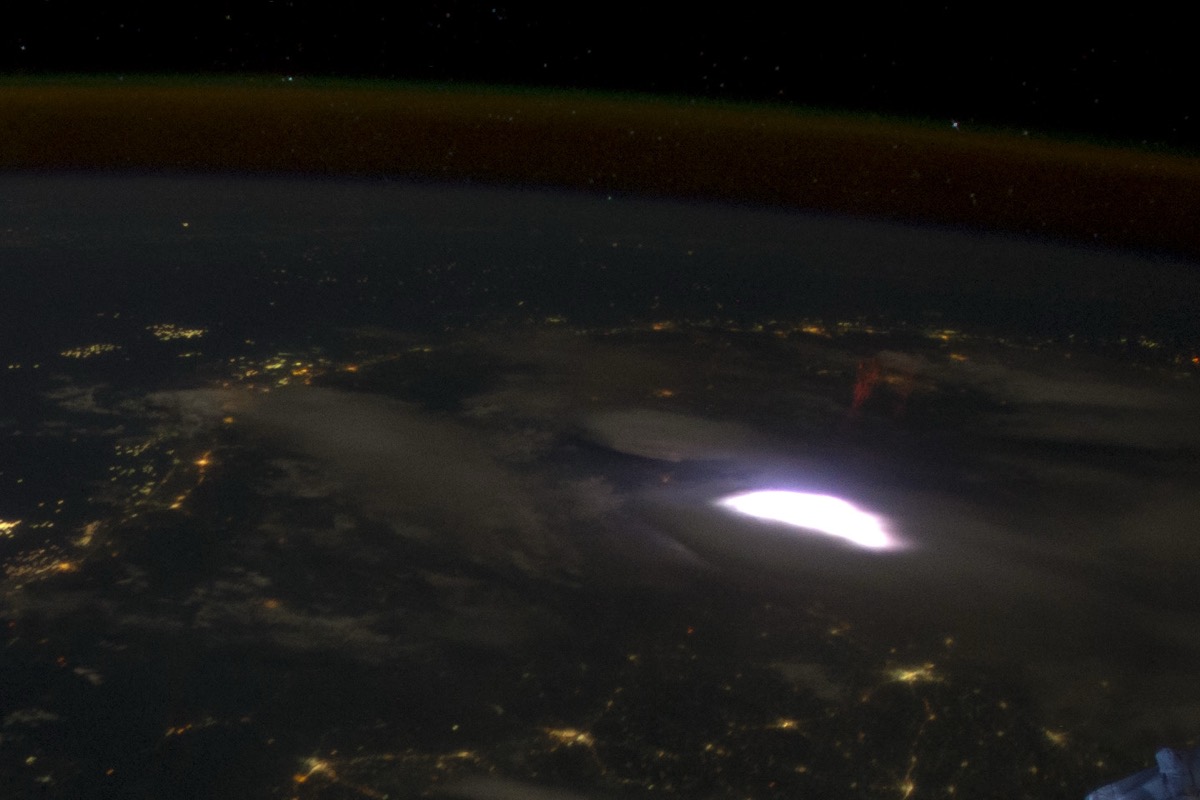
A sprite, which is lightning going the other way. Sprites appear directly above an active thunderstorm as a large but weak discharge, usually at the same moment as a powerful stroke below. They can extend up to sixty miles from the cloud top, last no more than a few seconds, and are mostly red.
They are faint, which is why they went unrecorded for so long. Sprites can only be seen at night, are rarely caught by the human eye, and are most often imaged with highly sensitive cameras. Aircraft pilots reported seeing lightning above storms for many years before researchers documented sprites and the other on video.
Most lightning starts inside a thunderstorm and travels through the cloud, and roughly five to ten times as many flashes stay in the cloud as reach the ground. Above the storm, something else happens. Large thunderstorms produce transient luminous events, which NOAA describes as rarely observed visually and not well understood.
Sprites are the most familiar of them. They appear directly above an active thunderstorm as a large but weak discharge, and they usually happen at the same time as powerful positive cloud-to-ground strokes. They can extend up to sixty miles from the cloud top, last no more than a few seconds, and are mostly red. Their shapes get described as resembling jellyfish, carrots or columns.
Faintness explains the history. Sprites are not very bright, so they can only be seen at night. Highly sensitive cameras do most of the imaging, because the human eye rarely catches one. Aircraft pilots occasionally reported seeing lightning above storms for many years before researchers documented sprites and other such events with sensitive video.
The family extends further up and further out. and gigantic jets emerge from the top of the thundercloud without being directly tied to cloud-to-ground lightning. They rise in narrow cones, fanning out at twenty-five to thirty-five miles. Gigantic jets reach the ionosphere. are rapidly expanding disk-shaped glows up to three hundred miles across, lasting less than a thousandth of a second. One caution: this is an educational page that describes these events rather than explaining them, as the laboratory itself notes.
wat. Pilots reported lightning above the clouds for years before any camera caught it.
wat wat
A whole class of electrical activity sat above storms unrecorded because it was too dim and too brief. Pilots knew about it; the instruments took decades to catch up.
How do we know?
NOAA’s National Severe Storms Laboratory sets out the family of transient luminous events, giving for each one its appearance, the lightning it accompanies, its altitude range and its duration.
What is still unknown
An educational page from a research laboratory, and it says plainly that these events are rarely observed visually and not well understood. The shapes and ranges are descriptions rather than a theory of how they form.
Learn something?
Where to next
 Why does lightning return again and again to the same corner of Venezuela?lightning
 What makes those hanging pouches on the underside of a storm cloud?storms
 Is the ozone hole actually closing?atmosphere