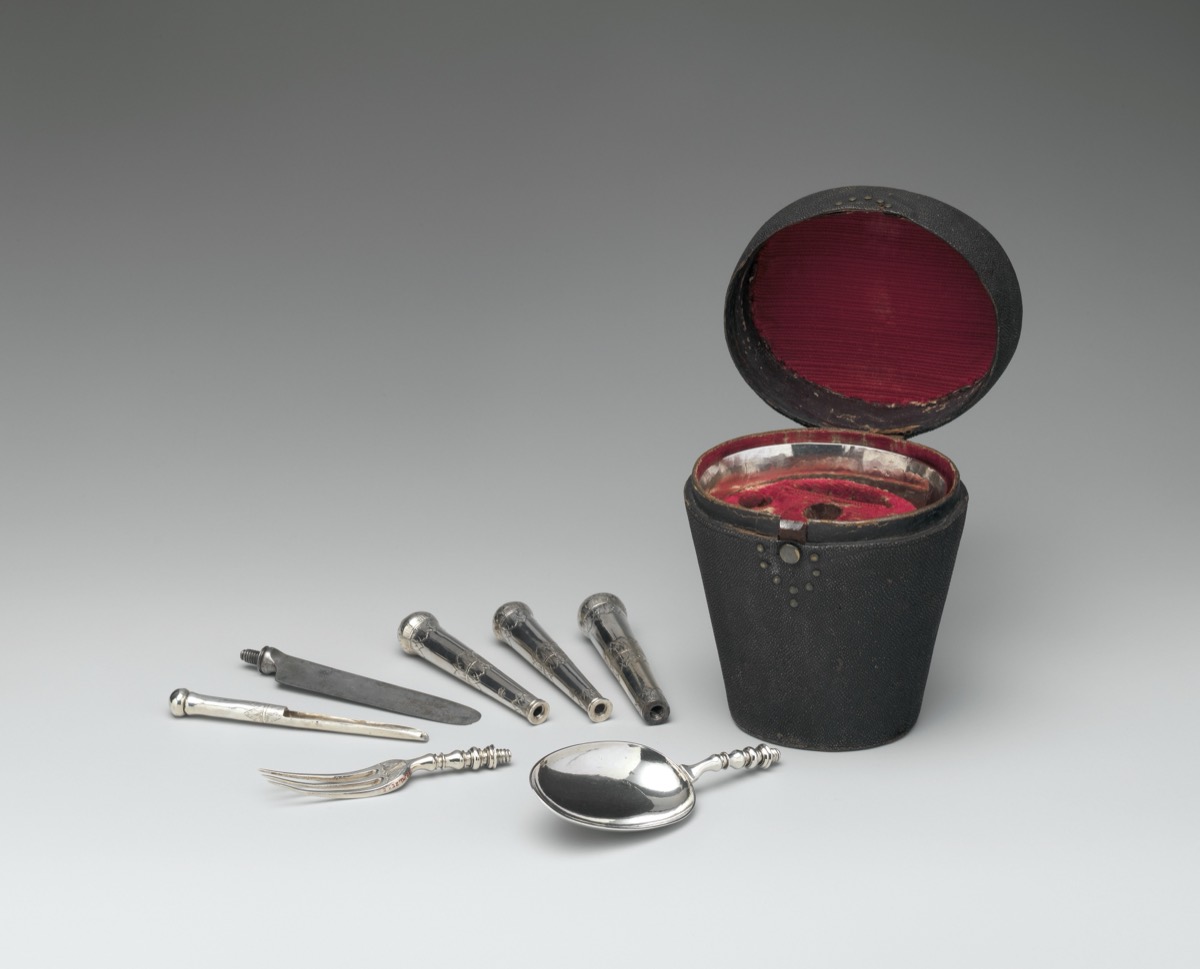
By making the handles come off. A conical case holds a silver beaker along with a knife, fork, spoon and , all with . The Met dates the set to 1709 or 1710, with the cup by the London silversmith and the cutlery by two makers identified only by initials.
The engraving says what it was for. Hunting scenes of a stag and boar hunt are cut into the beaker, which the museum takes to suggest the beaker was intended for use during a hunt. The case itself is wood covered in , and the removable fitting inside is lined with velvet and silver braid, so the contents travel without rattling.
The object is a pocket canteen, which the Met classifies as a traveling set, made in 1709 or 1710. The conical case is fitted with a silver beaker and a knife, fork, spoon and marrow spoon, all with removable handles. The case stands about thirteen and a half centimeters tall, and the cup inside is just under nine.
The removable handles are the idea. A handle is the part of a knife or a spoon that makes it awkward to pack, and it is also the part that serves no purpose while the piece is in its box. Detaching them turns a full place setting into a bundle of slim components that fit a cone, which is a shape a saddlebag will accept.
Materials follow the same logic. The case is wood covered with shagreen, a hard granular leather, and inside it a removable wooden fitting is lined with velvet and silver braid. The silver is cushioned, the outside is tough, and the whole assembly comes apart for cleaning.
The engraving tells you the occasion. Hunting scenes of a stag and boar hunt are cut into the beaker, and the museum reads this as likely suggesting the beaker was intended for use during a hunt. The pieces are attributed to three makers: the cup by Charles Overing of London, the cutlery to T. T. of England and E. H. of London. One caution: this is a short catalogue record, which describes the object and infers its use from the decoration rather than from any record of it being used.
wat. Take the handles off and a whole table folds into something a saddlebag will carry.
wat wat
A place setting that packs into a cone is a solution to a problem nobody has now. Eating properly away from a house meant carrying the house’s equipment, in a form a horse would tolerate.
How do we know?
The Metropolitan Museum’s catalogue record for object 68.141.256a to j lists the contents of the case, the removable handles, the engraved hunting scenes, the materials, the makers and the date.
What is still unknown
A catalogue record of a few sentences, which describes the object and infers its purpose from the engraving. It records no evidence of the set in use and nothing about who owned or carried it.
Learn something?
Where to next
 Does a long password have to be complicated as well to be strong?design
 Why has nobody fixed the splatter problem?design
 Does a park make people happy, or do happy people choose the park?travel