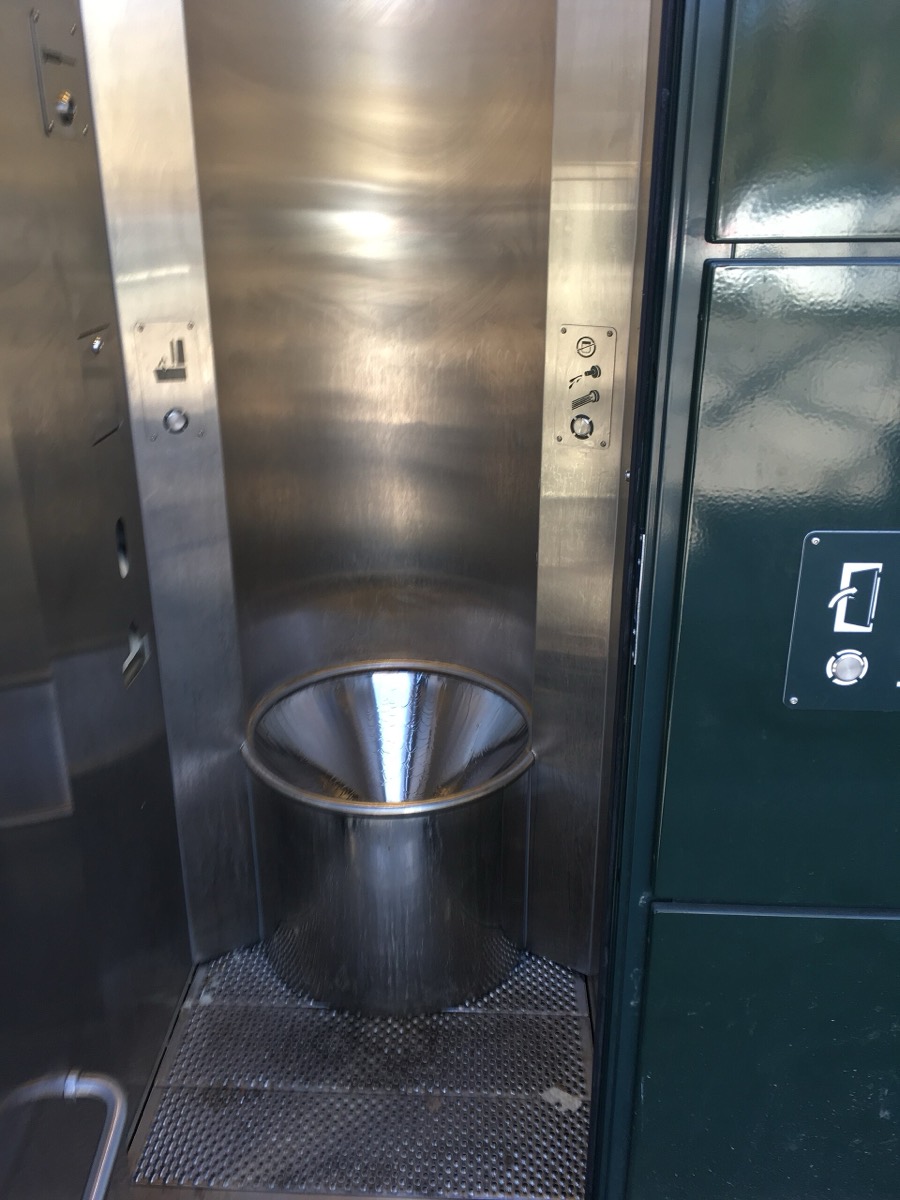
Urinals are a staple of public spaces, and their designs have remained essentially stagnant for over a century. The splatter they produce costs cleaning hours, chemicals and water, and lands on floors and users. Impinging stream angle is one of many factors involved, which makes it a candidate to solve.
Geometry fixes it. Below an invariant critical of about 30 degrees, under human urination conditions is strongly suppressed. Shapes derived by solving the keep the stream at or under that angle, and in experiments they cut splashback to of a common contemporary commercial urinal.
Urinals are a staple of public spaces, yet their designs have remained essentially stagnant for over a century. Their use often results in significant splatter, as urine splashes upon impact and generates droplets that travel back onto the floor and the user.
The consequences are mundane and large. Splashback creates unhygienic environments, high cleaning costs, and an unpleasant workload for custodial staff, across millions of fixtures.
Impinging stream angle is one of many factors that affect splashback, and it turns out to have a threshold. The authors theoretically predict and experimentally validate that below an invariant critical value of about 30 degrees, the flow rate of splashback under human urination conditions can be significantly suppressed.
The designs follow from that angle. Solving differential equations derived from the isogonal curve problem yields shapes that keep the stream impacting at or below the critical angle. Experiments validate that they reduce splashback to only 1.4 percent of a common contemporary commercial urinal.
wat. Keep the stream under 30 degrees and the splash all but disappears.
wat wat
The fix is a curve rather than a device, so it needs no power, no sensors and no behavior change from anyone.
How do we know?
Thurairajah and colleagues predicted the critical angle theoretically, derived urinal shapes from differential equations for the isogonal curve problem, and then validated both the angle and the designs experimentally.
What is still unknown
Validated under controlled urination conditions, not through a year in a railway station.
Learn something?
Where to next
 Does a long password have to be complicated as well to be strong?design
 An air dryer spreads more bacteria than a paper towel. Is that always true?hygiene
 How did you pack a full place setting for a hunt in 1709?design