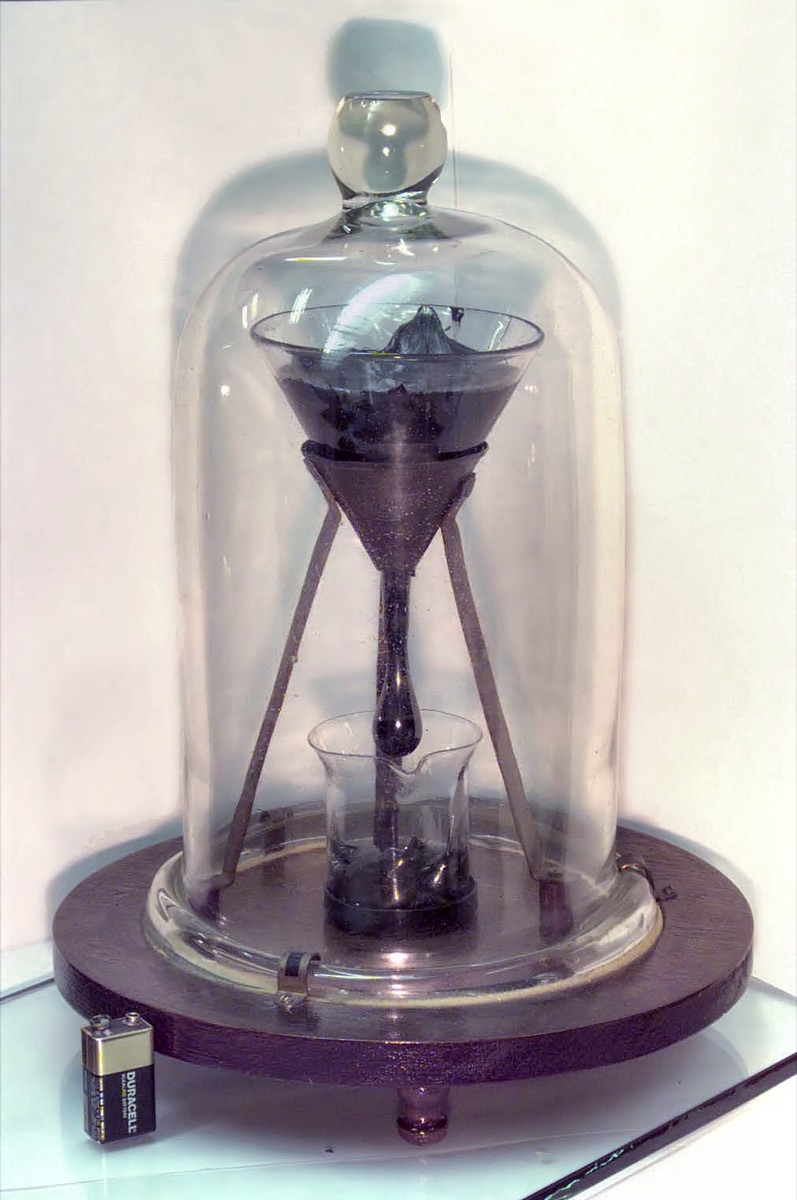
In 1927 the physicist Thomas Parnell heated and poured it into a sealed glass funnel, and three years later he cut the stem open and waited. At room temperature pitch shatters under a hammer, the way brittle glass does. What happens if you simply wait?
The first drop took eight years to fall. The next five each took seven to nine years, the sixth arriving in April 1979 and the seventh in July 1988. Then the thing slowed down, and the eighth drop took more than twelve years. Nine drops have fallen since 1930, the tenth is expected some time in the 2020s, and nobody has ever once watched a drop let go.
The material in the funnel shatters when struck, and a drop still falls from it about once a decade. Both behaviors are real, and what sets them apart is the rate at which force is applied: fast and it fractures, slow and it flows.
Parnell, the first professor of physics at Queensland, heated pitch and poured it into a sealed funnel in 1927, then let it settle for three years before cutting the stem in October 1930. The first drop took eight years. The next five took seven to nine years each.
Then the record gets interesting. The eighth drop took more than twelve years, possibly because installed during a renovation cooled the pitch and raised its , and that drop was visibly larger. The ninth never fell cleanly, since it ran into the tail of the eighth sitting in the beaker, and it was left that way rather than disturbing the experiment.
What the experiment really measures is the of the observer. Nine drops in nearly a century, no witness to a single one, and a tenth expected in the 2020s. Guinness calls it the longest-running laboratory experiment, and its real subject is how long you have to watch before a solid turns out to be a liquid.
wat. The pitch poured into a funnel in 1927 looks and breaks like a solid, and it has let go of only nine drops.
wat wat
Solid and liquid are not absolute labels. The rate at which you look decides whether something very slow appears frozen or flowing.
How do we know?
The University of Queensland has kept the apparatus and the record of drop times since 1930, and Guinness World Records lists it as the longest-running laboratory experiment.
What is still unknown
Temperature, the dwindling mass left in the funnel and contact between drops have all changed the pace, so the interval is not a clock. The ninth drop never fell cleanly at all, because it met the tail of the eighth standing in the beaker below.
Learn something?
Where to next
 Why is every look at the sky a look into the past?time
 Why did the calendar lose ten days at once?time
 Can something with no brain at all learn a rhythm?time