Dating rock art is hard, and the usual method dissolves a sample of the calcite crust that formed over a painting to measure uranium decay. That averages across whatever the sample happened to contain. A new application of the same chemistry images the crust instead, at much finer spatial accuracy, and it was turned on the limestone caves of Maros-Pangkep in South Sulawesi. What did the better resolution do to the dates?
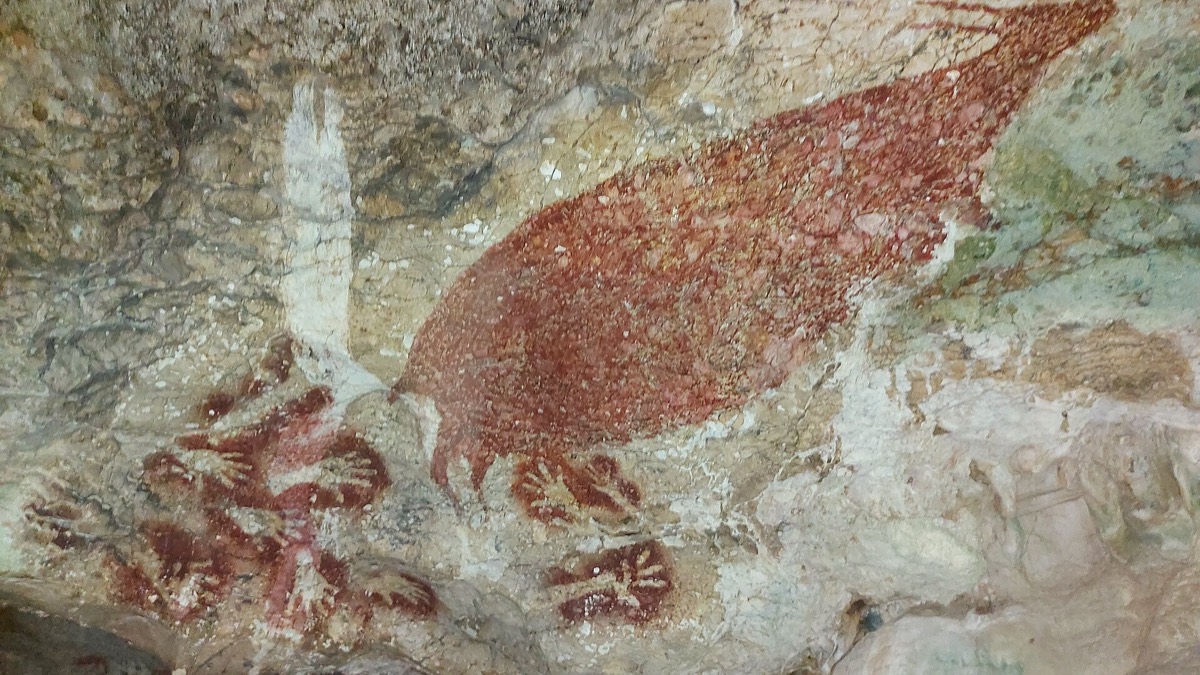
It pushed them older, and found an older scene. A hunting scene at Leang Bulu’ Sipong 4 came out with a of 50.2 thousand years, at least 4,040 years older than the earlier method had indicated. A newly described scene at Leang Karampuang, showing human-like figures interacting with a pig, got a minimum age of 53.5 thousand years. Painted at least 51,200 years ago, it is now the earliest known representational art.
Previous dating research had already established the Indonesian island of Sulawesi as host to some of the oldest known rock art. That work rested on solution analysis of calcite deposits overlying paintings in the limestone caves of Maros-Pangkep. Prehistoric rock art is notoriously hard to date accurately, and that method has a built-in limitation: dissolving a sample averages across calcite that formed at different times.
This study used a novel application of the same chemistry, uranium-series imaging, to re-date some of the earliest art in the karst area and to date stylistically similar motifs at other Maros-Pangkep sites. The method provides enhanced spatial accuracy, which in practice means it can target the calcite closest to the paint.
That produced older minimum ages for art already dated. A hunting scene from Leang Bulu’ Sipong 4 now has a minimum age of 50.2 thousand years, give or take 2.2. That makes it at least 4,040 years older than previously thought.
The imaging approach also assigned a minimum age of 53.5 thousand years, plus or minus 2.3, to a newly described scene at Leang Karampuang. Painted at least 51,200 years ago, this depicts human-like figures interacting with a pig, and is now the earliest known surviving example of representational art and visual storytelling in the world. The authors conclude that figurative portrayals of anthropomorphic figures and animals, and their arrangement into composed scenes, have a deeper origin in the history of modern human image-making than had been recognized.
wat. A painted scene of figures around a pig, at least 51,200 years old, is the earliest surviving picture that tells a story.
wat wat
The claim is about composition rather than skill. A scene of figures interacting is a story, and finding one this old means visual storytelling has a deeper origin in human image-making than had been recognized.
How do we know?
Oktaviana and colleagues applied laser-ablation uranium-series imaging to calcite deposits overlying rock art in the Maros-Pangkep karst, re-dating previously dated art and dating stylistically similar motifs at other sites.
What is still unknown
These are minimum ages, since the calcite formed after the painting, so the art is older than the figures by an unknown margin. The dates carry stated uncertainties and the method is a novel application being introduced here.
Learn something?
Where to next
 How many separate visits made the art at Chauvet?cave art
 What did a scan that never touches the wall find in cave paintings?cave art
 How do you date a painting that contains no carbon?cave art